How to Build a Business Website That Generates Leads From Google
A business website that exists but generates no leads is one of the most common, and most quietly accepted, failures in small business marketing, because the site looks finished, it has a homepage, a contact page, maybe a services list, and it feels like the job is done. It is not. A website that actually generates leads from Google is a different, more deliberate thing than a website that merely exists, and the difference is almost entirely in decisions most business owners never think to make.
The uncomfortable starting point: most business websites are not actually trying to rank
A site can look complete and still be functionally invisible to Google, because looking complete and being structured for search are different things. A homepage with no real, specific written content beyond a hero image and a slogan, no page targeting an actual specific service someone would search for, and no genuine reason for Google to consider it more relevant than a competitor's page, will simply not appear in meaningful search results, regardless of how polished its design is. This is the actual starting point most business owners need to accept before anything else here matters.
What Google is genuinely trying to match a search to
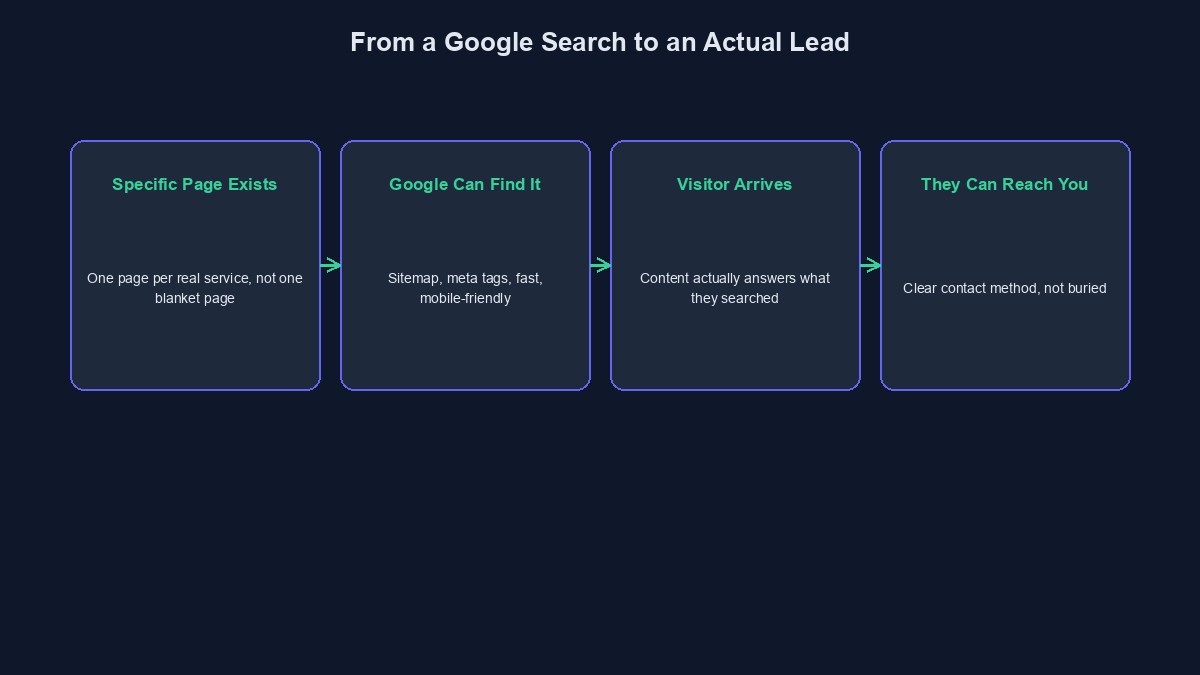
A search for "wedding photographer in Lagos" is Google trying to find the page that most specifically, most usefully, answers exactly that query, not merely a business that offers wedding photography somewhere on its site. This means a single, generic "Services" page listing everything you do is structurally weaker for search than a dedicated, specific page for each real service you offer, since a dedicated page can actually contain the specific words, details and context a specific search is looking for, in a way a shared, general page dilutes.
The structural decision that actually matters most: one page per real, distinct thing you offer
If your business offers three genuinely different services, break each into its own real page, with genuine, specific, useful content about that one thing, rather than three paragraphs sharing a single page. This single structural choice, unglamorous and easy to skip, is consistently the highest-leverage decision available to a small business website, since it multiplies the specific search terms your site has a genuine chance of matching, rather than competing with itself for one broad, generic ranking.
Content that actually helps you rank, versus content that just exists
Generic, vague copy, "we provide quality services at affordable prices," genuinely helps nothing, since it contains no specific information a search engine, or a real visitor, can actually use. Content that helps is specific: your actual service area, the actual problems you solve, actual answers to the actual questions a potential customer would have before choosing you. A blog covering genuinely useful, specific questions your own customers actually ask, not generic industry filler, is one of the most reliable ways a small business site accumulates real search visibility over time, since each genuinely useful article is a new, specific door Google can send a specific search through.
The technical basics that quietly determine whether any of this even works
A site that loads slowly, is not readable on a phone, or lacks basic technical elements, a real page title, a real meta description, a sitemap Google can actually find, undermines even genuinely good content. These are not advanced concerns, they are the baseline a site needs before content quality even gets a fair chance to matter, and they are worth confirming directly rather than assuming a modern-looking site automatically has them handled correctly.
Local signals: the specific thing that matters disproportionately for a local business
For a business serving a specific city or area, a claimed, accurate Google Business Profile, with a real address, real hours, and genuine customer reviews, is one of the highest-leverage things available, often mattering as much as the website itself for exactly the kind of "service near me" searches a local business actually depends on. This is a separate, free tool from your website, worth setting up and maintaining deliberately rather than treating as an afterthought.
Turning an actual visitor into an actual lead, since ranking alone is not the goal
A visitor who finds your page through search and then cannot easily figure out how to actually contact you has not become a lead, regardless of how well the page ranked. A clear, direct, low-friction way to reach you, a visible phone number, a simple contact form, a WhatsApp link, placed prominently rather than buried, is what actually converts search visibility into a real inquiry, and it is worth auditing your own site honestly for exactly this, imagining you are a stranger who just arrived and genuinely wants to contact you.
Backlinks: the part that builds slowly but genuinely compounds
A link from another genuine, relevant website pointing to yours remains one of the more durable signals Google uses to judge a site's real trustworthiness, and it is worth pursuing deliberately rather than ignoring entirely. Realistic, sustainable ways a small Nigerian business actually earns this: getting listed in legitimate local business directories, being mentioned in genuine press coverage or a guest article on a relevant, real publication, and, quietly effective over time, other businesses linking to a genuinely useful piece of content you published because it actually helped them. Avoid bulk, low-quality link-buying schemes entirely, since a backlink profile that looks artificially manufactured is a pattern Google's own spam systems are specifically built to catch, and the short-term appearance of progress it offers is not worth the real risk to your site's standing.
A worked example: restructuring a site that looked fine but generated nothing
Picture a small accounting firm whose existing website had a single "Services" page briefly mentioning tax filing, bookkeeping, and business registration assistance, three sentences each, and had received, over an entire year, essentially no inquiries through the site itself. Restructuring into three genuine, separate pages, each with real, specific content, what tax filing for a small Nigerian business actually involves, common mistakes, what the firm's own process looks like, and doing the same for the other two services, along with claiming and properly filling out a Google Business Profile that had existed but was never actually completed, produced a measurable, if gradual, increase in real search-driven inquiries over the following months, not from any dramatic redesign, but from the site finally having something specific for a specific search to actually match.
Mistakes that quietly waste the effort put into this
Writing content aimed at sounding impressive rather than being genuinely specific and useful. A search engine, and a real visitor, both respond to genuine specificity far more than polished but vague marketing language.
Treating the website and the Google Business Profile as unrelated efforts. For a local business, they work together, and neglecting one meaningfully undermines the other's effectiveness.
Burying the actual way to contact you. All the search visibility in the world does not produce a lead if a real, arrived visitor cannot quickly find how to reach you.
Expecting fast results and abandoning the effort when they do not appear immediately. Genuine search visibility, built on real content and real technical basics, accumulates over months, not days, and treating it as a quick campaign rather than an ongoing practice is a common, avoidable disappointment.
A short glossary
SEO (search engine optimisation): the practice of structuring and writing a site so search engines can understand and rank it for relevant searches. Meta description: the short summary shown under your page's title in search results, worth writing deliberately rather than leaving blank. Google Business Profile: Google's free local-business listing tool, separate from your website but closely tied to local search visibility. Sitemap: a file listing your site's pages, helping search engines find and understand your site's structure.
Where this fits into building your site properly from the start
Every business site built on our platform includes the technical basics this guide assumes, real meta tags, a working sitemap, mobile-friendly pages, from the start, rather than something bolted on separately later. Our own blog is, honestly, a working example of the specific-content-over-time approach described above, and our guide to getting more customers online covers the wider set of tactics this SEO-specific guide sits alongside. You can start building free to see the technical foundation directly.


Comments
No comments yet. Be the first to share your thoughts.