How to Build an Appointment Booking System Online
An online appointment booking system sounds like a simple, solved problem, a calendar, some available slots, a confirmation. In practice, the specific rules a real business needs, a stylist who cannot be double-booked, a consultant whose sessions vary in length, a clinic that needs a buffer between patients, turn what looks simple into something that deserves genuine, deliberate design. This guide covers what an appointment system actually needs to get right, honestly, including where off-the-shelf tools stop being enough.
The one rule every appointment system exists to enforce, and why it is harder than it sounds
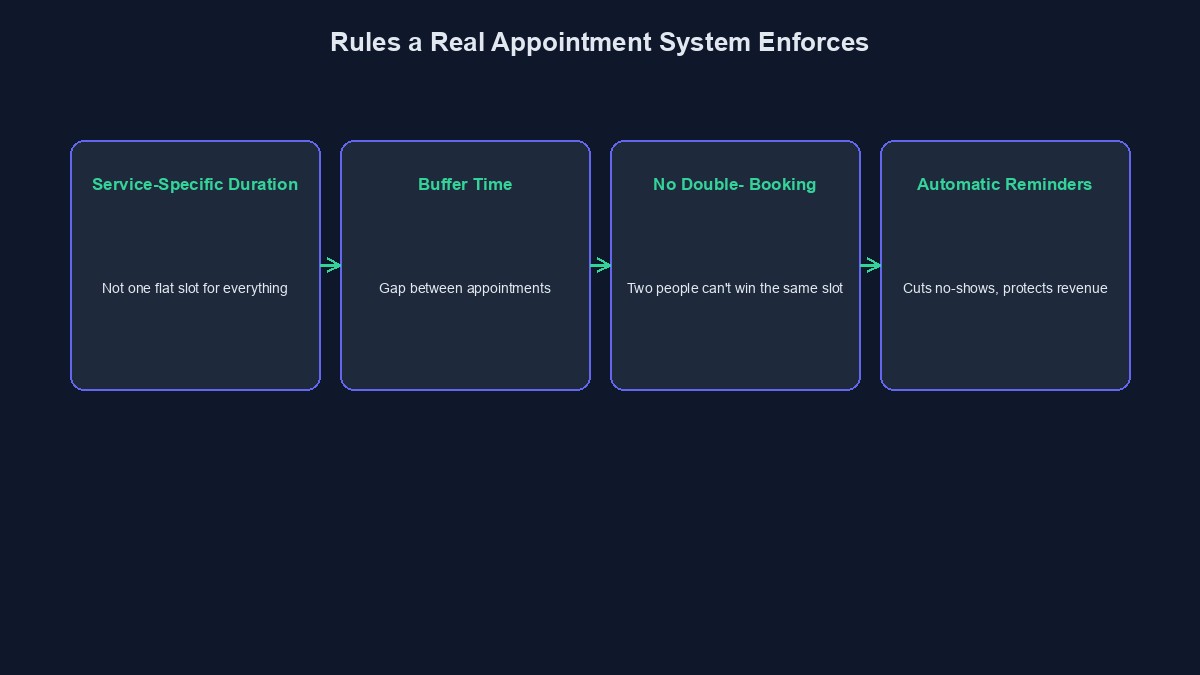
The entire point of a booking system is preventing two people from being promised the exact same slot with the same resource, a specific stylist's chair, a specific consultant's time, a specific room. This sounds trivial and is a genuine, classic source of software bugs: two customers viewing the same available slot at nearly the same moment, both attempting to book it, and a system that does not handle this correctly can double-book both of them, a failure that is significantly more damaging to trust than almost any other booking mistake, since it means physically showing up to a conflict the business itself created.
What "available" actually has to account for, beyond a simple calendar
A genuinely correct availability calculation accounts for the specific service's actual duration, not a flat, uniform slot length across every offering, any buffer time a business genuinely needs between appointments, cleaning a treatment room, preparing for the next client, and a specific staff member or resource's own actual working hours and existing bookings, not just the business's general opening hours. A system treating every appointment as an identical, interchangeable time block, with no buffer and no resource-specific tracking, will eventually produce a real scheduling conflict the moment a business's actual services and staff differ enough from that oversimplified assumption, which for most real businesses is almost immediately.
Rescheduling and cancellation: the part most basic booking tools handle poorly
Customers genuinely need to reschedule and cancel, and a system that makes this difficult simply pushes that friction onto a phone call the whole point of online booking was meant to eliminate. A real system needs a clear, fair cancellation policy that is actually enforced by the software rather than only stated in text, a way for the business to distinguish a customer who cancelled respectfully with notice from one who simply never showed up, and, ideally, an automatic way to offer a newly freed slot to someone else waiting for one, rather than that freed time simply going unused.
Reminders: unglamorous, and one of the highest-leverage features available
A significant share of missed appointments across almost every service business are not deliberate, they are simply forgotten. An automatic reminder, by SMS or WhatsApp, sent a day and, ideally, a few hours before a scheduled appointment, is consistently one of the highest-leverage features a booking system can offer, directly reducing lost revenue from no-shows for a cost that is genuinely small compared to the value of the appointment slots it protects.
Payment: whether to require it upfront, and why that decision matters
Some businesses collect payment, or a deposit, at the time of booking, which genuinely reduces no-shows since a customer with money already committed has a real incentive to actually attend. Others prefer payment on arrival, avoiding the added friction of a payment step during booking, accepting a somewhat higher no-show rate as the tradeoff. Neither choice is automatically correct; it depends on your specific service's typical appointment value and your business's actual, observed no-show pattern, and it is worth deciding deliberately rather than defaulting to whichever option required less initial setup work.
Where a ready-made booking template exists today, and where it genuinely does not
Our own platform's real, proven date-range booking system, built for hotel reservations, genuinely solves a meaningfully related problem, real availability calculation, real conflict prevention, a full payment-integrated checkout, and it is worth understanding as proof that this category of system is not abstract or theoretical for us. What we do not offer today as a separate, ready-made template is a generic, configurable appointment system built specifically for single time-slot services, a salon, a clinic, a consultant, rather than multi-night stays. Being honest about this distinction matters: the underlying booking-system expertise and proven conflict-prevention logic is real, the specific generic-appointment product is not yet a template you can simply configure today.
Group and recurring bookings: a genuinely different, harder case
A single customer booking a single slot is the easier, more common case. A group booking, several people needing the same time slot together, a fitness class with a fixed capacity, or a recurring appointment, the same customer booked automatically for the same slot every week, introduces real, separate logic beyond the individual-slot case: tracking remaining capacity rather than simple availability, and handling what happens when one occurrence of a recurring series needs to be individually rescheduled or cancelled without breaking the rest of the series. Worth knowing this exists as a genuinely separate requirement before assuming a system built only for simple, individual bookings will automatically extend to cover it.
A worked example: what a correctly built system prevents
Picture a hair salon with three stylists, each working different hours and each requiring a genuine fifteen-minute buffer between clients for setup. A correctly built system checks availability against the specific stylist requested, that stylist's actual working hours, their existing bookings, and the required buffer, before ever showing a slot as available, meaning a customer booking online sees only genuinely bookable times, never a slot that looks open but would actually create a conflict. A customer who needs to reschedule does so directly online, automatically freeing their original slot for someone else, rather than requiring a phone call the salon's own staff would otherwise have to personally handle. An automatic reminder sent the evening before each appointment measurably reduces the salon's previous, real no-show rate, protecting revenue that would otherwise have simply gone unused.
Mistakes that show up repeatedly in booking systems built without this care
Treating every appointment as an identical, uniform time block regardless of the actual service or resource involved. This works only until a business's real service variety inevitably breaks the oversimplified assumption.
No genuine handling of the double-booking race condition. Two customers booking the same slot within moments of each other is a realistic scenario, not an edge case, and a system that has not deliberately addressed it will eventually produce a real conflict.
Skipping automatic reminders as a "nice to have" rather than treating them as core. The revenue genuinely protected by reducing no-shows routinely outweighs the modest cost of sending them.
Making cancellation and rescheduling difficult enough that customers call instead. This defeats a meaningful part of the actual point of building an online booking system in the first place.
A short glossary
Buffer time: a deliberate gap built into scheduling between appointments, for setup, cleaning or preparation. Double-booking: two customers both being confirmed for the same slot and resource, a genuine bug a correctly built system prevents. No-show: a customer who does not attend a booked appointment without cancelling in advance. Race condition: a software bug arising when two actions happen at nearly the same moment in a way the system does not correctly handle, the exact underlying risk behind double-booking.
Where to go from here
Our real, proven hotel booking system demonstrates the genuine availability and conflict-prevention capability this guide describes, built and working today. A generic appointment-booking system for single-session services, a salon, a clinic, a consultant, built specifically for your actual services, staff and buffer requirements, is a real, custom build our development team can deliver, and bringing your business's actual scheduling rules to that conversation gets you a genuinely correct system far faster than starting from a generic, unproven assumption. You can start building free to explore what is already available as a ready template today.



Comments
No comments yet. Be the first to share your thoughts.