Hotel Booking Website vs Listing on Airbnb: What Works in Nigeria
This is a genuinely common, genuinely difficult decision for a Nigerian property owner: build your own booking website, list on a platform like Airbnb or Booking.com, or do both. Most advice on this topic comes from one side or the other, either a web platform selling you a website or a listing platform's own content encouraging you to list with them. This guide tries to give the actual trade-offs honestly, since the right answer genuinely differs depending on your property's specific situation, not a single universal recommendation.
What you actually get from your own website
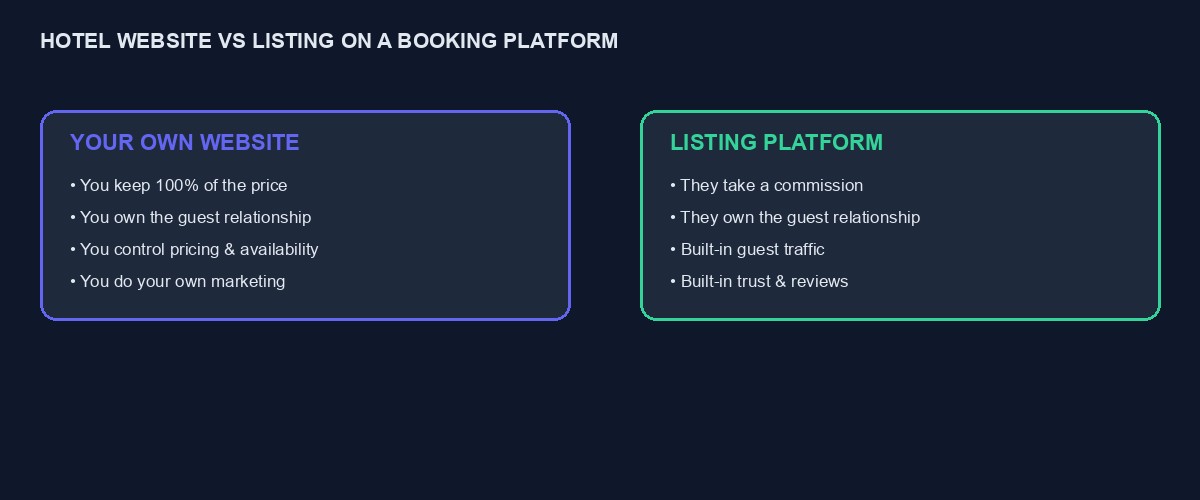
Building your own hotel or short-let booking website, covered in detail in our guide to starting a hotel booking website in Nigeria, means every booking made through it keeps its full value, with no commission taken by a third party. You own the guest's contact details directly, letting you build a genuine returning-guest relationship, send a direct offer for their next visit, or simply follow up personally in a way a listing platform's own messaging system does not fully allow. You control your own pricing and availability calendar entirely, with no platform-imposed restrictions on how you present your property or communicate with a prospective guest before they book.
What you actually get from listing on a platform
A listing platform's single biggest, genuine advantage is traffic: an established platform already has a large pool of travellers actively searching, many of whom would never have found your property's own website through a search engine, particularly a newer property with no existing search visibility yet. Alongside traffic, these platforms bring built-in trust, a review system travellers already understand and rely on, secure payment handling you do not have to build yourself, and, for international travellers specifically, a familiar, comfortable booking experience in a system they may already have used in other countries.
The commission cost, made concrete
The trade-off for that traffic and trust is a commission, typically taken as a meaningful percentage of every booking's value, which compounds over a property's real, ongoing volume into a genuinely substantial ongoing cost. It is worth calculating this explicitly against your own actual numbers rather than treating it as an abstract percentage: work out roughly what a typical month's bookings through a listing platform would have earned you directly, and compare that against the same bookings after the platform's commission, which for a property doing meaningful volume often reveals a larger real cost than the percentage alone suggests until it is actually calculated against real figures.
Why "just do both" is the honest default answer, with a caveat
For most Nigerian properties, the genuinely sensible answer is running both simultaneously, using a listing platform for the traffic and trust it brings to guests who would never otherwise find you, while directing your own returning guests, referrals, and anyone you reach through your own marketing toward your own website, where the full booking value stays with you and no commission is paid. The caveat, and it is an important one, is that this only works cleanly if both systems stay genuinely synchronised: a room booked through the listing platform must be immediately reflected as unavailable on your own website's calendar, and the reverse, or you risk the exact double-booking problem covered in our hotel booking website guide, now made worse by having two separate systems that can each independently accept a booking for the same room on the same night.
Keeping two calendars in sync, practically
Some listing platforms offer a calendar synchronisation feature, commonly using a shared calendar format, that can automatically block dates on one system once they are booked on the other, and setting this up properly, if your specific listing platform and booking website both support it, removes most of the manual risk. Where automatic synchronisation is not available or not fully reliable, a strict, disciplined manual habit, checking and updating both calendars at a fixed time daily, is the fallback, and it is worth treating this discipline as seriously as any other part of running the property, since a single missed update is exactly the kind of gap that produces an embarrassing, trust-damaging double booking.
Which approach suits which kind of property
A brand new property with no existing reputation or returning-guest base genuinely benefits most from listing-platform traffic in its first months, since a new, unknown website has essentially no organic search visibility yet, and depending entirely on your own website at this early stage means very few people will actually find it. An established property with a genuine base of returning guests, referrals, and some existing local reputation gets proportionally more value from directing that existing demand to its own website, since those guests already know and trust the property and do not need a listing platform's trust signals to book confidently.
A property in a competitive, well-covered area, central Lagos or Abuja, where listing platforms already have deep coverage, may find the platform's commission harder to justify against the traffic it genuinely brings, since guests searching that area have abundant listed options regardless of whether your specific property is among them. A property in a less-covered area, where listing platforms have thinner competition and thinner existing guest expectations, may find listing genuinely more valuable, since it is a meaningful, otherwise-unavailable source of visibility for that specific location.
The trust question, examined honestly
A listing platform's trust system, reviews, verified guest profiles, secure payment handling, genuinely solves a real problem: a first-time guest has no independent way to judge whether an unfamiliar property's own website is legitimate, and a platform's established reputation lends that trust by association. This is a real, valuable service, and it is worth being honest that a brand-new property's own website cannot replicate it quickly. Building equivalent trust on your own site takes time: genuine, collected reviews from real stays, a real, findable address and contact details, and simply existing long enough that search engines and word of mouth have built some independent reputation around your own domain. Until that trust is genuinely built, a listing platform's borrowed trust is doing real, valuable work that a pure own-website strategy cannot immediately replace.
Payment handling: who actually protects the money
A listing platform typically holds a guest's payment and releases it to the property only after certain conditions are met, check-in confirmed, a cancellation window passed, which protects both sides from various kinds of dispute, at the cost of the property not having full, immediate control over when funds are received. Running your own website means you take on this responsibility directly, deciding your own cancellation and refund policy and handling any dispute yourself, which is more control and also more responsibility, covered in the payment-handling discipline described in our guide to accepting online payments in Nigeria. Neither approach is inherently safer; they simply place the responsibility, and the control, in different hands.
Marketing effort: what each approach actually demands of you
Listing on a platform requires relatively little ongoing marketing effort from you directly, since the platform itself is doing the work of bringing searchers to a page where your property can be discovered. Running your own website successfully requires genuine, ongoing effort: search visibility takes months to build, as covered in our guide to getting more customers online, and a website with no active marketing behind it, no social presence, no word-of-mouth encouragement, no search optimisation, will simply sit largely unvisited regardless of how well built it is. Be honest with yourself about how much ongoing marketing effort you are actually willing and able to put in before assuming your own website will meaningfully reduce your dependence on listing-platform traffic.
International versus local guests
If a meaningful share of your actual guests are international travellers, unfamiliar with Nigeria and naturally more cautious about an unfamiliar local property's own website, a listing platform's international trust and payment familiarity carries proportionally more weight for that specific audience. If your guests are predominantly Nigerian, often booking through a personal referral or a WhatsApp conversation already carrying some trust before they ever reach a booking page, your own website's relative disadvantage in trust matters considerably less, since much of the trust-building work has already happened through the personal channel that brought them to you in the first place.
A simple way to decide where you currently stand
Look honestly at your last three months of actual bookings and sort them into two genuine categories: bookings that came from a stranger discovering your property for the first time, and bookings that came from someone who already knew you, a returning guest, a referral, a direct message. The first category is where listing-platform traffic is doing real, hard-to-replace work for you right now. The second category is where you are very likely paying a commission on a booking that did not actually need the platform's traffic-generating function at all, and is exactly the segment a direct-booking website captures back, as shown in the worked example above.
A worked example: an imagined short-let apartment owner's decision
Picture an owner with three short-let apartments in Lekki, currently listed exclusively on a well-known platform, paying its commission on every booking, with no website of their own at all. Reviewing six months of bookings honestly reveals a meaningful, recurring pattern: roughly a third of guests are returning or referred by a previous guest, arriving through a direct WhatsApp message rather than a fresh platform search, and these returning guests are still being routed through the platform's booking flow purely out of habit, with the commission being paid on bookings that never actually needed the platform's traffic-generating function at all.
Building a simple booking website specifically for these returning and referred guests, while keeping the platform listing active for genuinely new, platform-sourced guests, redirects roughly that same third of bookings away from the commission entirely within a couple of months, a direct, calculable saving with no reduction in actual booking volume, since the platform-dependent new-guest bookings continue exactly as before. The owner adopts a simple, disciplined daily calendar-check habit across both systems, since the specific listing platform used does not offer reliable automatic synchronisation for this property type, treating it as a fixed five-minute daily task rather than an occasional afterthought.
What listing platforms typically require, and what that costs beyond commission
Beyond the commission itself, listing platforms typically impose their own rules on how quickly you must respond to enquiries, how strictly your calendar must be kept updated, and sometimes penalise a property for cancelling a confirmed booking, even for a legitimate reason, more heavily than a direct guest relationship would. These are not necessarily unreasonable rules, since they exist to protect the platform's own guest experience, but they represent a real loss of flexibility worth weighing alongside the pure percentage commission cost when deciding how much of your business to route through a platform versus your own, fully self-controlled website.
A phased approach for a property just starting out
For a genuinely new property with no existing reputation or returning-guest base, a sensible phased approach avoids over-investing in a website's marketing before there is any real direct demand to capture. Start primarily on a listing platform, building initial reviews and reputation through real, well-handled stays. Once a genuine pattern of returning or referred guests starts to appear, which the review of your own booking history described above will make visible, invest in a proper booking website specifically to capture that segment directly, rather than building the website first and hoping direct demand eventually catches up to justify it. This ordering matches the investment to actual, demonstrated demand rather than a guess made before you have real data about your own property's specific guest behaviour.
Revisiting the decision as your property grows
The right balance between your own website and listing-platform presence is not a decision made once and left alone. As your property builds its own reputation, its own returning-guest base, and its own search visibility, the value of listing-platform traffic relative to its commission cost genuinely shifts, and it is worth deliberately reviewing this balance every few months using the same simple review of recent bookings described above, rather than defaulting to whatever mix you happened to start with and never questioning it again as your property's actual situation changes.
Mistakes owners make with this decision
Assuming a website alone will replace listing-platform traffic quickly. A new website has no existing search visibility, and building that visibility takes months of consistent effort, covered in our guide to getting more customers online, not an instant replacement for platform traffic.
Running both without genuine calendar discipline. This is the single most damaging mistake in the combined approach, and it is worth building a specific, unskippable habit around rather than treating it as a minor administrative detail.
Never actually calculating the real commission cost. A vague sense that "the platform takes a cut" undersells the real, compounding cost across genuine volume, and calculating it explicitly against your own numbers is what actually informs a sound decision rather than a guess.
Treating the decision as permanent and never revisiting it. A new property's optimal mix shifts as it builds its own reputation and returning-guest base, and revisiting the balance every few months, as your own direct demand genuinely grows, keeps the decision matched to your property's actual, current situation rather than a choice made once and never reconsidered.
Building the "both" approach properly
If you decide, as most Nigerian properties reasonably do, to run both, our hotel booking template gives you the website half of this combination, with real availability, multiple payment paths, and an admin dashboard, ready to sit alongside whatever listing platform presence you maintain. You can start building free to see it directly, and our fuller guide to starting a hotel booking website in Nigeria covers the technical build this comparison assumes you are weighing against a listing platform.



Comments
No comments yet. Be the first to share your thoughts.