
How to Start a Hotel Booking Website in Nigeria
Nigeria's hospitality sector has quietly become one of the more competitive spaces for digital tools, and yet a huge share of hotels, guest houses and short-let apartments still run entirely on phone calls and a WhatsApp status showing which rooms are free this week. If you are building a hotel booking website, either for your own property or for a client, the difference between a website that genuinely takes bookings and one that is really just a glorified brochure comes down to a specific set of features most first attempts skip. This guide walks through what a real hotel booking website actually needs, how Nigerian guests differ from a generic international template's assumptions, and a realistic build process from nothing to live.
Why a "contact us to book" page is not actually a booking website
The most common first attempt at a hotel website is a set of nice photographs, a description of the rooms, and a contact form or WhatsApp button asking the visitor to enquire about availability. This is a genuine website, and it is not a booking website, because it does not actually answer the one question every visitor arrived with: is a room free on the specific dates I need, and can I secure it right now. Every "enquire and wait" step between a visitor's intent and a confirmed booking loses some share of visitors who simply move on to a property that answers the question immediately, which is a real, measurable cost for a business competing against other properties that do offer instant booking.
What real availability actually means, technically
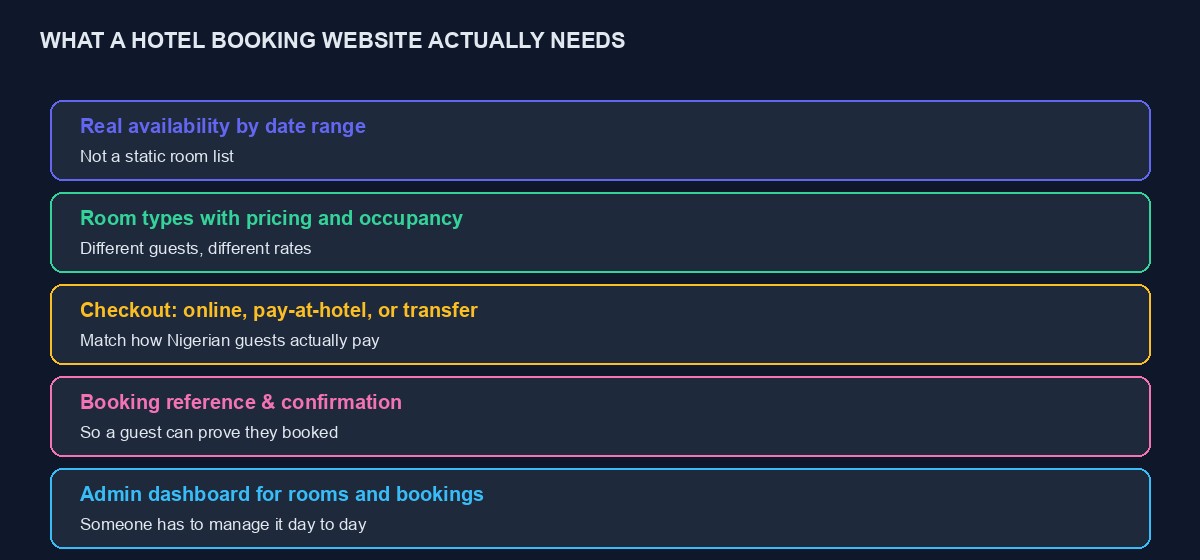
A genuine booking system needs to know, for every room type, which specific date ranges are already booked, and calculate availability by checking a new booking request against every existing one for overlapping dates, not simply a manually updated "available" or "sold out" flag someone forgets to change. This matters because a flag-based system inevitably drifts out of sync with reality, either showing a room as available that a phone booking has already claimed, or the reverse, showing a room as sold out that was actually freed by a cancellation nobody updated the flag for. Real date-range availability checking, calculated fresh against actual existing bookings every time, is the single feature that separates a booking system from a booking-shaped brochure.
Room types, pricing and occupancy, not one generic room
Even a small guest house rarely has genuinely identical rooms, and a booking system needs to represent this properly: different room types, each with its own price, its own maximum occupancy, and its own description and photographs, rather than forcing every room into one generic listing with a single price. This also matters for revenue, since it lets you price a room with a private bathroom differently from a shared-facility room, or charge more for a room that sleeps four than one that sleeps two, capturing the real value difference rather than averaging everything into one flat rate that undercharges your best rooms and overcharges your basic ones.
Checkout that matches how Nigerian guests actually pay
A booking system built around a single online card payment, the default assumption in many international hotel booking templates, misses a meaningful share of how Nigerian guests actually prefer to pay. Online payment through a gateway like Paystack or Flutterwave, covered in our guide to accepting online payments in Nigeria, should be available and encouraged, since it secures a booking immediately and reduces no-shows. Alongside it, offering pay-at-the-hotel for a guest who prefers to settle on arrival, and bank transfer with a clear, manually confirmable process, covers guests who are hesitant to pay a property they have not stayed at before entirely upfront, a genuine and common caution among Nigerian travellers booking a property for the first time.
A booking reference the guest can actually use
Once a booking is confirmed, the guest needs something concrete: a clear booking reference, sent by email or displayed immediately, that they can show at check-in or quote if there is any confusion. This sounds obvious and is skipped surprisingly often in a rushed first build, leaving a guest with nothing more than a vague memory of having booked online, which creates an awkward, trust-eroding moment at check-in if the property's own records do not immediately, clearly confirm the booking without the guest having to explain and re-justify it themselves.
An admin dashboard someone will actually use daily
The guest-facing side of a booking website is the visible half. The admin side, where someone on the property's staff actually manages rooms, sees upcoming bookings, and handles a cancellation or a special request, is what determines whether the system gets used correctly day to day or quietly abandoned in favour of the old phone-and-notebook method within a month. A genuinely usable admin view shows upcoming check-ins and check-outs clearly, at a glance, without requiring the person using it to be comfortable with a complicated interface, since hotel front-desk staff are not always the most technically confident users, and a system that assumes otherwise gets bypassed.
Building it, step by step
Step 1: gather the real details before building anything
Every room type, with its real price, real maximum occupancy, real photographs, and a real, honest description. Your actual delivery, so to speak, is truthful, specific detail, not generic phrases like "cosy and comfortable" that could describe any room anywhere. Note your cancellation policy explicitly, since this needs to be shown to a guest before they book, not decided ad hoc when a cancellation actually happens.
Step 2: choose between building custom and using a template
A fully custom-built booking system, handling availability logic, payments, and an admin dashboard correctly, is a genuinely substantial development project, not a weekend build, and the availability-checking logic specifically is easy to get subtly wrong in ways that only surface once two guests have accidentally been booked into the same room on the same dates. A template-based platform built specifically for hotel bookings, where this logic is already built and tested, is the sensible default for most properties, reserving a fully custom build for a property with genuinely unusual requirements a template cannot accommodate.
Step 3: connect real payments and test them properly
Register with a payment gateway, complete verification, and test with a genuine small transaction before ever taking a real guest's booking, following the same discipline covered in our guide to accepting online payments in Nigeria. Confirm the pay-at-hotel and bank transfer paths are equally clear to a guest choosing them, not an afterthought bolted onto a system built primarily around online card payment.
Step 4: test the whole flow as a real guest would
Book a room yourself, for real dates, through every payment path you offer, and confirm the booking reference, any confirmation email, and the admin view all show the booking correctly and consistently. Then deliberately try to break it: book overlapping dates for the same room type and confirm the system correctly shows it unavailable the second time, rather than allowing a double booking through.
Step 5: launch on your own domain, with real photographs
Register your own domain, connect it, and use genuine photographs of your actual rooms rather than generic stock images, since a guest choosing between properties is making a trust decision as much as a price decision, and real, honest photographs, even slightly imperfect ones, build more confidence than polished but generic images that could belong to any property anywhere.
Handling the specific Nigerian reality of unreliable internet
A guest booking from a phone on a patchy mobile connection, or hotel staff managing the admin dashboard through an intermittent office connection, is a real, common condition to design around rather than assume away. Keep the booking flow itself short and light, avoiding heavy images or unnecessary steps between a guest choosing dates and confirming a booking, since every additional step is another point where a dropped connection can lose the attempt entirely. For the admin side specifically, a system that clearly shows whether a change has actually saved, rather than leaving staff uncertain whether an update went through, avoids the quiet, dangerous failure mode of staff believing a room has been marked unavailable when the update never actually completed.
Managing seasonal demand and pricing
Nigerian hospitality demand shifts meaningfully around specific periods, Christmas and New Year especially, alongside local events, conferences, and, for properties near universities, admission and graduation periods. A booking system that lets you adjust pricing for specific date ranges, charging more during a known high-demand period and less during a genuinely quiet one, captures real additional revenue during peak periods without needing manual, error-prone adjustments to your base pricing that you then have to remember to revert afterward. Plan this a season ahead where possible, since guests researching a stay during a known busy period often book earlier than usual, and a system still showing off-season pricing during a high-demand window is quietly leaving money on the table.
Coupon codes and direct-booking incentives
One of the genuine advantages of a hotel's own booking website over relying entirely on a third-party listing platform, covered in more depth in our comparison guide, is the ability to offer a direct-booking discount or a coupon code without paying a platform commission on that booking at all. A modest, clearly communicated incentive, a small percentage off for booking directly rather than through a listing platform, meaningfully encourages returning guests and word-of-mouth referrals to book the property's own site, where the full value of the booking stays with the property rather than being shared with a third-party platform's commission.
What to do about reviews and reputation
A booking website with no visible trust signals, no reviews, no indication other guests have genuinely stayed and been satisfied, asks a first-time visitor for a real leap of faith. Where you can, display genuine guest reviews, collected honestly after an actual stay, and never invent them, which is both dishonest and increasingly easy for a sceptical visitor to spot as generic or implausible. If your property is new and genuinely has few reviews yet, be patient rather than tempted to fabricate; a handful of real, specific reviews collected over the first few months of proper operation builds more lasting trust than a larger number of reviews a careful visitor suspects are not genuine.
Multi-property and multi-room-type complexity, once you grow
A single small guest house with two room types is a straightforward booking system. A property with a dozen room types, or a small chain managing several properties from one dashboard, needs the underlying system to genuinely scale to that complexity without becoming confusing to manage day to day. If you are starting small, it is worth choosing a platform built to handle this growth rather than one that will need to be entirely rebuilt the moment your property expands beyond its original, simpler scope, since migrating booking history and guest records between systems mid-growth is a genuinely disruptive, avoidable inconvenience.
A note on cost, in general shape
A template-based hotel booking platform typically costs a modest, predictable monthly fee, or nothing at all for a starting tier, considerably less than commissioning a fully custom build, which is genuinely substantial development work given the availability-logic complexity described above. Payment gateway fees are separate, a small percentage per transaction, charged by whichever gateway you connect rather than the booking platform itself. Weigh this modest recurring cost against what a single avoided double-booking, or a single month of bookings captured that would otherwise have gone to a competitor with instant online booking, is genuinely worth to your specific property, which for most properties handling any real volume makes the investment straightforward to justify.
A short checklist before you consider the website finished
Real date-range availability, checked against actual existing bookings, not a manually maintained flag. Room types with accurate, honest pricing and occupancy. At least one online payment option, tested with a genuine small transaction, alongside pay-at-hotel or bank transfer for hesitant first-time guests. A clear booking reference the guest actually receives and can use. A cancellation policy shown before booking, not discovered afterward. An admin view your actual staff can use confidently, tested by having them try it, not just by you. And real, honest photographs and, where you have them, real guest reviews, never invented ones.
A worked example: an imagined guest house going digital
Picture a small guest house in Ibadan with six rooms across two types, currently taking bookings entirely by phone and a shared spreadsheet the owner updates manually, occasionally forgetting, which has twice resulted in two guests arriving for the same room on the same night. Moving to a real booking system starts with the honest inventory: two room types, their real prices, real maximum occupancy, and the owner's actual cancellation policy, which had never been written down formally before. The booking system is configured with genuine date-range availability, connected to a Paystack account for online payment, with pay-at-hotel offered as well for guests uncomfortable paying upfront to a property new to them online.
In the first month, roughly a third of bookings come through online payment, most of the rest choosing pay-at-hotel, and the double-booking problem, the original reason for making the change at all, simply stops occurring, since the system now correctly refuses to accept a second booking for dates already taken rather than relying on the owner remembering to check a spreadsheet under pressure during a busy call.
Mistakes worth avoiding
Launching without testing the double-booking case specifically. This is the single most damaging failure mode for a hotel booking system, and it is worth testing deliberately rather than assuming it works because the happy path does.
Only offering online card payment. Excluding pay-at-hotel and transfer options narrows your bookings to only the guests already comfortable paying a new property entirely upfront, which is a smaller group than it might seem.
Using generic stock photography instead of real photos. A guest choosing a Nigerian guest house is looking for reassurance the property is genuinely as described, and generic images undercut exactly that reassurance.
No clear cancellation policy shown before booking. A guest who discovers your cancellation terms only after a problem arises is, reasonably, an unhappy one, and showing the policy clearly upfront protects both sides.
Where this is already built for you
Our own hotel booking template includes exactly the features described in this guide: real date-range availability, room types with pricing and occupancy, guest or logged-in checkout, coupon codes, multiple payment paths including online gateways, pay-at-hotel and bank transfer, booking-reference tracking, and an admin dashboard for managing rooms and bookings. You can start building free, with no card required, to see it directly, and our guide comparing a hotel booking website against listing on a platform like Airbnb covers the wider strategic decision alongside the technical one covered here.



Comments
No comments yet. Be the first to share your thoughts.