How Much Does It Cost to Build a Social Media App?
"How much does it cost to build a social media app" is a question that genuinely deserves an honest answer, not a hyped-up one. Everyone dreams of building the next big platform, but the real cost of a social media app depends entirely on which real features you actually need, and a few of those features are far more expensive to build properly than people expect.
What a social media app is actually made of, underneath
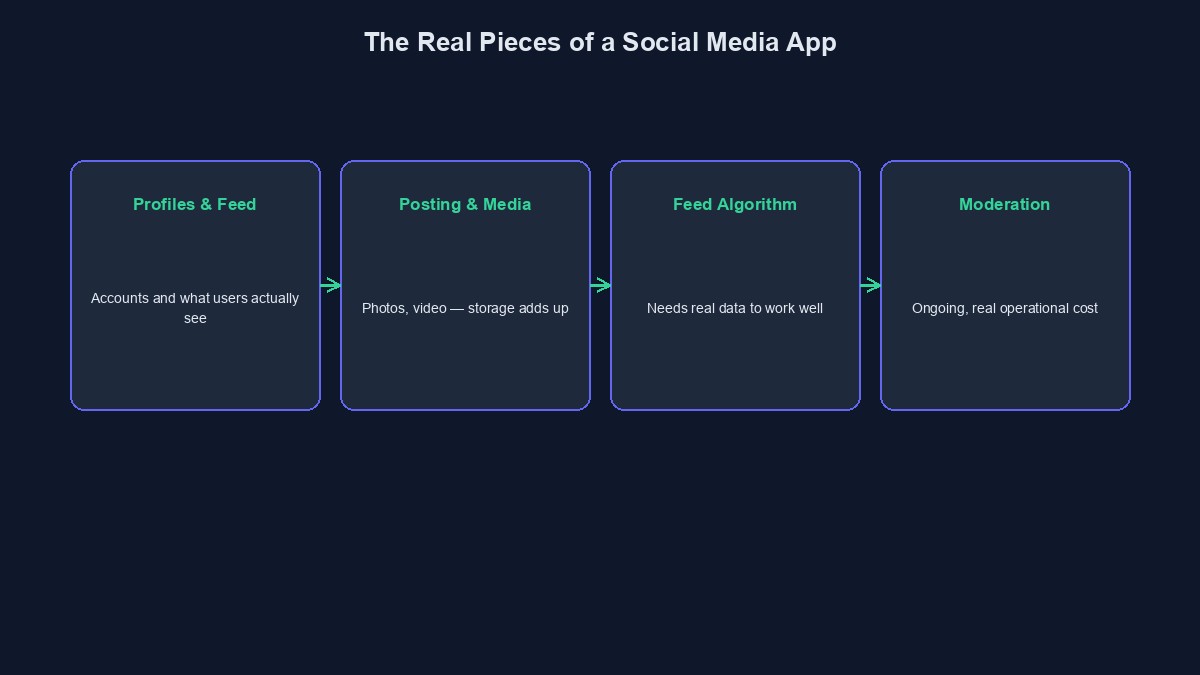
Strip away the specific idea, and almost every social media app shares the same real, core pieces: user profiles and accounts, a feed showing content from people you follow, the ability to post content, text, photos or video, ways to interact, likes, comments, follows, and a notification system telling users when something relevant happens. How these core pieces are combined and styled is what makes one app feel different from another, but the underlying engineering challenges are largely shared across almost all of them.
The genuinely hard, expensive parts, named honestly
The feed algorithm, deciding what content to actually show each specific user and in what order, is one of the most difficult parts to get right, and it is a continuous, ongoing effort, not something you build once and finish. Media storage and delivery, handling potentially huge amounts of photos and video, storing them reliably, and delivering them quickly to users anywhere, is a genuinely significant, ongoing infrastructure cost, not a one-time expense. Real-time features, live notifications, a chat or messaging system, need specific, more complex technical approaches than a normal website, since they depend on an open, constant connection rather than a simple page load. And content moderation, catching and removing genuinely harmful or inappropriate content, whether through automated tools, real human moderators, or both, is a real, ongoing operational cost many first-time founders significantly underestimate.
What actually drives the real cost up or down
Whether your app is primarily text and photos, which is meaningfully simpler and cheaper, or video-first, which brings much higher storage, processing and delivery costs. Whether you need real-time chat and messaging built in from day one, or whether that can genuinely wait for a later version. How much personalisation your feed algorithm actually needs at launch versus a simpler, chronological feed to start with. And whether you are launching on both Android and iPhone simultaneously, or starting with one platform to prove the idea first.
Three realistic tiers, honestly described
A genuinely minimal version, basic profiles, a simple chronological feed with no complex personalisation, basic photo posting, and simple likes and comments, is real, substantial software, but a meaningfully smaller undertaking than a full-featured platform. A more complete version, adding a smarter feed, direct messaging, and richer media support, moves meaningfully higher in both cost and real build time. A version genuinely aiming to compete with an established platform, with sophisticated content recommendation, heavy video support, and real content moderation systems at scale, is a serious, major, ongoing software investment, closer to what a well-funded startup budgets for over years, not a single upfront project.
Why comparing yourself to Instagram or TikTok directly is misleading
These platforms represent years, in some cases well over a decade, of continuous engineering investment from large, well-funded teams, refining their specific algorithms and infrastructure at a truly massive scale. Your actual, realistic goal is almost certainly a genuinely working first version that proves your specific idea with real early users, not an immediate, full clone of a platform that took a huge team years to build. Pricing your first version against their entire current, mature product produces an unrealistic, discouraging number that has little to do with what a genuine first launch actually requires.
The ongoing costs that quietly add up after launch
Server and storage costs that grow directly with how many users and how much content your app actually has, meaning a successful, growing app's hosting bill genuinely increases over time, not a fixed, one-time cost. Content moderation, whether through paid tools, human reviewers, or both, as your user base grows. And continuous, ongoing development, since a real social app is never genuinely "finished," it evolves constantly based on what real users actually do and ask for.
Deciding who your app is actually for, before writing any code
A social app built for "everyone" usually ends up built for no one in particular, and struggles to find its first real, engaged users. A social app built for one specific, real group of people, students at one university, people in one specific hobby, small business owners in one city, has a genuine, clear reason for those first users to actually show up and stay. It is far easier, and far cheaper, to build well for a real, specific group first, and grow wider later once the core idea is genuinely proven, than to try to serve everyone from day one.
A worked example: a realistic first version, scoped honestly
Picture a founder wanting to build a social app specifically for a niche community, say, university students sharing study resources and organising events, rather than attempting to compete broadly with an established general platform. A realistic first version includes real user profiles, a simple, honest chronological feed, photo posting, and basic commenting, deliberately leaving out a complex recommendation algorithm and built-in messaging for a genuine second phase, launched only once the core idea is actually proven with a real, if small, group of genuinely engaged early users. This scoped-down first version costs meaningfully less to build and, more importantly, gets real, honest feedback from real users months sooner than waiting to build every feature first.
Mistakes that inflate cost or waste effort in this specific category
Trying to build a sophisticated, personalised feed algorithm before you have any real users or real data to build it from. A feed algorithm needs real user behaviour to actually improve; building an elaborate one before launch, with no real data yet, is effort spent on a feature that cannot meaningfully work well yet anyway.
Underestimating ongoing media storage and delivery costs, especially for a video-focused app. This is a genuine, scaling cost tied directly to your app's growth, not a cost that ends at launch.
Ignoring content moderation until a real problem forces the issue. This is a real operational and legal risk, worth planning for honestly from the start, not treating as optional.
Launching on two platforms simultaneously before validating the idea on one. This roughly doubles early cost and effort, for validation you could often get from a single platform first.
A short glossary
Feed algorithm: the logic deciding what content is shown to a specific user, and in what order. Content moderation: the process of reviewing and removing content that violates a platform's rules, whether by automated tools, human reviewers, or both. Real-time features: functionality like live chat or instant notifications, requiring a constant, open connection rather than a simple page reload. MVP (minimum viable product): the smallest genuinely useful version of a product, built to test a real idea before investing in every possible feature.
Where to go from here
Our broader guide to how much an app costs in Nigeria covers general cost factors this social-app-specific guide builds on top of. A real social media app, however scoped, is a genuine custom software project, and our development team is the right place to talk through your specific idea, your realistic first version, and your actual budget honestly.

Comments
No comments yet. Be the first to share your thoughts.