
How Much Does an App Cost in Nigeria?
"How much does an app cost" is one of those questions that has no single honest answer, and anyone who gives you one specific number without asking a single question about what you actually want to build is guessing, or selling. What genuinely determines cost is a handful of concrete factors, and once you understand them, you can estimate a realistic range for your own specific idea rather than anchoring on a figure that has nothing to do with your actual project.
Why there is no single answer, explained honestly
An app that lets a small team log deliveries and an app that processes payments for thousands of daily users are both, technically, "an app," and their costs can differ by a factor of twenty or more. The word itself describes almost nothing about complexity, which is why a credible quote always follows a real conversation about what the app actually needs to do, not a five-minute phone call ending in a number.
The factors that actually drive cost
How many distinct kinds of user the app has, and what each is allowed to do, since every additional role, an admin, a customer, a delivery agent, multiplies the screens and logic needed. Whether it needs to work offline or only ever assumes an internet connection, since offline support adds real, non-trivial complexity around syncing data once connectivity returns. Whether it needs native mobile apps for iPhone and Android specifically, or whether a mobile-friendly website genuinely serves the purpose just as well for meaningfully less cost, since building and maintaining two separate native apps is considerably more expensive than one well-built responsive website. Whether it involves payments, and if so, how complex, a simple one-off checkout is far cheaper to build correctly than a marketplace splitting payments between multiple parties. Whether it needs to integrate with other systems, a specific delivery partner's API, a specific accounting package, since every external integration is its own piece of real work, with its own documentation to read and its own edge cases to handle. And how polished the design needs to be, since a functional, plain interface costs meaningfully less than one with custom illustrations, animations and a fully bespoke visual identity.
Three realistic tiers, described by what they actually contain
Rather than quote specific naira figures, which shift constantly with the exchange rate and inflation and would be stale within months of being written, here is what genuinely different tiers of app actually contain, so you can locate your own idea within them and have a grounded conversation with whoever eventually builds it.
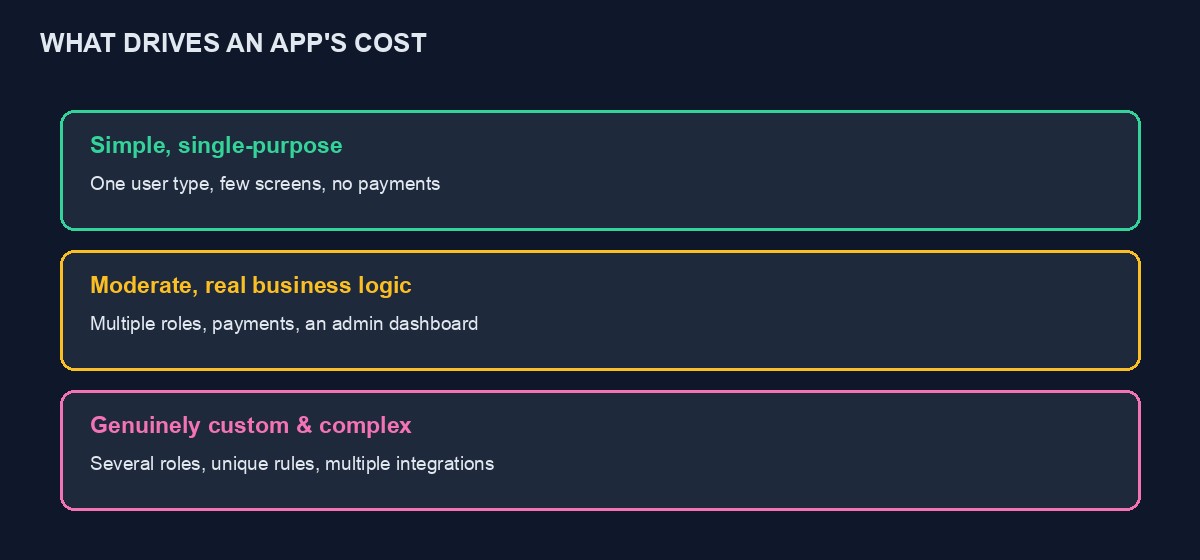
A simple, single-purpose app. One main kind of user, a handful of screens, no complex payment logic, minimal or no integration with outside systems. Something like an internal tool for a small team, or a simple booking form. This is the cheapest tier by a wide margin, and often achievable through a no-code or low-code platform without needing a full custom build at all, covered in our guide to building a web app without coding.
A moderately complex app with real business logic. Multiple kinds of user with different permissions, a working payment integration, perhaps one or two external integrations, a genuine admin dashboard for managing the business behind it. A typical small ecommerce store's backend, or a booking system with real availability logic, sits here. This tier represents meaningfully more work than the first, roughly proportional to how many distinct pieces of real business logic it needs, and is where a template-based platform that already contains this logic, rather than building it from nothing, offers real, meaningful savings.
A genuinely custom, complex product. Several distinct kinds of user, sophisticated business rules specific to your industry, multiple integrations, possibly native mobile apps alongside a web version, and ongoing feature development rather than a single, finished build. A multi-vendor marketplace, a fintech product, a platform with its own genuinely novel workflow, sits here, and this tier is where real, sustained software development investment is unavoidable, because no existing template or platform was built for your specific, unusual requirements.
Ongoing costs people forget to budget for
The initial build is rarely the whole cost. Hosting, the server your app actually runs on, is a genuine recurring expense, though it is modest for a small app and grows with real usage. Maintenance, fixing bugs discovered after launch, updating for changes in a platform or an integrated service, keeping security current, is an ongoing need, not a one-time cost, and a common, costly mistake is budgeting only for the initial build and being caught off guard by this recurring requirement. If your app involves payments or messaging, those services carry their own per-transaction or per-message fees, covered in our guides to payments in Nigeria and the WhatsApp Cloud API, which are separate from whatever you pay a developer or platform.
A worked example: pricing out an imagined delivery app
Picture a small logistics business wanting an app for customers to book a delivery and track it, riders to see and update their assigned jobs, and the owner to see everything and assign work. Working through the factors honestly: three distinct user roles immediately pushes this past the simplest tier. No complex payment logic is needed if customers pay on delivery rather than through the app itself, which keeps a meaningful source of cost out of the build. No offline support is strictly required if riders can be assumed to have mobile data, though building it in would be a genuine, specific addition worth pricing separately if connectivity in the actual delivery areas is unreliable. A mobile-friendly website, rather than two native apps, comfortably serves all three roles for considerably less than native development, since none of the described functionality specifically requires native device features a website cannot provide.
This lands the project in the moderate, second tier: multiple roles, real business logic around job assignment and status tracking, no payment complexity, no native app requirement. A freelance developer or small team, comfortable with the specific business logic, is a well-matched choice for this scope, and a credible quote would ask detailed questions about exactly how job assignment should work, what riders need to see, and what reports the owner wants, before proposing a number, rather than quoting immediately from the one-paragraph description alone.
Red flags in a quote worth watching for specifically
A price with no breakdown at all, just a single total figure, gives you nothing to evaluate or negotiate against if your requirements later shift. A quote that seems unusually low compared with others for a similarly described scope often means either a corner will quietly be cut somewhere you have not yet been told about, or the price will grow substantially once "extras" you assumed were included turn out not to be. A developer or agency unwilling to explain, in plain language, roughly what makes one part of your app more expensive than another is either inexperienced at estimating or not being fully transparent with you, and either is worth treating cautiously before committing real money.
Why the same app can cost differently in different hands
Two developers quoting the identical, well-specified project can still land on meaningfully different prices, and the difference is not always dishonesty on either side. Experience genuinely affects speed, an experienced developer who has built similar business logic before may complete it considerably faster than someone encountering the specific pattern for the first time, and speed translates directly into cost when billing by time. Location and cost of living affect a freelancer's or agency's baseline rates. And risk tolerance plays a real role too, a fixed-price quote for a vaguely specified project often carries a built-in buffer for the uncertainty, while an hourly arrangement shifts that same risk onto you instead, which is worth understanding explicitly before choosing between the two billing structures.
Build it yourself with AI, hire a freelancer, or use an agency: the real trade-offs
An AI app generator, covered in our guide to building an app with AI, can get a simple, first-tier idea working for very little money, mostly your own time, and is worth trying before spending on anything else for an idea in that tier. A freelance developer costs meaningfully more but brings judgement an AI tool alone cannot, particularly valuable for the second tier, where real business logic needs someone who understands the specific problem, not just generic patterns. An agency or development team costs the most but is the right choice for the third tier, where the project needs sustained, coordinated effort across design, backend, and often mobile development simultaneously, more than any single freelancer can reasonably carry alone.
Getting a credible quote, and spotting an uncredible one
A developer or agency who quotes a specific price without asking detailed questions about your users, your data, your integrations, and your actual business rules is guessing, and a guessed quote is a common source of painful cost overruns once the real complexity surfaces mid-project. A credible quote follows a real conversation, sometimes a paid discovery phase for a genuinely complex project, and comes with a reasonably clear breakdown of what is included, rather than a single opaque total figure with no visible structure behind it.
Reducing cost without gutting what actually matters
Cut features before cutting quality on the features you keep. A smaller, well-built app that does three things properly is worth more than a larger one that does eight things unreliably, and it costs less to build correctly the first time than to build broadly and then repeatedly fix. Consider whether a template platform already covers a large share of what you need, our own store, VTU and booking templates handle a genuine amount of real business logic already, and a custom build only needs to cover the specific, additional part that a template does not, rather than reinventing everything from scratch.
How currency and payment structure affect what you actually pay
Many Nigerian developers and agencies price in naira, reflecting local cost of living, while some, particularly those competing internationally or working with clients abroad, quote in dollars, which introduces real exchange rate exposure into a project's total cost if the rate moves meaningfully between when a quote is agreed and when later milestones are paid. Ask explicitly which currency a quote is fixed in, and if paying in dollars, understand whether the naira equivalent is locked at signing or floats with the exchange rate at each payment, since this detail alone can meaningfully change your actual total cost over a project spanning several months.
A sensible payment structure for any meaningful project splits payment across milestones, an initial deposit, a payment on a working prototype, a final payment on delivery, rather than paying the full amount upfront. This protects both sides genuinely: you are not exposed to the full cost if a developer disappears or the project stalls, and a serious developer is protected from doing substantial work for a client who might otherwise vanish before final payment. Be specifically wary of any developer or agency demanding full payment before any work begins, which is not how established, confident professionals typically structure a real project.
What a genuinely fair discovery conversation covers
Before you receive a real, credible quote, expect to be asked about your specific users and what each needs to do, what data the app needs to store and how sensitive it is, what other systems it needs to connect to, your realistic timeline, and your actual budget range, since a competent developer uses your budget to help shape what is realistic within it rather than treating it as an amount to simply spend in full regardless of what you actually need. If a conversation skips most of these questions and jumps straight to a number, treat that number as a rough guess rather than a grounded estimate, and be prepared for it to move once the real requirements surface partway through the build.
When a lower-cost option is genuinely the right call
Not every idea deserves a full custom build, and recognising this early saves real money. If your idea closely matches an existing template, a store, a booking system, a reseller platform, starting there and customising within it is almost always cheaper and faster than a custom build replicating functionality that already exists, tested, elsewhere. If you are still validating whether an idea has real demand at all, an AI-built prototype or a no-code version, covered in our guides to building an app with AI and building a web app without coding, is the financially sensible choice, saving a genuine custom-development budget for the moment you have real evidence the idea is worth that deeper investment.
What our own platform and team can do
If your idea fits one of our ready-made templates, starting is free, and you avoid the first-tier or second-tier custom build cost entirely for the parts already covered. For something genuinely custom, our team offers development packages, including an MVP-focused build, on the pricing page, and a custom project request gets you an honest, specific conversation about what your particular idea actually needs, rather than a guessed number.


Comments
No comments yet. Be the first to share your thoughts.