
How to Build a Pharmacy Website With Online Ordering
A pharmacy going online in Nigeria faces a specific problem most generic "how to build an ecommerce site" advice ignores entirely: you are not selling t-shirts. Medication is regulated, customers expect a level of trust a normal online store does not need to earn, and getting the ordering flow wrong has consequences beyond a bad review. This guide covers what actually differs about building a pharmacy website, honestly, including the regulatory groundwork that has to happen before the technical build even starts.
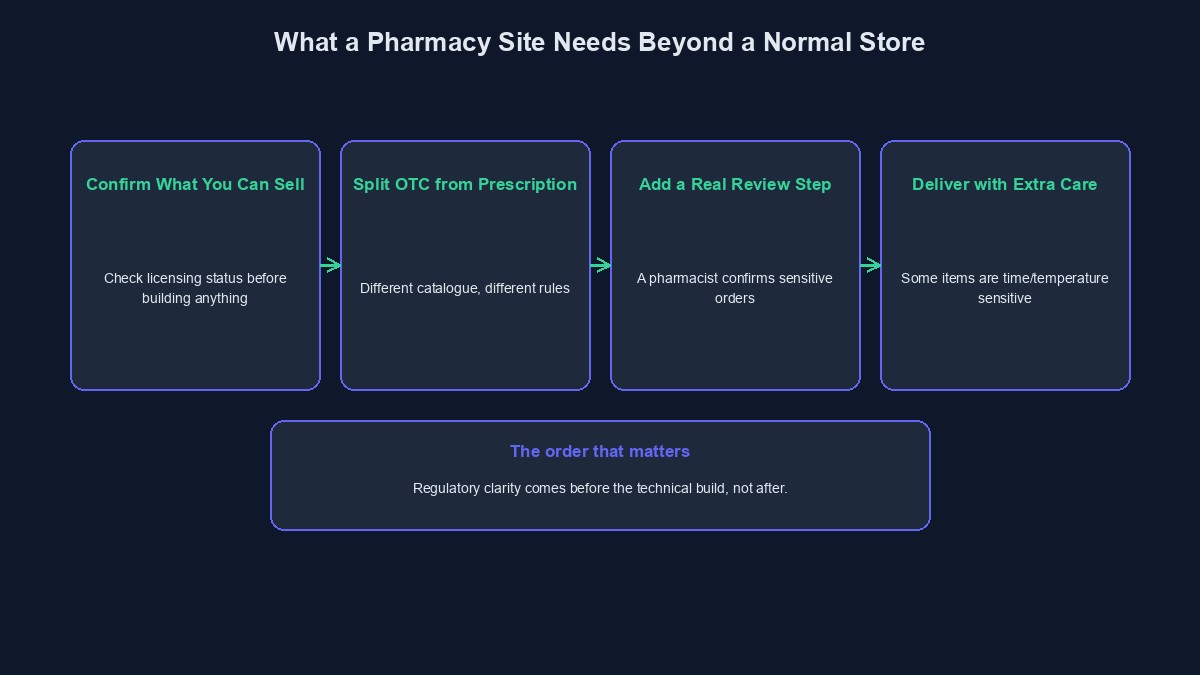
The part that comes before the website: what you are actually allowed to sell online
This is worth stating plainly, first, because it is the single most common thing generic ecommerce advice skips entirely. In Nigeria, the Pharmacists Council of Nigeria and NAFDAC govern what a pharmacy can and cannot do online, and prescription-only medication carries real restrictions on how it can be advertised, ordered and dispensed remotely. Before building anything, get clarity on your own specific licensing status and what your pharmacy is actually permitted to sell without an in-person prescription check, since this determines your entire product catalogue and ordering flow, not just a footer disclaimer. A pharmacy website selling clearly over-the-counter items, vitamins, first aid supplies, common non-prescription medication, sits on much simpler ground than one attempting to handle prescription fulfilment online, and being honest with yourself about which one you are actually building avoids a much more serious problem than a technical bug.
What the catalogue and ordering flow actually need, beyond a normal store
A pharmacy's product catalogue benefits from structure a generic store does not need: clear categories separating over-the-counter items from anything requiring more care, accurate stock levels since a customer arriving for a specific medication and finding it unavailable is a worse experience here than almost any other retail category, and product descriptions that are genuinely accurate rather than marketing copy, since a wrong dosage or usage description on a medication listing is a meaningfully more serious mistake than a wrong description on a t-shirt.
For anything requiring a prescription, the ordering flow itself needs an actual checkpoint, not just a checkbox saying "I have a prescription." A genuinely workable approach many Nigerian pharmacies use: the order is placed online, but a pharmacist reviews and confirms it, by phone or in a dashboard, before it is fulfilled, rather than shipping automatically the moment payment clears. This adds a manual step compared to a fully automated store, and that manual step is not a limitation to engineer away, it is the actual point.
Building this on a real ecommerce foundation, honestly
The underlying mechanics, a product catalogue, a cart, checkout connected to a real payment gateway, order management, stock tracking, are the same ecommerce foundation any online store needs, and our own ecommerce builder provides exactly this, ready to configure rather than build from scratch. What it does not do automatically is the pharmacy-specific layer described above, the prescription review checkpoint, the regulatory disclaimers specific to your licensing status. Those are configuration and process decisions you make on top of a real ecommerce foundation, not something a generic store builder, ours included, decides for you, and it would be dishonest to suggest otherwise.
Delivery: the part that genuinely differs from ordinary ecommerce
Medication delivery carries handling considerations an ordinary parcel does not, some items are temperature-sensitive, and a delayed or mishandled delivery is a more serious problem than a delayed t-shirt. Choose a delivery partner, or an in-house delivery process, with this specifically in mind rather than defaulting to whichever courier is cheapest, and be explicit with customers about realistic delivery windows for their specific area, the same honesty principle that matters for any Nigerian online store, covered in more depth in our guide to reducing failed deliveries, applies here with somewhat higher stakes.
Trust signals that matter more here than for an ordinary store
A customer buying medication online is taking a bigger trust leap than one buying a phone case, and the signals that earn that trust are specific: your actual pharmacy licence or registration details, visibly stated rather than buried, a real, responsive contact channel for questions a customer might have before ordering, and, where relevant, visible confirmation that a real pharmacist is involved in reviewing orders rather than the process being fully automated with no human oversight at all.
Payment and receipts: a small detail that matters more for medication
A clear, itemised digital receipt for every order matters more here than for an ordinary store, since a customer, or their insurance provider where relevant, may genuinely need it later, and a pharmacy that only sends a vague order confirmation is missing something its specific customers are more likely to actually need than an ordinary retail buyer. Building this in from the start, a properly itemised receipt generated automatically the moment a payment is confirmed through a real gateway integration, rather than a generic "thank you for your order" message, is a small, low-effort addition worth prioritising specifically for this category.
A worked example: a small pharmacy's actual rollout
Picture a neighbourhood pharmacy building its first website, deliberately starting with only its over-the-counter catalogue, vitamins, first aid, common non-prescription items, rather than attempting to handle prescription orders online from day one. The store launches with clear stock levels, honest delivery windows based on a real conversation with a local courier, and a visible, real contact number staffed by someone who can actually answer a question. Three months in, with the ordering flow and delivery process genuinely proven at this smaller scope, the pharmacy begins exploring a prescription-review workflow for a specific, limited category of medication, having already built the operational habits, checking stock accurately, fulfilling orders reliably, that the more sensitive category depends on.
Mistakes worth avoiding specifically in this category
Treating prescription medication exactly like any other ecommerce product, with no real review step. This is the single most consequential mistake available here, and it is worth building the review checkpoint properly rather than skipping it under pressure to look fully automated like a generic store.
Not being clear about your own regulatory standing before building anything. A polished website built on top of an unclear or unresolved licensing question is a genuinely bad foundation, regardless of how well the technical side is executed.
Inaccurate stock levels on medication specifically. A customer told an item is available, paying, and then discovering it is not, is a worse experience in this category than almost any other, and accurate stock tracking deserves real, regular attention.
Copying generic ecommerce marketing language onto medication listings. Accurate, plain descriptions matter more here than persuasive copy, and the two goals occasionally pull in different directions.
A short glossary
Over-the-counter (OTC): medication that can legally be sold without a prescription. Prescription-only: medication legally requiring a valid prescription before it can be dispensed. Fulfilment checkpoint: a manual review step, here a pharmacist confirming an order, inserted before automatic processing continues. NAFDAC: Nigeria's National Agency for Food and Drug Administration and Control, one of the relevant regulatory bodies for anything sold as medication.
Where to go from here
Our ecommerce builder provides the real catalogue, checkout and order-management foundation this guide assumes, and our broader guide to starting an ecommerce business in Nigeria covers the general foundations this pharmacy-specific guide builds on top of. You can start building free to see the underlying store builder directly, and if your specific pharmacy's needs go beyond what a configured store can do, particularly around a genuinely custom prescription-review workflow, our custom development team is worth a direct conversation rather than forcing a generic tool to do something it was not built for.



Comments
No comments yet. Be the first to share your thoughts.