
How to Reduce Failed Deliveries for a Nigerian Online Store
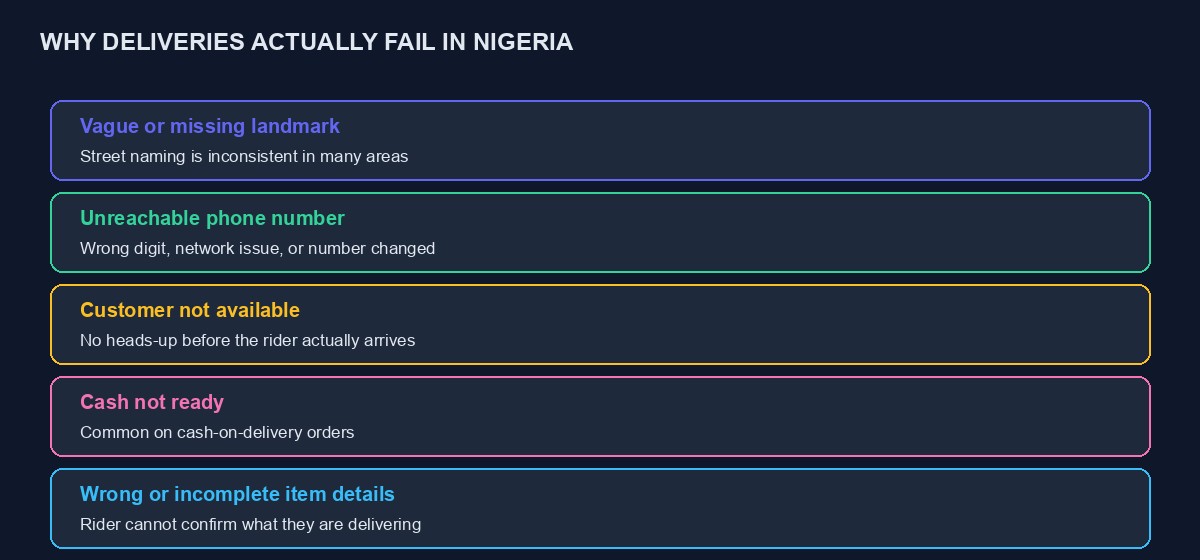
A failed delivery costs more than the wasted trip. It costs a second delivery attempt, a frustrated customer who is now less confident about ordering from you again, and, for cash-on-delivery orders, a real chance the order simply falls through entirely once the initial momentum is lost. Most failed deliveries in Nigeria trace back to a small, specific, and genuinely fixable set of causes, not to bad luck or an unreliable courier, and this guide covers each one and the concrete fix that addresses it.
Why this is worth fixing deliberately, not just accepting as normal
It is easy to treat a certain rate of failed deliveries as simply the cost of doing business, especially once it happens often enough to feel routine rather than alarming. This framing costs more than it appears to, because every failed delivery represents real money, courier fees you have often already paid, and real customer trust, since a customer whose first delivery attempt failed is measurably less likely to complete a second attempt enthusiastically than one whose order arrived smoothly the first time. Treating your failed delivery rate as a number worth actively reducing, rather than an unavoidable background cost, is where the improvements in this guide start paying for themselves.
Cause one: incomplete or unclear addresses
Formal street addressing is inconsistent across much of Nigeria, and a customer typing their address into a checkout form often gives something technically accurate and practically unfindable, a street name without a house number, an estate name without which specific block or gate. The single most effective fix is asking for a landmark explicitly, as a required field, not an optional one: the nearest well-known building, junction, or business, since this is frequently what a rider actually navigates by, far more than a formal street address alone. Make this field required at checkout rather than optional, since an optional field is one many customers skip specifically when it would have mattered most.
Cause two: an unreachable or incorrect phone number
A rider who cannot reach a customer by phone when they arrive, or when they need clarification about the address, cannot complete the delivery, and a wrong digit, a switched-off phone, or a number the customer no longer actively uses is a surprisingly common, entirely preventable cause. Validate the phone number format at checkout, and for higher-value orders specifically, consider a brief confirmation call or message before dispatch, catching a wrong or unreachable number while the order is still easy to fix, rather than after a parcel is already on the road and a failed attempt has already cost you a courier fee.
Cause three: the customer genuinely was not expecting the rider
Even with a correct address and phone number, a delivery fails if nobody is actually available when the rider arrives, and a customer who ordered days ago may have genuinely forgotten roughly when to expect it, especially if your original delivery estimate was vague. A simple, low-cost fix: send a message the day of, or the morning of, expected delivery, giving the customer real notice rather than assuming they are tracking the order's progress on their own initiative. This single habit meaningfully reduces "customer not available" as a failure cause, because it turns a delivery from something happening to the customer unexpectedly into something they are actively anticipating.
Cause four: cash not ready for cash-on-delivery orders
For orders paid on delivery, a customer without the exact or sufficient cash on hand when the rider arrives is a genuine, recurring cause of failed or awkward, delayed completions. State the exact amount due clearly in your delivery notification message, and where practical, encourage exact change or a specific, round total that is easy to have ready, since an unexpected or oddly specific amount is more likely to catch a customer without the right cash prepared than a round, clearly stated figure they had time to prepare for.
Cause five: confusion about what is actually being delivered
Particularly for orders with several items, or where a substitution happened, a rider who cannot clearly explain or confirm what is in the parcel can create hesitation or refusal at the doorstep, especially from a cautious customer wary of unsolicited deliveries, a reasonable caution given how common delivery-related scams have become. Include a clear packing note or receipt inside, or attached to, the parcel itself, and where your courier supports it, ensure the rider has basic order details available to reference, so a hesitant customer can be reassured quickly rather than the delivery stalling at the door over confusion that a moment's clarity would have resolved.
A worked example: cutting a real failure rate through small, specific changes
Picture a small business selling home décor items, experiencing failed deliveries on roughly one in six orders, a rate the owner had come to treat as simply normal for the business. Reviewing a month of failed delivery reports specifically, rather than treating them as an undifferentiated lump, reveals a clear pattern: nearly half trace to addresses missing a usable landmark, and most of the rest split between unreachable phone numbers and customers who were simply not expecting the rider that particular day.
Three specific, low-cost changes follow directly from this pattern. The checkout form gains a required landmark field, with a short example shown to guide what a useful answer looks like. A brief WhatsApp message goes out the morning of expected delivery, confirming the rider is on the way. And orders with an unreachable-looking phone number, flagged by a quick manual glance before dispatch, get a confirmation message before being sent out at all. Within six weeks, the failed delivery rate drops to roughly one in fifteen orders, not through a different, more expensive courier, but through fixing the specific, identified causes behind the failures the business was already experiencing.
Building the habit of actually reviewing failures, not just absorbing them
The example above depended on one deliberate habit worth building into any business shipping physical products: treat every failed delivery as a small, specific data point, not just an annoying, absorbed cost, and review them periodically, monthly for a smaller business, more often for a busier one, looking specifically for a pattern rather than treating each one as an isolated, unrelated incident. A pattern, once actually visible, usually points toward one or two concrete, fixable changes, exactly as it did in the example above, rather than requiring you to guess broadly at what might help.
Handling a failed delivery well when it still happens
Even with every improvement above in place, some deliveries will still fail, and how you handle that moment matters almost as much as preventing it in the first place. Reach out to the customer promptly once you learn of a failed attempt, rather than waiting for them to notice and message you first, and offer a clear, specific next step, a redelivery on a day and rough time window that suits them, rather than a vague "we'll try again." A customer whose failed delivery is handled quickly and clearly often ends up more confident in your business than one whose delivery simply succeeded quietly the first time, because a well-handled problem is a genuine demonstration of reliability that a smooth, uneventful order never gets the chance to show.
The cost of a failed delivery, made concrete
It is worth actually calculating what a failed delivery costs your specific business, rather than treating it as a vague, unquantified annoyance. Add up the courier fee for the failed attempt, whether it is refunded, discounted, or charged in full for a redelivery, the time spent by you or your team handling the resulting customer conversation, and a reasonable estimate of how much less likely that specific customer now is to order again. For many small businesses, this total is considerably higher than it feels in the moment, which is precisely why the relatively small, low-cost fixes covered in this guide, a required landmark field, a same-day notification, tend to pay for themselves quickly once measured against the real, if often unmeasured, cost of the failures they prevent.
Adjusting your approach by product type
Not every business needs every fix in this guide applied with equal weight. A business shipping small, low-value items can reasonably tolerate a slightly higher failure rate than one shipping expensive, bulky, or fragile products, where a failed delivery is more costly in every sense, and deserves the fuller set of precautions, including the pre-dispatch confirmation call, applied more consistently. Match the level of care in your own process to what a failed delivery genuinely costs for the specific products you sell, rather than applying either too little care to a high-value shipment or unnecessarily heavy process to a low-value one where it is not worth the added friction.
A note on rural and semi-urban deliveries specifically
Everything in this guide applies with extra force once you are shipping outside the major cities, where addresses are often less formal, phone reception can be genuinely patchier, and a rider may be covering a wider, less familiar area for a single delivery. If a meaningful share of your customers are in smaller towns, consider a slightly more thorough version of the confirmation habits above for those specific orders: a landmark description that is unusually detailed, a phone confirmation rather than only a message, and setting a somewhat longer, more honest delivery window from the start, since these areas genuinely take longer to serve reliably and pretending otherwise in your stated timeline sets up a promise your actual delivery experience there cannot consistently keep.
What a courier can and cannot fix on your behalf
It is worth being honest about where responsibility genuinely sits. A courier can improve their own reliability, their own communication, their own handling of a failed attempt, and choosing well among the options covered in our guide to comparing courier services for Nigerian ecommerce matters. But the specific causes covered in this guide, address quality, phone number accuracy, customer readiness, are largely within your own business's control, at the point of checkout and communication, not the courier's, and no courier, however excellent, fully compensates for an address with no usable landmark or a phone number nobody answers.
A simple checklist to add to your checkout and dispatch process
Require a landmark alongside the formal address, with a visible example of a good answer. Validate the phone number format, and consider a confirmation step for higher-value orders. Send a same-day or morning-of delivery notice rather than assuming the customer is tracking progress themselves. State the exact amount due clearly for cash-on-delivery orders. Include a clear packing note inside the parcel. And review your actual failed deliveries periodically for a pattern, rather than treating each one as an unrelated, unavoidable incident.
Where this connects to running your store well overall
Reducing failed deliveries sits alongside the wider set of habits covered in our guides to starting an ecommerce business in Nigeria and choosing a courier, and it is one of the higher-leverage, lower-cost improvements available to an established store, since the fixes above cost little beyond a small amount of attention and a few adjusted checkout fields, while the customer trust and courier fees saved compound meaningfully over months of real order volume.
If you are running your store on our ecommerce builder, proper order records and customer contact details are already captured at checkout as part of the standard flow, which makes both the landmark field and the pre-delivery notification described above straightforward to add without building custom checkout logic yourself. You can start building free to see it directly.



Comments
No comments yet. Be the first to share your thoughts.