How to Build a Rider and Delivery Management System
A rider and delivery management system is the part of a delivery business that customers never actually see, but everything depends on. It is the system that decides which rider gets which delivery, tracks where every rider actually is, and gives a business real control over its own delivery operation instead of guessing and hoping. This guide explains what a real one actually needs, in plain terms.
What this system is actually for, stated simply
At its core, this system answers three questions, correctly, every single time: which orders currently need a rider, which riders are currently free and able to take one, and which rider should actually get this specific order. Get this working correctly and reliably, and a delivery business runs smoothly. Get it wrong, and orders sit unassigned, riders sit idle nearby with nothing to do, and customers wait far longer than they should.
The real, separate pieces this system needs
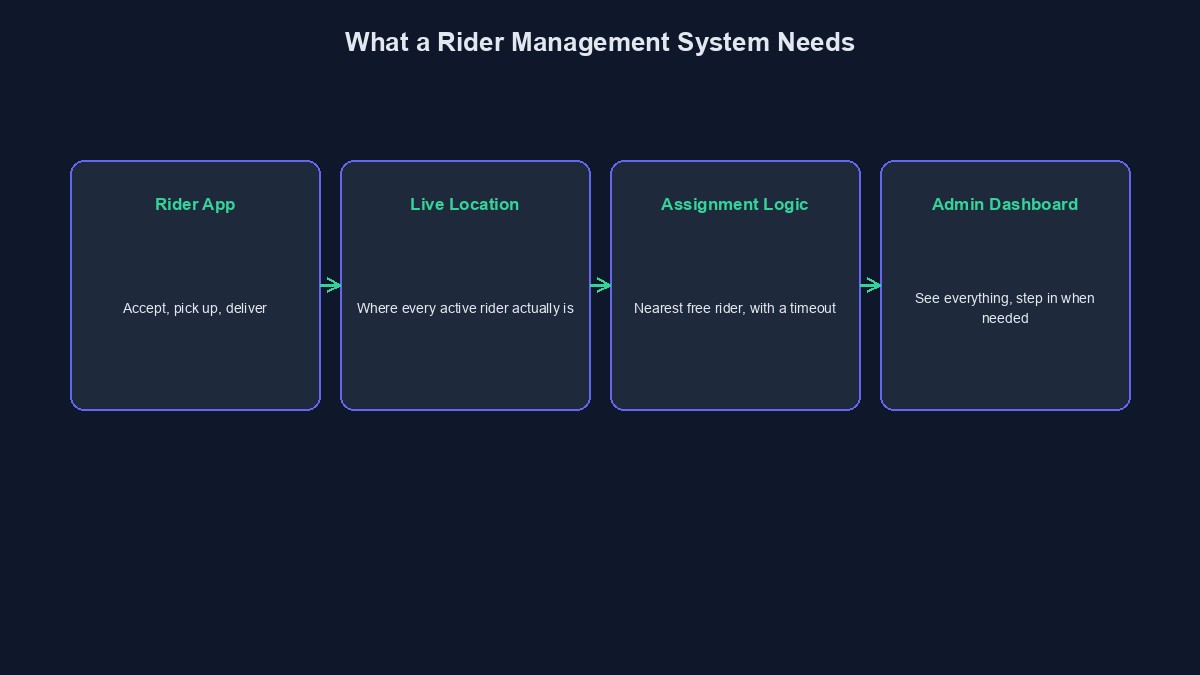
A rider app, the actual tool a real rider uses on their own phone, to see available deliveries, accept one, and mark it as picked up and later delivered. A live location system, constantly tracking where each active rider genuinely is, which is what makes accurate assignment and live tracking possible at all. An assignment system, the real logic deciding which specific rider gets offered which specific order, based on distance, current availability, and how many deliveries they are already handling. And an admin dashboard, where the business itself sees everything happening in real time, all active riders, all current orders, and can step in manually when something needs a real human decision.
How rider assignment actually works, in plain terms
The simplest, most honest approach: when a new order needs a rider, the system looks at every rider who is currently marked available and checks how far each one actually is from the pickup point. The nearest genuinely available rider is offered the order first. If they do not accept within a short window, the system offers it to the next nearest rider instead, rather than a customer's order sitting stuck waiting on one unresponsive rider indefinitely. This simple approach is genuinely good enough for most businesses starting out. More advanced systems add extra real factors, how many deliveries a rider is already juggling, how reliable that specific rider has historically been, but these are refinements worth adding once real volume actually justifies the added complexity, not requirements for a working first version.
What live tracking actually requires, technically
The rider's own phone, through the rider app, regularly sends its current location to the system while they are on an active delivery. This location is then shown, updating in close to real time, on both the customer's own tracking screen and the business's admin dashboard. This needs to work reliably even on an ordinary rider's phone with a normal, sometimes patchy, mobile data connection, which is a real, practical engineering consideration, not just a theoretical one, particularly in areas with less reliable network coverage.
Handling the situations that inevitably go wrong
A rider's phone loses signal or battery mid-delivery, genuinely and regularly. A rider accepts an order and then, for a real reason or not, cannot actually complete it. A customer is not reachable or not present at the delivery address when the rider genuinely arrives. A real system needs honest, clear ways to handle each of these, reassigning a stuck order to another rider after a reasonable timeout, giving the business's own admin dashboard a way to manually intervene directly, and a clear, defined process for what a rider should actually do when a delivery genuinely cannot be completed as planned.
Paying riders: a real, separate part of this system
Riders need to be paid accurately and on a schedule they can genuinely trust, based on real completed deliveries, and a proper system tracks this automatically rather than relying on manual, error-prone calculation after the fact. Whether riders are paid per delivery, a fixed rate plus a distance-based bonus, or some other genuine structure, the system should calculate this correctly and transparently, since riders who do not trust they are being paid accurately do not stay, and a delivery business's entire operation genuinely depends on riders who want to keep working for it.
Why a spreadsheet stops working sooner than most businesses expect
Many small delivery businesses genuinely start by tracking riders and orders in a spreadsheet, or a WhatsApp group, and this can honestly work for the very first handful of riders. The real problem shows up quickly as volume grows: no one has a live, accurate view of who is actually free right now, orders get assigned late or twice by accident, and customers get no real tracking at all. The point at which a real system genuinely becomes worth building is usually earlier than most founders expect, often once a business has more than a small handful of riders working at the same time.
A worked example: a realistic first version
Picture a small delivery business starting with around ten riders in one specific city area. A realistic, honestly scoped first version of their management system includes a simple rider app for accepting and completing deliveries, live location tracking that works reliably even on modest, ordinary Android phones, straightforward nearest-available-rider assignment, and an admin dashboard clearly showing every active rider and every current order at a glance. Advanced features, a rider performance-scoring system, automatic dynamic pricing based on real-time demand, are deliberately left for a genuine later phase, once this core system is actually proven working reliably with the business's real, initial group of riders and real customers, rather than attempting every advanced feature before the basics are even solid.
Mistakes that undermine this kind of system specifically
Building an overly complex assignment algorithm before you have enough real riders and real order volume for it to actually matter. A simple, honest nearest-available approach is often genuinely sufficient at real early-stage scale.
No real, functioning way for a business's own admin to manually intervene when something goes wrong. Automation genuinely helps at scale, but a human still needs a real, working way to step in when a specific situation the automated logic did not anticipate comes up.
Underestimating how much a patchy mobile connection affects real-world location tracking. A system that only works flawlessly on a strong, stable connection will fail regularly in real, everyday conditions many riders actually work in.
Paying riders manually and inconsistently instead of building accurate payment tracking directly into the system from the start. This is one of the fastest ways to genuinely lose good, reliable riders to a competitor who pays them more consistently and transparently.
A short glossary
Assignment system: the logic deciding which available rider gets offered a specific delivery order. Live tracking: continuously showing a rider's real, current location as they move, both to the customer and the business. Admin dashboard: the internal tool a business uses to see and manage all active riders and orders in real time. Timeout: a set time limit after which an unaccepted order is automatically offered to a different rider instead.
Where to go from here
Our companion guide to how much a delivery app actually costs covers the real budget side of a system like this. A genuine rider and delivery management system, built specifically for your real riders, your real city, and your real order volume, is a custom software project, and our development team is the right place to bring your actual, specific requirements for an honest, grounded conversation rather than a generic estimate.

Comments
No comments yet. Be the first to share your thoughts.