How Much Does It Cost to Build an App Like Uber?
"How much would it cost to build an app like Uber" is one of the most common questions a software agency hears, and it is also one of the hardest to answer honestly with a single number, because "an app like Uber" can mean a dozen genuinely different things depending on how much of Uber's actual complexity you really need. This guide breaks the real cost down honestly, piece by piece, instead of throwing out one made-up figure.
Why "an app like Uber" is not really one single app
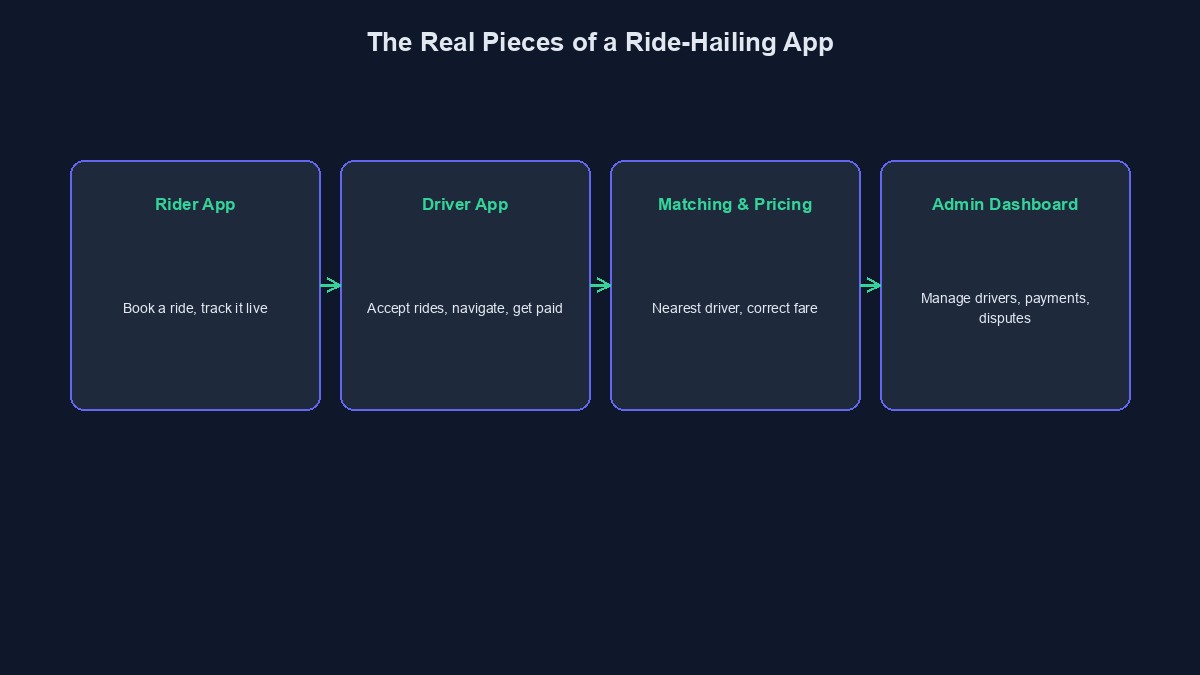
A real ride-hailing app is actually at least three separate apps working together, a rider app for customers to book a ride, a driver app for drivers to accept and complete rides, and an admin dashboard for the business to manage everything, drivers, payments, disputes, in one place. Each of these is a real, separate piece of software, and the total cost is really the cost of all three combined, plus the system connecting them.
The genuinely hard, expensive parts, named honestly
Live GPS tracking, showing a rider exactly where their driver is in real time on a moving map, sounds simple as a user but is genuinely complex to build correctly and keep reliable at real scale. Matching a rider to the nearest available driver quickly and fairly is its own real algorithm, not a simple database lookup, and getting it wrong means riders waiting too long or drivers being unfairly skipped. Real-time price calculation, including surge pricing during high demand, needs careful, correct logic, since getting a fare wrong is a direct, immediate money problem for your business. And a real, reliable payment system, handling both digital payments and cash, with a clear system for how and when drivers actually get paid out, is a genuinely serious piece of financial software on its own.
What genuinely changes the price, in order of real impact
How many cities or areas you plan to launch in first, since real-world map data and driver density needs differ by area. Whether you need both a rider and driver app for two platforms each, Android and iPhone, effectively doubling some of the mobile development work unless you use a genuinely good cross-platform approach. How much of the safety and trust features, driver background verification, an in-app SOS button, trip-sharing with a contact, you build in from day one versus adding later. And how polished and fully-featured the admin dashboard needs to be for your specific team's real day-to-day operations.
Three realistic tiers, honestly described
A genuinely minimal version, one city, core booking and tracking only, basic payment, a simple admin panel, sits at the lower end of this category but is still a real, substantial software project, not a quick build. A more complete version, adding proper safety features, better driver tools, more robust payment handling and reporting, moves meaningfully higher. A version genuinely competing at real, multi-city scale, with the reliability, safety features, and operational tooling that level of business actually needs, is a serious, major software investment, closer to what a real, funded transportation company would budget for, not a starter project.
Why the real Uber itself is a poor benchmark for your actual cost
Uber has spent well over a decade and enormous sums building, testing, and refining exactly this system at global scale, across regulatory environments, payment systems, and languages worldwide. Your actual need is almost certainly a real, working version for your specific city or region, not a global-scale clone, and pricing your project against Uber's entire existing infrastructure produces a wildly inflated, unrealistic number that has little to do with what you actually need to launch and start operating.
The ongoing costs many first-time founders forget to budget
Live map and location services from a provider like Google Maps genuinely cost real, ongoing money at scale, priced by usage, not a one-time fee. SMS and notification costs for ride confirmations and driver alerts add up steadily as your ride volume grows. And ongoing development, fixing bugs, improving the matching algorithm, adding features real drivers and riders actually ask for, is a genuine, continuous cost long after the first version launches, not a one-time expense that ends at launch.
The legal and regulatory side, worth knowing about early
Ride-hailing is genuinely regulated in Nigeria, and this differs from state to state. There are real requirements around driver licensing, vehicle standards, and how the business itself operates legally in a given state. This is not a technical cost, but it is a real cost and a real delay if ignored until after the app is built. Looking into your specific state's actual requirements early, before spending heavily on development, avoids a painful, expensive surprise later.
A worked example: scoping a realistic first version honestly
Picture a founder wanting to launch a ride-hailing service in one specific Nigerian city, rather than attempting a national or multi-country launch immediately. A realistic, honestly scoped first version includes rider booking, live driver tracking, a straightforward matching system, and payment through a real, established Nigerian payment gateway rather than a custom-built payment engine. Surge pricing, advanced analytics, and multi-city support are deliberately left out of this first version, planned honestly as a second phase once the core service is actually proven working with real drivers and real riders in one real market, rather than trying to build every possible feature before ever testing whether the core idea genuinely works.
Mistakes that inflate cost or waste money in this category specifically
Trying to build every feature Uber has before launching anywhere. This delays getting real feedback from real users by months or years, for features a huge share of which may not even matter for your specific market.
Underestimating the ongoing cost of maps and location services. This is not a one-time fee; it scales with real usage and needs a genuine place in your ongoing budget, not just your launch budget.
Skipping driver verification and safety features to save on early cost. This is one of the worst places to cut corners, since it directly affects real rider and driver safety and trust.
Assuming one developer can realistically build all three real apps, rider, driver, and admin, alone in a short timeframe. This is a genuinely large, multi-part project, and treating it as a quick solo build usually produces a rushed, unreliable result.
A short glossary
Matching algorithm: the logic deciding which available driver gets offered a specific ride request. Surge pricing: automatically raising the price during high demand or low driver availability. Admin dashboard: the internal tool a business uses to manage drivers, rides, payments and disputes. Cross-platform development: building one app that works on both Android and iPhone from largely the same codebase, rather than two fully separate native apps.
Where to go from here
Our broader guide to how much an app costs in Nigeria covers the general cost factors this ride-hailing-specific guide builds on top of. A real ride-hailing platform, rider app, driver app, and admin dashboard together, is a genuine custom software project, and our development team is the right place to have a real, specific conversation about your actual city, your actual scale, and your actual budget, rather than working from a generic, one-size-fits-all quote.

Comments
No comments yet. Be the first to share your thoughts.