Is ChatGPT Banned on WhatsApp Business? What Actually Changed in 2025
Somewhere between late 2025 and early 2026, a lot of businesses that had happily connected ChatGPT to their WhatsApp number got a real, unwelcome surprise. Meta changed the rules, and "ChatGPT on WhatsApp" stopped meaning what most people assumed it meant. Here is what actually changed, honestly, and what it really means if you are running a business on WhatsApp today.
The short, honest answer
ChatGPT itself, offered as an open, general-purpose assistant you can message directly on WhatsApp and ask literally anything, is genuinely restricted under Meta's current WhatsApp Business API terms. A business-built chatbot that happens to use an AI model internally, to help draft replies to specific, recognised customer questions, order status, appointment booking, FAQs, is not restricted at all, and remains explicitly, specifically allowed. The distinction is not "AI versus no AI," it is "an open-ended AI assistant as the whole product" versus "AI as one internal tool inside a scoped business chatbot."
What actually happened, and when
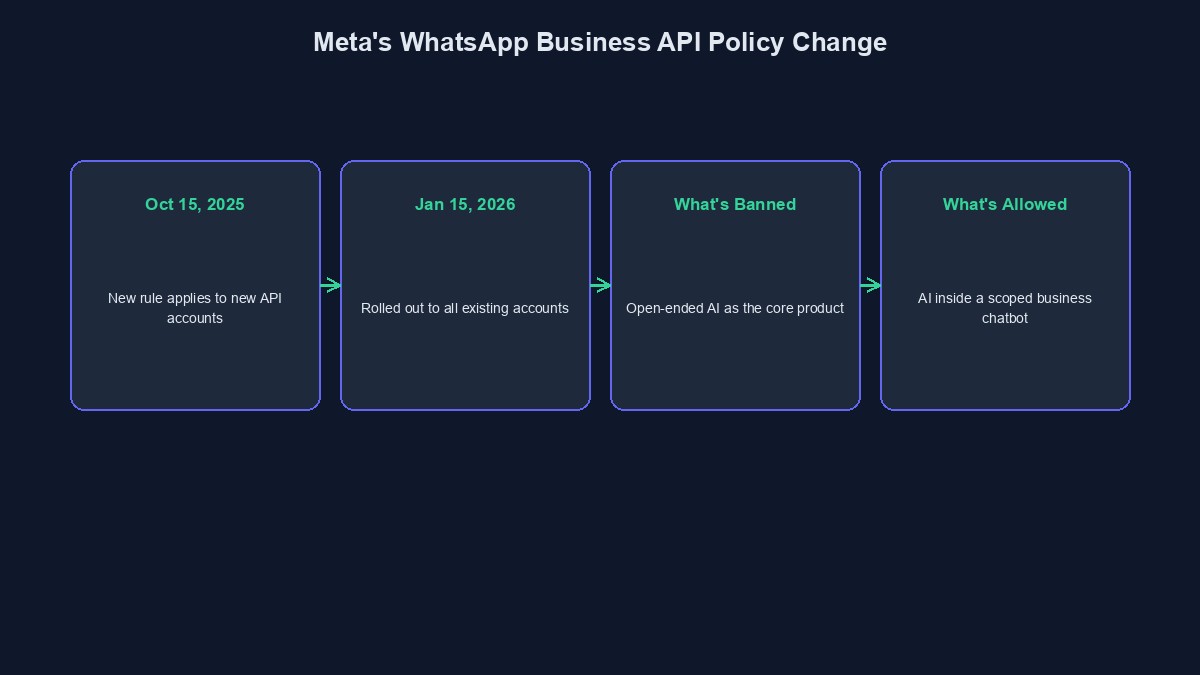
Meta updated the WhatsApp Business API's terms, introducing a new restriction on general-purpose AI assistants, systems built to hold open-ended conversations on any topic, generate general text, or act as a broad personal assistant, rather than a defined business function. The new terms applied to new WhatsApp Business API accounts from 15 October 2025, and rolled out to existing accounts by 15 January 2026, meaning that by now, every business on the platform operates under the new rules, not just new signups.
What Meta actually banned, specifically
The restriction targets general-purpose AI products, companies whose core offering is the AI assistant itself, ChatGPT, Claude, Perplexity, and similar tools, being distributed through WhatsApp as an open channel to chat with them directly. It is aimed at the pattern of "message this number and talk to an unrestricted AI about anything," not at businesses using AI as a supporting feature inside their own, purpose-built customer service.
What genuinely remains allowed, specifically
A retailer's order-status bot, a clinic's appointment-reminder system, a support team's ticket-triage automation, each of these can genuinely use AI internally to help draft a natural-sounding reply, and none of them are affected by this restriction, because the AI is a supporting part of a defined business function, not the entire, open-ended product itself. Meta has been explicit that this move does not affect businesses using AI to serve customers on WhatsApp in this scoped way.
Why Meta actually made this change
The reasoning, based on what has been publicly reported, comes down to two real, practical business concerns rather than a safety-first decision alone. Open-ended AI assistants generated a genuinely large volume of messages, placing real strain on WhatsApp's own infrastructure. And WhatsApp's business model runs on template-based message pricing, which a freeform, open-ended AI conversation does not naturally fit into, meaning Meta was not able to monetise that traffic the way it does structured business messaging.
The regulatory pushback, honestly acknowledged
This change did not land without real friction. The European Commission opened an investigation into whether restricting rival AI assistants' access to WhatsApp, an infrastructure previously open to third parties, amounts to anti-competitive behaviour, and Italy's own regulator separately told Meta to suspend the policy there specifically. This is a genuinely live regulatory dispute in parts of the world, not a fully settled matter everywhere, and a business operating in, or serving customers in, the European Union specifically should watch this space rather than assume the global policy applies identically everywhere without exception.
What this actually means for your business, practically
If your current setup routes WhatsApp messages into an open, general-purpose AI assistant with no real scope or restriction on what it can be asked, that pattern is the one genuinely at risk under the current policy, regardless of which AI model sits behind it. If your setup is a defined chatbot, answering specific business questions, checking real order data, booking real appointments, using AI as one internal tool rather than the entire experience, you are very likely already on the right side of this, and no action is actually needed beyond making sure that scope genuinely stays defined rather than quietly drifting into open-ended territory over time.
A worked example: the same business, before and after
Picture a business that, in mid-2025, set their WhatsApp number up to forward every incoming message straight into ChatGPT and reply with whatever it generated, genuinely useful, but also genuinely open-ended, since a customer could ask it literally anything, including things entirely unrelated to the business. After the policy change, the same business restructures this into a defined bot: recognised order-status questions get a real, data-backed answer; recognised FAQ questions get an AI-drafted, pre-approved reply; anything else gets handed to a real person. The second version is not just compliant, it is genuinely a better customer experience, since it no longer occasionally answers an unrelated question with confident, irrelevant nonsense.
Mistakes worth avoiding
Assuming "we use AI" automatically means you are affected. The restriction targets open-ended, general-purpose assistants specifically, not AI used as a tool inside a defined business function.
Assuming the European situation is fully, permanently settled. Regulatory pushback in the EU and Italy specifically was real and ongoing as of this writing, and a business with EU exposure should keep watching this, not assume the global policy is the final word everywhere.
Doing nothing because "it probably does not apply to us." If your bot's actual scope has quietly drifted toward open-ended over time, this is worth an honest, specific check, not an assumption.
A short glossary
General-purpose AI assistant: an AI positioned as the core, open-ended product itself, able to discuss essentially anything, the specific pattern now restricted on WhatsApp's Business API. WhatsApp Business API: the official, business-grade way of connecting WhatsApp to your own systems, distinct from the regular consumer WhatsApp Business app. Template-based messaging: WhatsApp's structured, pre-approved message format, central to how the platform prices and monetises business messaging.
Where to go from here
Our practical guide to using ChatGPT for customer service on WhatsApp covers exactly how to build the kind of scoped, compliant setup this guide describes. And if you want a purpose-built WhatsApp bot already built around this exact distinction, rather than assembling the compliance details yourself, you can start building free and see it directly in your dashboard.
Comments
No comments yet. Be the first to share your thoughts.