What Should You Own After Paying a Developer to Build Your Website?
You paid a developer. The website is live. So the website is yours, right? Many people assume so, and in daily life it feels true. But "I paid for it" and "I legally own all of it" are not always the same thing, and the difference matters the day you want to change developers, sell your business or have a dispute. This guide explains, in plain words, what you should own, what you usually will not, and how to make sure it is written down. This is general information and not legal advice.
The surprise most people get
When someone creates something original, like code or a design, the copyright generally starts with that person. Paying them does not automatically move it to you. Many countries work this way, and the safe assumption in Nigeria is the same: copyright starts with the creator, and a transfer of copyright needs to be in writing. That means that without a signed agreement, the developer may still hold the copyright to the code they wrote for you, and you may only have the right to use it. In practice, many developers never make trouble about this. But "they probably will not" is a weak foundation for a business asset.
What you should own
These are the things that should be yours when the project is paid for, and your agreement should say so.
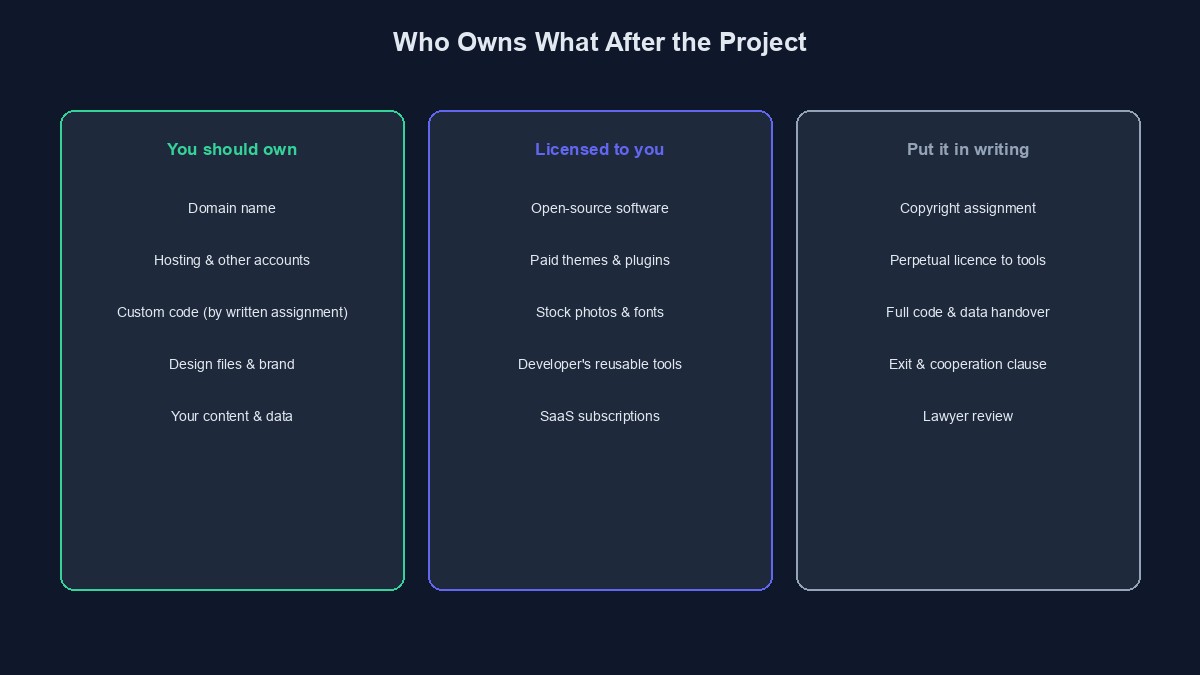
- The domain name. Registered in your name, with your email.
- The hosting and other accounts. Hosting, DNS, email, analytics, payment gateway and messaging accounts, held by you.
- The custom code written for you. By a written assignment of the copyright from the developer to you, usually effective once you have paid in full.
- The design files and your brand. Logo files, design source files and any artwork created for you.
- Your content. The text, photos and videos you supplied or paid to have created.
- Your data. Customer lists, orders, messages and records, plus the right to export them.
- Credentials and keys. Logins and API keys for everything the site uses.
- Backups and documentation. A copy of everything, plus the written instructions.
What you usually will not own, and that is normal
Open-source software. Most modern websites are built on free tools and libraries that belong to their original authors and come with a licence. A developer cannot give you ownership of those. You get the right to use them under their licence, which is usually generous.
The developer's own reusable tools. Developers often have personal code libraries they use on every project. A common and fair arrangement is that they keep ownership of those, and you receive a permanent, unrestricted licence to use them within your project. Ask for the words "perpetual" and "irrevocable" so they cannot be taken away later.
Paid themes, plugins and stock images. You buy a licence, not ownership. Make sure the licence is in your name and covers commercial use. Check the rules before using stock photos or music, as some licences are limited.
Software-as-a-service tools. If your site runs on a subscription platform, you rent it. That is a legitimate choice, but know that you are renting.
When does ownership pass to you?
Commonly, ownership of the custom work is transferred when you have paid the full amount. That protects the developer from non-payment and is reasonable. The important thing is that the clause exists, says so clearly, and that the transfer happens automatically, without the developer having to agree again later.
Get it in writing, in plain language
A simple agreement should cover at least these points: what is being built; the total price and payment dates; that copyright in the custom work passes to you on full payment; that you receive a licence to any pre-existing tools or third-party parts the developer uses; that the domain, hosting and accounts are in your name; that you get the full code, data and access at the end; and how either side can end the agreement. Nothing here needs complicated words. If the project is important, have a Nigerian lawyer review or draft it. Ten minutes of a lawyer's time is cheap compared with a dispute.
Be careful with "we agreed on WhatsApp"
Chat messages can show intention, but they are a weak and messy way to settle ownership. A short signed document is much stronger. If you already have a project without an agreement, ask the developer for a simple written confirmation of ownership now. Most will sign it, and it is far easier before a quarrel than after.
A quick example
Illustrative example: the people, businesses and numbers in this section are made up to show how this works. They are not real clients or real results.
A founder in Lagos built a delivery app with a freelancer, paid in full, and never signed anything. Two years later an investor asked, "Do you own the code?" Neither of them could prove it. He spent weeks tracking down the freelancer and getting a signed assignment, and nearly lost the deal. If the clause had been in the original agreement, it would have taken a minute.
Common mistakes
Assuming payment equals ownership. It often does not, without a written transfer.
Leaving accounts in the developer's name. Domain and hosting are the two most expensive things to recover later.
Ignoring licences. Using a theme or image outside its licence can lead to demands for payment, or to takedowns of your site.
Short glossary
Copyright: the legal right to control copying and use of an original work. Assignment: a written transfer of copyright from one person to another. Licence: permission to use something without owning it. Open source: software released with a licence that lets others use it freely, under stated terms.
Where to go from here
To make sure ownership comes with real access, see what a developer should hand over. To avoid being tied to one person, read how to avoid developer lock-in. And if you are planning a custom project with us, send a request and ask us the same ownership questions you would ask anyone else. Get the answers in writing.

Comments
No comments yet. Be the first to share your thoughts.