Why WhatsApp Catalog Doesn't Work in Nigeria (And What to Use Instead)
If you have ever tried to find WhatsApp's Catalog feature on your own Nigerian business account and quietly assumed you were simply looking in the wrong place, you were not doing anything wrong. WhatsApp's native Catalog, the feature letting a business showcase products directly inside the app with photos, prices and descriptions a customer can browse without leaving the chat, genuinely is not available in Nigeria, or across most of Africa, at the time of writing. This is surprisingly rarely explained clearly anywhere, and this guide covers exactly why, what you can actually use instead, and how to build a genuinely good WhatsApp-based product browsing experience despite the gap.
Confirming this is genuinely a platform gap, not something you are missing
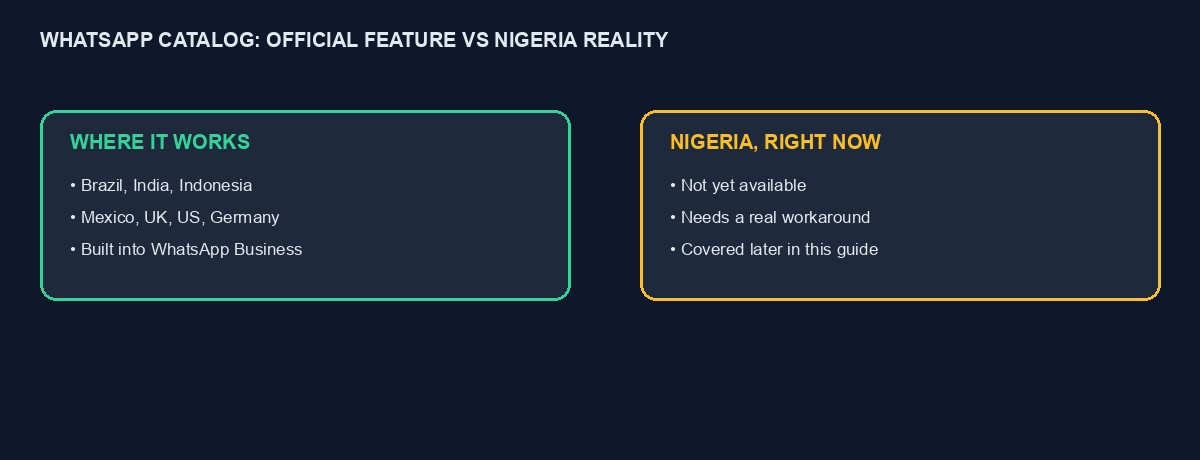
WhatsApp's official Catalog feature has rolled out region by region since its introduction, currently available in a specific set of markets, Brazil, India, Indonesia, Mexico, the UK, the US and Germany among them, with no official presence yet across Africa broadly, Nigeria included. This is a genuine platform limitation, not a settings toggle you have missed or a feature restricted to a paid tier you have not unlocked, and no amount of searching your own WhatsApp Business app's settings will surface a Catalog option that Meta has not yet enabled for accounts registered in this region.
Why this matters more in Nigeria than it might elsewhere
Given how thoroughly WhatsApp dominates Nigerian business communication, covered throughout our broader guides on WhatsApp bots and Nigerian ecommerce, this specific gap has a real, practical impact: a customer messaging a Nigerian business on WhatsApp, wanting to browse what is available before committing to a specific question, has no native, built-in way to do this the way a customer in a market with Catalog access does. This has genuinely shaped how Nigerian WhatsApp commerce works in practice, with sellers sending individual product photos one at a time in a chat, or directing customers to check a separate website or Instagram page, neither of which is as smooth as a native, built-in browsing experience would be.
Option one: link WhatsApp directly to your actual website's product pages
The most durable, fully-controlled approach is treating your own website as the real catalogue, and using WhatsApp specifically as the fast, low-friction conversation channel that follows from it. A WhatsApp button on each product page, opening a chat with a message pre-filled to reference that specific product, "Hi, I'm interested in the blue ceramic vase," gives a customer browsing your actual, full catalogue on your website a frictionless way to move straight into a real conversation about a specific item, without needing WhatsApp itself to host the browsing experience at all. This approach keeps your product catalogue in a system you fully own and control, our own ecommerce builder supports this pattern directly, rather than depending on a third-party workaround tool that could change its terms or pricing at any point.
Option two: a dedicated WhatsApp-catalogue workaround tool
A number of smaller, Nigeria and Africa-focused platforms have built specifically to fill this exact gap, letting you upload a product catalogue to their own system, which then generates a shareable, browsable link or interface customers can view, with orders routed back into WhatsApp for the actual conversation. These tools genuinely solve the immediate problem and are worth considering for a seller who wants a catalogue-browsing experience quickly without building a full website first, with the honest trade-off that you are now depending on a third-party platform for your product catalogue's presentation, worth weighing against simply building this into your own website from the start if you are planning a more established, longer-term online presence anyway.
Option three: structured, consistent manual sharing
For a smaller seller not yet ready for either a full website or a dedicated catalogue tool, a disciplined, consistent manual approach still works reasonably well: a well-organised set of product photos, saved and ready to send in response to specific enquiries, each with a clear, consistent caption stating the price and key details, sent promptly rather than searched for under time pressure each time a customer asks. This is genuinely more labour-intensive than either of the tooled options above and remains a perfectly workable starting point for a very small operation, provided the organisation and consistency are genuinely maintained rather than degrading into a disorganised camera roll nobody can navigate quickly under real customer pressure.
Building a genuinely good browsing experience despite the gap
Whichever approach you choose, a few habits meaningfully improve the actual customer experience regardless of the underlying tool. Keep product photos genuinely consistent in style and quality, so a customer scrolling through several feels they are looking at a coherent business rather than a scattered, informal collection. State prices clearly and consistently in every single product message or listing, since hidden or inconsistently stated pricing is one of the fastest ways to lose a hesitant customer's trust. And respond to a product enquiry quickly, since the entire point of routing customers through WhatsApp in the first place is the immediacy it offers, an advantage entirely lost if responses actually take hours.
What "Catalog not being available" actually looks like in practice
Concretely, this means a few specific things a Nigerian business account genuinely cannot do that a business in a supported market can. There is no native tab inside a customer's chat with your business showing a scrollable grid of your products with prices attached. There is no way for a customer to tap a product directly from within WhatsApp and add it to a cart that stays inside the app. And there is no way for your own WhatsApp Business app to display an organised, built-in storefront view when a customer visits your business profile, beyond your business description and a short list of basic details. Understanding these specific absences precisely helps you evaluate any third-party tool claiming to solve this honestly, since some workaround tools genuinely replicate a browsable, structured experience close to the native feature, while others simply generate a shareable image or PDF that is not meaningfully different from sending photos manually.
Evaluating a third-party catalogue tool properly before committing
If you are considering one of the dedicated Nigeria-focused catalogue workaround tools, apply the same evaluation discipline covered throughout our broader guides to choosing any third-party service: check what happens to your product data and any order history if you stop paying or the service becomes unavailable, confirm whether the actual customer-facing experience feels genuinely smooth on a real phone, on real mobile data, not just in the tool's own polished demo, and check the tool's actual current pricing structure carefully, since some charge a flat fee, others a percentage of sales processed through them, which meaningfully changes the real, ongoing cost depending on your actual volume. Test it with a handful of your real products and a real, deliberately unfamiliar test customer, exactly the same discipline covered throughout our other technical guides, before committing your entire product catalogue to any single third-party workaround.
A note on WhatsApp Business API catalogs, a separate, distinct feature
It is worth being precise here, since there is a genuinely separate, related feature that can cause confusion: businesses using the official WhatsApp Cloud API, covered in our guide to the WhatsApp Cloud API, can, through the API directly, send structured product messages and, in supported configurations, reference a product catalogue programmatically, which is a different, more technical capability from the simple, native Catalog tab available to ordinary WhatsApp Business app users in supported markets. This API-level capability's actual availability and behaviour specifically for Nigerian-registered business accounts is worth verifying directly against Meta's current, official documentation before building a product around an assumption, since platform capabilities in this specific area continue to evolve and a claim accurate at the time of writing may shift.
Keeping customers informed about how to browse, clearly
Whichever approach you settle on, make it genuinely obvious to a new customer how to actually see what you sell, rather than assuming they will figure it out. A clear line in your WhatsApp business profile description, "see our full range at [your website link]," or a pinned message at the top of new conversations pointing toward your chosen browsing solution, removes the guesswork a customer would otherwise face, arriving in your chat and not immediately knowing whether to ask a general question, wait for you to send photos, or look somewhere else entirely for your actual product range.
A worked example: an imagined fashion seller's transition
Picture a small fashion seller who had been managing product enquiries entirely through individually sent photos in WhatsApp chats, a system that worked reasonably well at low volume and became genuinely unmanageable once daily enquiries grew past a certain point, with photos misplaced, inconsistent pricing occasionally quoted from memory, and a growing backlog of unanswered messages during busy periods.
Building a simple website specifically to host the full, organised product catalogue, with a WhatsApp button on every individual product page pre-filled to reference that specific item, moves the actual browsing burden off WhatsApp entirely while keeping the fast, familiar conversation channel Nigerian customers genuinely prefer for the final question and purchase decision. Enquiries now arrive already referencing a specific, known product, considerably faster to respond to than an open-ended "do you have anything nice," and the seller reports spending noticeably less time per enquiry despite a higher overall volume, since the website is now doing the browsing work that used to consume real, individual attention for every single customer.
A short checklist for a solid WhatsApp product experience right now
Decide explicitly which of the three approaches, your own website with pre-filled WhatsApp links, a dedicated third-party catalogue tool, or disciplined manual sharing, genuinely fits your current business size and stage, rather than drifting into whichever felt easiest to start without a deliberate choice. Keep pricing consistent across every channel you use. Respond quickly, since speed is the actual advantage WhatsApp offers over a pure website. State clearly, in your profile or an opening message, how a customer should actually browse your range. And if you are relying on a third-party workaround tool, know your exit plan, what you would do and how quickly you could rebuild your catalogue elsewhere, before you genuinely need it.
Mistakes to avoid working around this gap
Assuming Catalog will simply arrive in Nigeria soon and waiting for it. There is no announced or confirmed timeline for this, and building your current business around a feature that may not arrive for years, if ever, in this specific region is a poor bet against your own actual, present customer experience.
Inconsistent pricing across different channels or messages. A customer who receives one price in a chat and finds a different one on your website loses trust immediately, and consistency across whatever combination of channels you use matters more than which specific workaround you chose.
Treating a third-party catalogue tool as a permanent, risk-free foundation. A smaller, newer platform can change pricing, restrict features, or in the worst case shut down, and building your entire product presentation around one without a plan for what you would do if it disappeared is a real, if often overlooked, business continuity risk.
Where this connects to your wider online presence
This gap is really one specific instance of a broader theme covered throughout our guides to starting an ecommerce business in Nigeria and getting more customers online: WhatsApp is an excellent, high-trust conversation channel for Nigerian customers, and it is not, currently, a complete storefront on its own. A proper website, with WhatsApp integrated as the fast path to a real conversation rather than asked to be the entire browsing experience, remains the more durable, fully-controlled foundation.
Our ecommerce builder gives you exactly this combination, a full product catalogue you control entirely, with WhatsApp buttons built into every product page, and you can start building free to see it directly.



Comments
No comments yet. Be the first to share your thoughts.