Best Courier Services for Ecommerce in Nigeria, Compared
Ask ten Nigerian online sellers which courier they use and you will get ten different, confidently held opinions, usually formed from one specific bad experience with a competitor rather than a careful comparison. This is understandable, because delivery is the part of running an online business that happens furthest from your own control, in someone else's hands, on someone else's schedule, and a single bad experience leaves a strong impression. This guide is a genuine comparison, covering what actually matters when choosing, the honest trade-offs of the major options, and how to actually test a courier before committing your whole business to them.
Why "which courier is best" is the wrong question
There is no single best courier for every Nigerian online business, because the right choice depends entirely on what you sell, where your customers are, and how they prefer to pay. A courier that excels at same-day delivery within Lagos may be a poor fit for a seller whose customers are spread across a dozen smaller towns. A courier built around cash-on-delivery collection may charge a premium a fully prepaid business does not need to pay. Rather than asking which courier is objectively best, ask which courier is the best match for your specific delivery pattern, and compare candidates against that specific pattern rather than a generic reputation.
The major categories of courier available
National logistics companies with wide physical networks. Companies like GIG Logistics and Red Star Express have built extensive branch networks across the country over years, which gives them genuine reach into smaller towns that newer, tech-first couriers often have not yet covered. Their tracking and technology can feel less polished than newer competitors, and pricing is often less transparent upfront, but their actual physical coverage is frequently their strongest asset for a seller shipping nationwide.
Tech-first, app-driven delivery services. A newer wave of logistics companies has built their business around a smoother technology experience, real-time tracking, easier booking through an app or API, and often more transparent, calculator-based pricing. Their physical coverage tends to be strongest in major cities and can thin out noticeably in smaller towns, which is worth testing directly against your own actual customer locations rather than assuming national coverage from a polished website.
International couriers for cross-border shipping. DHL, FedEx and similar international operators are the right choice specifically when you are shipping outside Nigeria, and a poor, expensive choice for purely domestic delivery, where their pricing structure is built for a different kind of shipment entirely.
Aggregator platforms that compare several couriers at once. Some newer services sit on top of several couriers simultaneously, letting you compare price and estimated time across multiple providers for a specific route before booking, which can be genuinely useful for a seller without a strong existing preference, though it adds a layer between you and the actual courier that can complicate resolving a problem directly.
What actually matters when comparing, beyond the marketing page
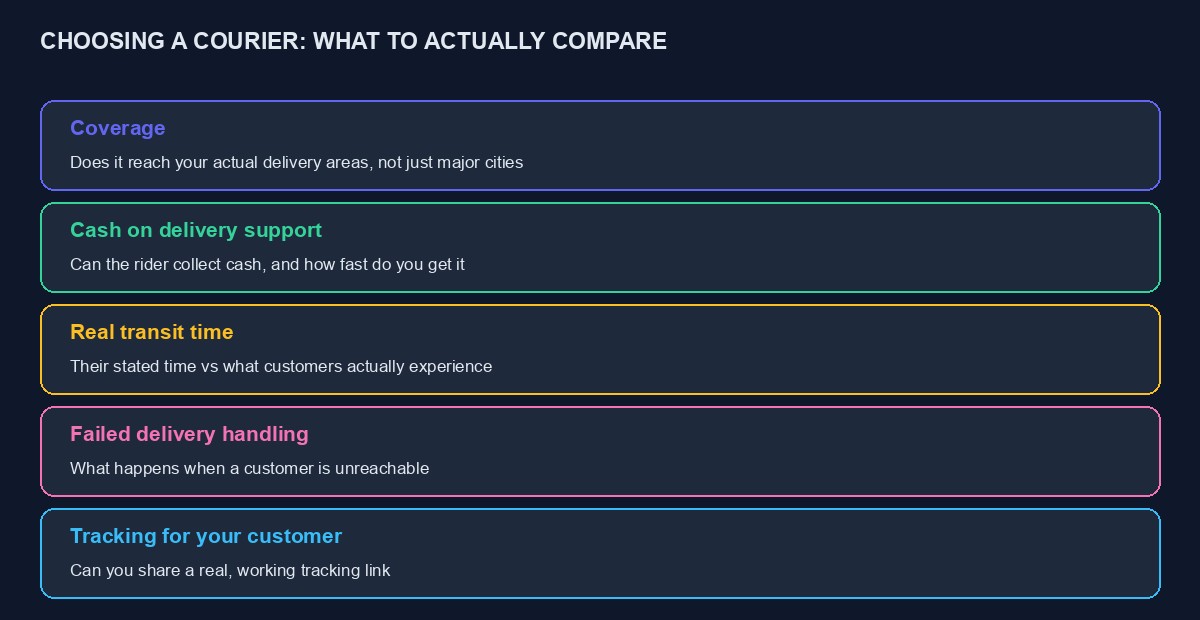
Coverage of your actual delivery areas. Not a general claim of "nationwide coverage," but specifically whether they reliably reach the towns and areas your real customers are actually in. Ask directly, by name, for the specific areas you ship to most, rather than accepting a vague confirmation.
How they handle cash on delivery, if you offer it. Confirm specifically how quickly collected cash reaches you, since some couriers settle this weekly, some faster, and a slow settlement cycle ties up your own cash flow in a way that matters more the more of your sales go through cash on delivery.
Real transit time, not stated transit time. A courier's own website will state an optimistic delivery window. Ask other sellers, ideally ones shipping similar routes, what they actually experience, since the gap between stated and real transit time is frequently the single biggest source of customer complaints that are not actually your fault.
What happens when a delivery fails. A customer who does not answer their phone, an incorrect address, a genuinely undeliverable parcel: ask specifically what the courier's process is, whether the parcel is returned to you, held, or simply lost from communication, since this detail matters far more than it seems until the first time it actually happens to one of your orders.
Whether you can offer real tracking to your customer. A tracking link that actually works and updates meaningfully reduces the number of "where is my order" messages you personally have to handle, and a courier whose tracking is unreliable or rarely updated pushes that entire customer service burden back onto you.
A simple, real test before committing your whole business
Before choosing a single courier exclusively, run a genuine, deliberate test: send the same kind of parcel you actually sell, to a handful of real addresses matching your actual customer spread, through two or three candidate couriers simultaneously, and track the real experience of each, not just the price quoted. Note the actual delivery time against the stated one, whether tracking updates meaningfully, and how their customer service responds if you contact them about the shipment mid-transit. This costs a small amount of real money and time, and it tells you more about which courier actually fits your business than any amount of reading reviews or asking other sellers, whose delivery pattern may be meaningfully different from yours.
Pricing: what to actually compare
Courier pricing in Nigeria commonly depends on weight, distance, and sometimes declared value, and comparing two couriers fairly means comparing quotes for your actual, real shipment profile, not a generic small parcel, since the pricing curve can shift meaningfully at different weights and distances. Ask for a quote covering your typical order, and if your product range varies significantly in size or weight, get quotes across that real range rather than assuming one number represents your typical cost.
Using more than one courier, and when that genuinely makes sense
Many established Nigerian online sellers eventually use more than one courier, routing by destination, a national logistics company for smaller towns their newer competitor does not reach well, and a faster, tech-first service for major-city same-day delivery. This adds real operational complexity, managing two relationships, two sets of tracking links, two support contacts, and it is worth the complexity only once your volume and geographic spread genuinely justify it, rather than adopting it prematurely for a business still shipping a handful of orders a week, where the added complexity outweighs the marginal benefit.
A worked example: choosing between two real-feeling options
Picture a small business selling skincare products, shipping mostly within Lagos with occasional orders to a handful of other major cities. Two couriers are under consideration: one, a newer, app-based service with sleek tracking and slightly higher prices, strongly covers Lagos same-day delivery but has thin, unreliable coverage outside it. The other, an established national logistics company, has less polished tracking but genuinely reliable coverage everywhere the business ships, including the occasional order to a smaller town neither the business nor the newer courier had specifically tested before.
Rather than picking one exclusively based on which website looked more professional, the business runs the real test described above: five real shipments through each, matching its actual order pattern. The newer service performs excellently within Lagos, arriving faster than the stated window on every test. The established company performs adequately within Lagos and noticeably better on the one out-of-city test shipment, where the newer service's stated coverage turned out to be technically true and practically unreliable. The business settles on using the newer, faster service for Lagos orders specifically, and the established national company for anything outside it, a decision reached from direct, real evidence rather than a guess based on which website looked more modern.
Reducing failed deliveries regardless of which courier you choose
Whichever courier you settle on, a meaningful share of failed or delayed deliveries in Nigeria trace back to address and contact details that were incomplete or unclear from the start, rather than the courier's own performance. Collect a genuinely detailed address at checkout, including a clear landmark, since street addressing is inconsistent in many Nigerian areas and a landmark often does more to actually locate a delivery than a formal street address alone. Confirm the phone number is correct and reachable, and consider a brief confirmation message before dispatch for higher-value orders, catching an obviously wrong address before a parcel is already on the road rather than after a failed delivery attempt.
A quick reference for matching courier type to business type
A business shipping almost entirely within one major city, with speed as the priority, is usually best served by a tech-first, app-based courier, where same-city performance tends to be strongest. A business shipping nationwide, including smaller towns, is usually better served starting with an established national logistics company, whose physical branch network reaches further than most newer competitors, adding a faster city-specific option later once volume justifies managing two relationships. A business relying heavily on cash-on-delivery orders should weight the settlement-speed comparison covered above more heavily than a business that is mostly or entirely prepaid, where it barely matters at all.
Mistakes sellers commonly make when choosing a courier
Choosing based on price alone. The cheapest quoted rate is meaningless if the courier does not reliably reach your actual delivery areas, and a failed or badly delayed delivery costs you far more in lost trust and repeat business than the small amount saved on shipping.
Never actually testing before committing full volume. Switching every order to a new courier based on a promising sales conversation, without the small, deliberate test described above, means discovering coverage or reliability problems at full volume rather than on a handful of controlled trial shipments.
Blaming yourself, or letting customers blame you, for the courier's failures. A late or lost delivery is frustrating for a customer regardless of whose fault it technically is, and while you cannot control the courier directly, you can control how honestly and quickly you communicate about a known delay, which meaningfully shapes whether the customer blames the courier or blames you.
Ignoring the settlement cycle for cash-on-delivery collections. A courier that collects cash on your behalf and settles slowly can quietly tie up a meaningful share of your working capital if a large share of your sales are cash on delivery, a detail easy to overlook when comparing couriers primarily on delivery speed and coverage.
Setting honest expectations with your customers about delivery
Whatever courier you choose, state your actual, tested delivery timeframes on your site, not the courier's optimistic marketing figure, and be specific by area if your experience genuinely differs between, for instance, Lagos and a smaller town further out. A customer told honestly that delivery to their specific area takes three to four days is far more forgiving of that timeframe than one told it takes one to two days and waits five, and the gap between promised and actual timing is one of the most common, entirely avoidable sources of a bad customer experience that has nothing to do with the courier's actual performance and everything to do with how the promise was set in the first place.
Where this fits into your broader online business
Delivery is one of the areas where good operational decisions, not clever marketing, quietly separate a business customers trust from one they do not, covered more broadly in our guides to starting an ecommerce business in Nigeria and getting more customers online. A reliable, honestly described delivery experience, even a modest one, builds more repeat business than an impressive-looking store let down by delivery problems the customer blames on you regardless of whose fault it actually was.
If you are building or growing your online store, our ecommerce builder gives you the order management foundation this whole comparison assumes you have in place, a proper record of every order and its status, which makes working with any courier, or several, considerably more manageable than trying to track deliveries through a scattered set of chat messages. You can start building free to see it directly.



Comments
No comments yet. Be the first to share your thoughts.