How to Sell Airtime and Data Through a Telegram Bot
This is the practical, VTU-specific companion to our broader guide on building a Telegram bot for your Nigerian business. Selling airtime and data is one of the clearest, most natural fits for a Telegram bot, because the entire transaction, choosing a network, a plan, and confirming payment, is a short, structured exchange that suits a bot far better than a free-flowing conversation would, and it is a business model where the low, verification-free setup cost of a Telegram bot genuinely matters given how thin VTU margins typically are.
Why VTU specifically suits a bot so well
A VTU purchase is, at its core, a small number of clear, repeatable decisions: which network, which kind of plan, which specific plan, and confirming the purchase, followed by an automatic, instant result. This is precisely the shape of interaction a bot with buttons and short menus handles cleanly, in contrast to a more open-ended customer service conversation where a bot's limitations show more obviously. A customer who has bought from your bot once typically needs no explanation the second time, since the flow is short and predictable, which is exactly the kind of repeat, high-frequency, low-friction transaction a VTU business depends on for real volume.
The core flow a VTU Telegram bot needs
Account linking, connecting a customer's Telegram identity to their existing account on your actual VTU platform, so a purchase made through the bot draws from and is recorded against their real wallet balance, not a separate, disconnected record the bot maintains on its own. Balance checking, letting a customer see their current wallet balance without needing to open your website separately. Network and plan selection, ideally through Telegram's inline button feature covered in our broader Telegram bot guide, letting a customer tap through choices rather than typing network names and plan codes correctly from memory. And purchase confirmation and result, completing the transaction against your real vending provider and reporting success or failure back to the customer immediately, exactly as your website's own purchase flow does.
Account linking: the detail that makes this actually work safely
The single most important technical detail in a VTU Telegram bot is how it connects a Telegram conversation to a specific, real customer account, since this is what stands between "any random person messaging the bot" and "a verified customer accessing their own actual wallet." A common, sound pattern is a short-lived, one-time linking code, generated and shown to the customer inside their existing dashboard, which they then send to the bot once, permanently associating that specific Telegram account with their real customer record for all future purchases. This pattern, which our own WhatsApp bot uses as well, covered in our guide to creating a WhatsApp bot, avoids ever asking a customer to type a password into a chat, which would be a genuine security risk, while still reliably confirming which real account the bot is now acting on behalf of.
Handling failed and ambiguous purchases
Exactly as with your website's own purchase flow, a VTU bot needs to handle failure gracefully, not just the success path. If a vending provider's response is ambiguous or delayed, the same category of problem covered in depth for providers like VTpass in our broader VTU content, the bot should communicate this honestly to the customer, "your purchase is being confirmed, we'll update you shortly," rather than either falsely confirming success prematurely or leaving the customer with no information at all while a transaction is genuinely still processing.
Building trust into a channel some customers are less familiar with
A customer entirely new to Telegram, asked to trust it with a real financial transaction, needs the same trust signals covered throughout our VTU and general business guides: clear confirmation of every transaction, a visible, accessible way to reach a real human for a dispute, and consistency with whatever your existing WhatsApp or website experience already looks like, so the bot feels like a genuine extension of your established business rather than a separate, less trustworthy side channel. Mentioning your Telegram bot from your existing, trusted channels, your website, your WhatsApp bot's own menu, transfers some of that established trust rather than asking Telegram to build it entirely from nothing.
Pricing tiers and agent access through a bot
If your VTU business already offers different pricing tiers, reseller, agent, or standard customer rates, covered in more depth in our guide to pricing data plans, a Telegram bot should respect these exact same tiers rather than showing every customer identical pricing regardless of their actual account level. This means the bot's plan-selection logic needs to check the linked customer's actual tier before displaying prices, exactly as your website already does, rather than treating the bot as a separate, simplified surface that happens to ignore tier-specific pricing your business otherwise depends on for its agent and reseller relationships.
Notifications: where Telegram's lack of a reply-window restriction genuinely helps
Because Telegram imposes no equivalent to WhatsApp's 24-hour free-reply window, covered in our broader Telegram bot guide, a VTU bot can proactively notify a customer about something relevant days after their last purchase with no template-approval workaround required: a plan they buy regularly is running a promotional discount, their wallet balance has dropped below a threshold they might want to top up before it runs out, or a provider issue that affected a recent purchase has now been resolved. This is a genuine, practical advantage for a business wanting to re-engage customers proactively, something considerably more constrained on WhatsApp without the specific template-approval process that rule requires.
Keeping the bot's language simple and specific
A VTU purchase involves real money and real expectations about instant delivery, and a bot's language during the transaction should be as specific and unambiguous as possible: confirm the exact plan, the exact price, and the exact phone number being credited before finalising a purchase, giving the customer one last clear chance to catch a mistake, a wrong number typed, an unintended plan selected, before money actually moves. This small, deliberate confirmation step costs a moment of friction and prevents a real, recurring category of customer complaint, a purchase correctly processed exactly as requested that the customer nonetheless disputes because they made an error they were never given a clear chance to catch.
Testing before real money moves through it
Test the complete flow yourself first, using your own real account and a small real purchase, confirming account linking, tier-appropriate pricing, and the actual vending provider transaction all behave correctly end to end, using the ngrok-based local testing approach covered in our webhook testing guide during development, before ever promoting the bot to real customers. Then, exactly as with any customer-facing automated purchase flow, deliberately test the failure cases: an insufficient balance, a plan that becomes unavailable mid-selection, a provider timeout, confirming the bot communicates each honestly rather than only having been tested against the single, smooth, successful path.
A worked example: an imagined student-focused data reseller
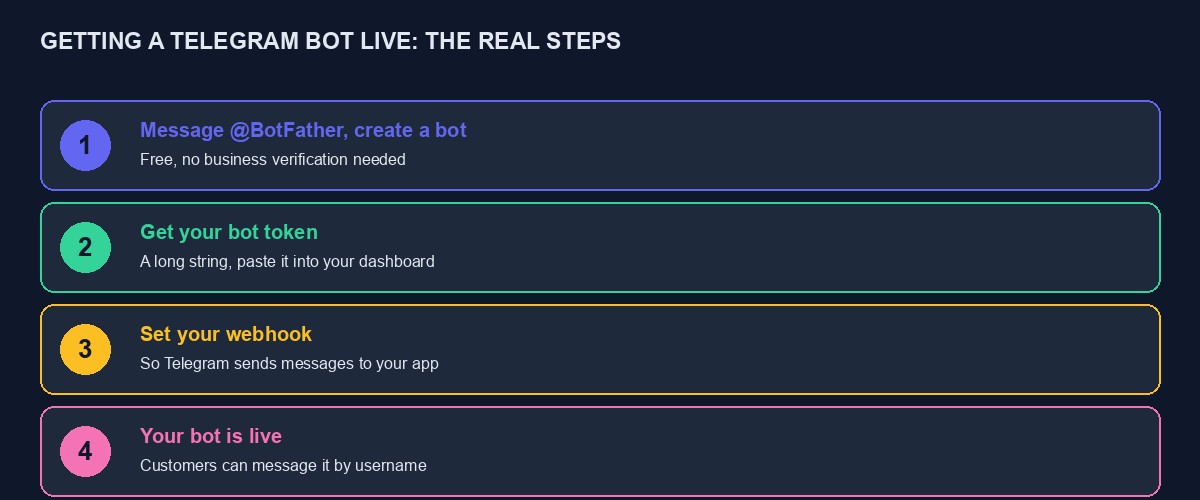
Picture a small data reselling business whose customer base skews heavily toward university students, many of whom the owner has noticed are already active in Telegram study groups and community channels. Building a Telegram bot alongside the existing WhatsApp-based purchase flow, using the free, quick BotFather setup described in the broader Telegram bot guide, replicates the core purchase flow: account linking through a one-time code shown in the customer's existing dashboard, balance checking, and network and plan selection through tappable inline buttons rather than typed commands.
Promoted specifically inside the student Telegram communities the owner is already part of, rather than as a general broadcast, the bot picks up a genuine, steady stream of purchases within its first few weeks, at zero additional per-message cost regardless of volume, a meaningful advantage given how thin VTU margins already are on any individual transaction. The bot does not replace the WhatsApp flow, which remains the business's primary channel; it captures a specific, already-engaged segment that was simply easier to reach on a platform they were already spending time in.
Comparing a bot purchase against your website's own checkout
It is worth being explicit about what a bot genuinely adds versus what your website's own checkout already provides, so the investment is made for the right reason. A bot does not typically offer a richer visual experience than a well-designed website checkout, and for a customer already comfortable navigating your website, it may add little beyond convenience. Its genuine value is meeting a specific customer where they already spend time, inside a messaging app they open dozens of times a day, reducing the friction of opening a separate website specifically to make a purchase, particularly for a small, quick, habitual transaction like buying a data plan a customer purchases regularly. For a first-time, unfamiliar customer researching your business more broadly, your website, with its fuller information, reviews and context, usually remains the better first touchpoint, with the bot earning its place as the fast, low-friction channel for repeat, habitual purchases from a customer who already trusts you.
Handling customer support questions the bot cannot answer
However well built, a VTU bot will regularly encounter questions and situations outside its designed purchase flow: a dispute about a specific past transaction, a question about a plan that is not currently listed, a general enquiry unrelated to buying anything at all. Build an explicit, clearly signposted way to escalate to a real person for any of these, a specific command or button labelled plainly, "talk to support," rather than letting the bot attempt to handle everything itself and produce a confusing, unhelpful response to a question it was never designed to answer. A customer who reaches a dead end with no visible way forward is considerably more frustrated than one who is clearly, quickly routed to a human the moment the bot recognises it cannot help.
Monitoring bot-driven transactions alongside your other channels
Once live, treat transactions coming through your Telegram bot as part of the same overall transaction monitoring and reconciliation habit covered throughout our VTU guides, not a separate stream reviewed differently or less carefully. A sudden spike in failed transactions specifically through the bot, distinct from your website's own failure rate, is a useful, specific signal worth investigating directly, since it may point to a bot-specific bug, an account-linking problem, or a UI confusion unique to the bot's particular interface, none of which would necessarily show up if you were only reviewing your overall, combined transaction success rate without separating it by channel.
Mistakes specific to a VTU Telegram bot
Not properly linking the bot to a real customer account. A bot that processes purchases without a solid, verified link to an actual customer record risks either fraud or genuinely confusing wallet mismatches, and this is not a detail to build loosely under time pressure.
Treating the bot's transaction handling as separate from your website's. The bot should draw from and update the exact same underlying wallet and transaction records as your website, not a parallel, disconnected system that then needs separate reconciliation.
Ignoring the ambiguous-response problem. The same provider reliability issues covered in our broader VTU content apply identically through a bot, and a bot that confidently reports success on an ambiguous provider response risks the same debit-without-delivery problem your website's own purchase flow needs to guard against.
Launching without a visible path to human support. A customer whose bot purchase genuinely fails needs an obvious, working way to reach a real person, not a dead end inside an automated conversation.
Where this is already built for you
If you are running a VTU project on our platform, a Telegram bot connected to your real wallet and purchase system, sharing the same underlying logic as the WhatsApp purchase bot covered in our guide to creating a WhatsApp bot, is available on eligible plan tiers, checked on the pricing page. You can start building free to see the platform directly, and our broader guide to building a Telegram bot for your Nigerian business covers the general setup this specific VTU use case builds on.

Comments
No comments yet. Be the first to share your thoughts.