
How Much Can a Freelance Web Developer Charge?
If you are a web developer in Nigeria trying to figure out what to charge, you already know the problem: everyone gives a different answer. One person says charge per hour. Another says charge per project. Someone else tells you a number that sounds too high, or too low, and you are not sure who to believe. This guide is a simple, honest answer, built around how freelance pricing actually works, not around one made-up number.
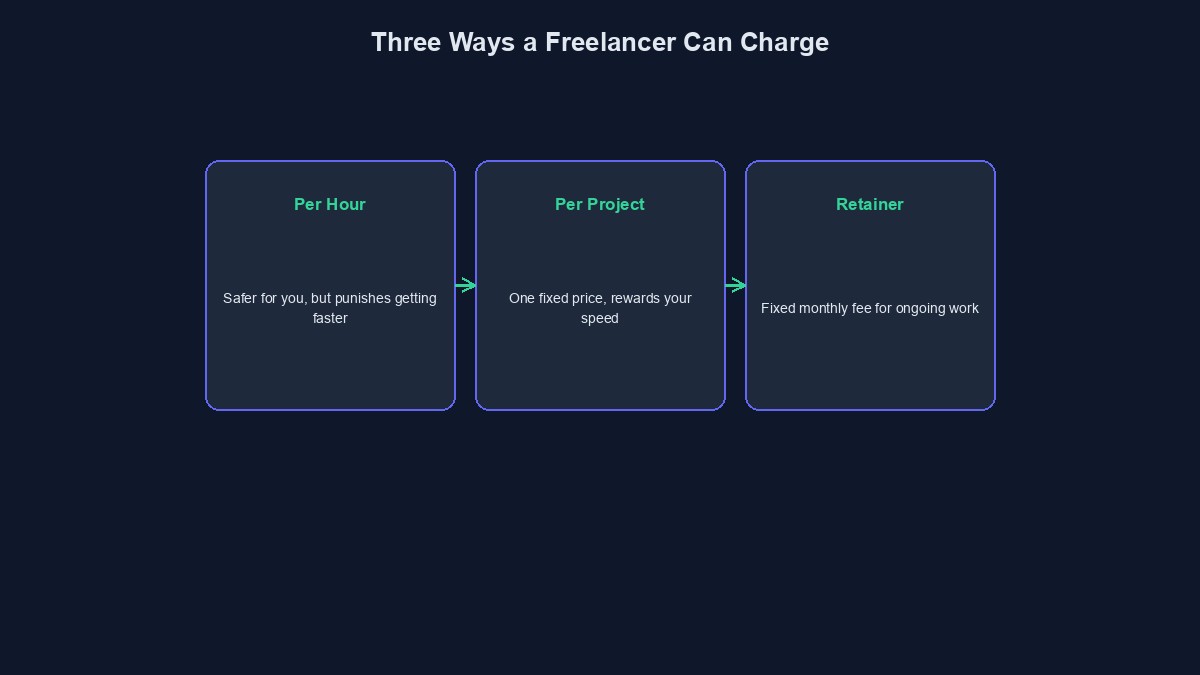
There is no one correct price. There are three ways to charge
Most new freelancers waste time looking for "the" correct rate, as if one number exists for every developer. It does not. What actually exists are three common ways to charge, and each one fits a different kind of work.
Per hour. You track your time and charge for every hour worked. This works best when the client is not sure exactly what they want yet, and the work might change as you go.
Per project. You agree on one fixed price for the whole job, no matter how many hours it actually takes you. This works best when the job is clearly defined from the start, a landing page, a specific feature, a small app.
Retainer. The client pays you a fixed amount every month for ongoing work, maintaining a site, adding small features, fixing bugs. This works best for long-term clients you already have a relationship with.
Why per-project pricing is usually better for you, once you know your speed
When you are new, per-hour pricing feels safer, since you get paid for every hour no matter what. But once you know roughly how long a type of job takes you, per-project pricing almost always earns you more. Here is why: if you get faster at something, hourly pricing punishes you, you finish sooner and earn less. Project pricing rewards you, you finish sooner and keep the same fee. The client also prefers it, since they know the total cost upfront instead of an open-ended number that could grow.
Real, honest price ranges by type of work
These are rough Nigerian market ranges, not fixed rules. Your actual price depends on your skill level, your portfolio, and who you are working for.
A simple landing page or small business website: a modest fee, often in the low hundreds of thousands of naira, sometimes less for a very simple one-page site.
A functional business website with several pages, a contact form, and basic features: a mid-range fee, often stretching into the high hundreds of thousands.
A more complex build, an online store, a booking system, a custom web app with real logic behind it: this moves into the millions, depending heavily on exactly what the app needs to do.
Ongoing maintenance as a retainer: often a smaller monthly fee compared to a full new build, since the work is lighter and spread out.
The mistake almost every new freelancer makes: pricing too low
New freelancers price low because they are scared no one will pay more. This backfires in a specific way. A client who pays very little often expects unlimited changes, treats your time as unimportant, and pays late, since they did not pay much in the first place. A client who pays a fair price treats you like a professional, because they are paying like one. Pricing low does not just cost you money, it changes how you get treated.
What actually changes your price, beyond just skill level
Your portfolio matters. A developer who can show real, working projects can charge more than one who only talks about skills. Who you work for matters too, a foreign client paying in dollars can often afford, and expects, a higher price than many local clients. How fast you deliver matters, since a rushed deadline is worth more than a relaxed one. And how much back-and-forth a client expects, endless revisions, long calls, constant messages, is real work that deserves to be priced in, not given away for free.
How to actually raise your rate without losing clients
The simplest way is to raise your price for new clients only, while keeping old clients at their current rate for a while. Another way is to add more value at the same price first, better communication, faster delivery, then raise the price once the client already sees you as reliable. The worst way is guessing a client cannot afford more and never asking. Many can. You will not know unless you try.
Getting paid on time, not just getting paid
A fair price does not help you if the client pays late, or not at all. Always ask for something upfront before you start, even a small percentage, since a client who refuses to pay anything upfront is a real warning sign. For a bigger project, break the payment into stages, a part at the start, a part in the middle, the rest when the work is done and approved. This way, you are never doing a huge amount of work with nothing paid for it yet.
A simple example, to make this real
Picture a developer who used to charge one flat fee for every website, no matter how simple or complex. After a few projects, they started separating jobs into three tiers, a simple site, a mid-level site with more pages and features, and a fully custom build. Clients who wanted something simple paid the simple price. Clients who wanted something bigger paid more, and now clearly understood why, since the tiers were explained upfront. The developer's total earnings went up, not because they worked more hours, but because the pricing finally matched the actual work.
Mistakes worth avoiding
Charging the same price for every job, no matter how different the work is. A five-page website and a custom booking system are not the same job, and should not cost the same.
Never writing anything down. A simple written agreement, even a short one, on price and what is included, prevents a huge share of client disputes later.
Being afraid to say no to a bad-fit client. A client who argues over a fair price before work even starts is usually a preview of how the whole project will go.
Forgetting to charge for revisions beyond a reasonable number. Unlimited free changes is one of the fastest ways a fairly priced project turns into an unfairly cheap one.
A short glossary
Retainer: a fixed monthly fee a client pays for ongoing work, instead of paying per project. Scope: the exact list of what is included in a project, agreed before work starts. Scope creep: when a client keeps adding extra requests without extra pay, quietly turning a fair price into an unfair one. Portfolio: real, finished work you can show a potential client as proof of what you can do.
Where to go from here
Our guide to web developer salaries in Nigeria covers what employed developers earn, if you are weighing a job against freelancing. And if you build websites for clients, our own platform lets you build real, working sites fast, VTU, ecommerce, booking and more, which can genuinely speed up how quickly you deliver a project and how much you can take on. You can start building free to see it directly.



Comments
No comments yet. Be the first to share your thoughts.