
How to Accept Online Payments in Nigeria
Every Nigerian business that starts selling online eventually hits the same wall: customers want to pay, and "just send money to this account" only gets you so far before it starts costing you sales, disputes, and hours spent manually matching bank alerts to orders. This is a practical overview of how online payments actually work in Nigeria, the real options available, and how to choose between them, written for a business owner rather than a developer. If you are technical and want to actually integrate a specific gateway, our Paystack API tutorial and Flutterwave API tutorial cover that directly.
Why "just send an alert" stops working as you grow
Plenty of small businesses start by asking customers to transfer money and send a screenshot of the alert as proof. This works when you have five orders a day and know most of your customers personally. It breaks down as volume grows: screenshots can be faked, alerts get missed in busy chat threads, matching a transfer to a specific order becomes genuinely error-prone by hand, and a customer who has to wait for manual confirmation before their order moves is a customer who might simply buy from a competitor whose checkout is instant instead. A proper payment gateway solves all of this by confirming payment automatically and telling your system, instantly and reliably, that a specific order has actually been paid.
What a payment gateway actually does for you
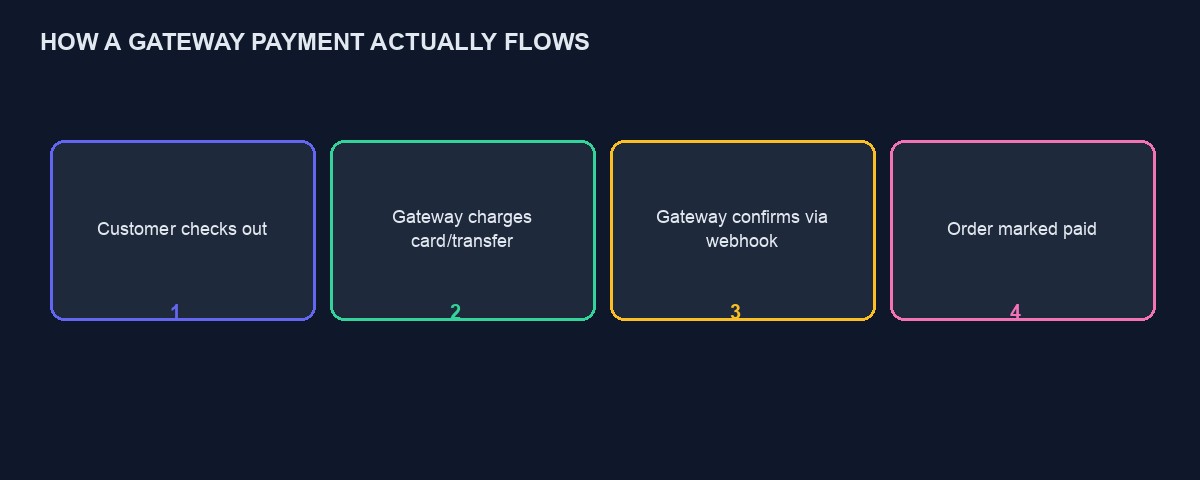
A payment gateway sits between your website and the banking system, handling the genuinely difficult, tightly regulated part of moving money safely, so you never have to touch a customer's card details directly, which would expose you to serious security and compliance obligations most businesses are right to avoid taking on themselves. Your website asks the gateway to charge a customer a specific amount, the gateway handles the actual transaction with the customer's bank or card issuer, and reports back, instantly and automatically, whether it succeeded. Our broader guide to what an API is covers the general shape of this kind of interaction if the concept itself is unfamiliar.
The major options, compared honestly
Paystack. Widely used by Nigerian businesses of every size, known for clean documentation and a smooth checkout experience, supporting cards, bank transfer, USSD, and mobile money. A sensible default for most Nigerian online businesses starting out.
Flutterwave. A close competitor to Paystack, with a similar range of payment methods and additional strength in handling international and cross-border transactions, useful if you expect a meaningful share of customers paying from outside Nigeria.
Stripe. Dominant internationally and excellent for businesses primarily serving customers abroad, though historically less tailored to purely Nigerian payment methods like local bank transfer and USSD compared with the two options above.
PayPal. Familiar to international customers and useful as a secondary option for a business with a significant diaspora or international customer base, though less commonly a Nigerian customer's first choice for paying a Nigerian business.
Direct bank transfer with automatic confirmation. Some gateways, including Paystack and Flutterwave, can generate a unique, temporary account number for each specific order, so a transfer to that account is automatically matched to the right order the moment it lands, giving you the trust and simplicity customers associate with bank transfer without the manual matching problem.
Cash or pay-on-delivery. Still genuinely important for some categories of Nigerian ecommerce, particularly where trust in paying upfront online has not yet been established with a particular customer, and worth offering selectively even alongside proper online payment options.
Registering with a gateway: what to actually expect
Signing up is free with every major gateway, and using it requires completing their verification process before you can receive real, live payments, typically your business registration details if you have a registered company, or personal identification if operating as an individual, plus your bank account details for settlement, where the money you have collected actually gets paid out to you. This verification is the gateway's own decision and can take anywhere from same-day to a week or more depending on how complete your documentation is, so start this process well before you plan to launch, not the week you intended to go live.
Understanding the fees, properly
Every gateway takes a percentage of each transaction, typically in the low single digits, sometimes with a flat fee added for certain payment methods, and sometimes with a cap on the fee for very large transactions. Read the actual current fee schedule on the gateway's own pricing page rather than trusting a remembered number, since these do change, and pay particular attention to whether international cards or transactions are charged at a different, usually higher, rate than local ones, since this affects your real margin if you expect customers paying from outside Nigeria.
Settlement: when the money actually reaches your bank account
A customer paying does not mean the money is instantly sitting in your own bank account. Gateways settle collected funds on their own schedule, commonly daily or next-business-day for most transactions, sometimes with a longer initial period for a brand new account while the gateway builds confidence in your business. Understand your specific gateway's settlement schedule before you rely on that cash flow for anything time-sensitive, restocking, paying a supplier, since a mismatch between "the customer paid" and "the money is actually in my account" is a common and avoidable source of cash flow stress for a new online business.
Handling failed and disputed payments
Payments fail for entirely mundane reasons more often than for fraud: insufficient funds, an expired card, a bank's own fraud check blocking an unfamiliar transaction. Build a calm, clear message for a failed payment, explaining what happened and suggesting the customer try a different method, rather than a generic, unhelpful error. For disputes, a customer claiming they were charged but did not receive what they ordered, keep clear records of every order and its delivery, since gateways generally require you to provide evidence when a dispute is raised, and a business with organised records resolves these considerably faster and more favourably than one relying on memory.
Security basics that are not optional
Never handle raw card details directly on your own server; let the gateway's own secure checkout page or properly certified embedded form do that specific job, which keeps you outside the scope of the strictest card-security regulations. Always verify a payment's actual status through the gateway's API or webhook before treating an order as paid, rather than trusting a redirect back to your site alone, since redirects can be interrupted or, in rare cases, manipulated, while a properly verified webhook, covered in our guide to what a webhook is, tells you the truth directly from the gateway's own confirmed records.
Choosing based on your actual customers, not a generic recommendation
If your customers are almost entirely Nigerian, Paystack or Flutterwave, with strong local bank transfer and USSD support, will serve you better than an international-first option. If a meaningful share of your customers pay from outside Nigeria, Flutterwave's cross-border strength or adding Stripe or PayPal alongside a local gateway is worth considering. Many established Nigerian businesses eventually run more than one gateway simultaneously, giving customers a choice and giving the business a fallback if one gateway experiences downtime, though this adds real complexity worth weighing against the benefit for a smaller, newer operation just starting out.
A worked example: a boutique's first month accepting online payment
Picture a small clothing boutique in Ibadan that has sold exclusively through WhatsApp and bank transfer for two years, with the owner manually checking alerts and confirming orders throughout the day. She signs up with Paystack, completes verification within four days using her business registration and bank details, and connects it to a simple online store. In the first week, most customers still pay by direct transfer out of habit, but now the store generates a unique account number per order, so payments match automatically instead of her checking her banking app between customer conversations. By week three, seeing "pay by card" as an option at checkout, a meaningful share of new customers, particularly ones she has never met in person, choose it instead, completing a purchase in under a minute rather than the back-and-forth of confirming a manual transfer. Her actual measurable change is not a dramatic transformation, it is roughly ninety minutes a day no longer spent manually checking and matching alerts, and a small but real number of sales that would previously have been lost to a hesitant customer unwilling to transfer money to an account with no automatic confirmation.
Common mistakes businesses make when setting this up
Delaying verification until launch week. Verification is outside your control once submitted, and treating it as a same-day formality rather than starting it early is one of the most common, entirely avoidable causes of a delayed launch.
Trusting a redirect without checking the actual payment status. A customer landing back on a "success" page is not the same as confirmed proof of payment. Always verify through the gateway's own webhook or API before treating an order as genuinely paid.
Only offering one payment method. Nigerian customers have real, varied preferences, card, transfer, USSD, and offering only one narrows your potential customers for no real benefit, since modern gateways support several methods through the same single integration.
Ignoring the fee structure until the first settlement. Understand the actual percentage and any flat fees before pricing your products, rather than being surprised by a smaller settlement than expected on your first real payout.
Not testing with real, small transactions before fully launching. A test-mode success does not guarantee a live-mode success under real conditions. Run at least one genuine, small live transaction yourself before directing real customer traffic at a new checkout.
A note on trust, which matters as much as the technology
A working payment gateway solves the mechanics of accepting money. It does not automatically solve customer trust, and Nigerian online shoppers, reasonably wary given how common online fraud has been, still look for other signals: a real, described business with a findable address, clear delivery and refund policies, and evidence, real reviews, real photographs, that a business is legitimate before they trust a checkout with money. A well-configured gateway paired with a business that has otherwise done nothing to earn trust will still underperform a business that has genuinely built it, so treat the payment integration as necessary infrastructure, not as the whole solution to converting a hesitant visitor into a paying customer.
Regulation: a brief, honest note
Payment gateways operating in Nigeria are licensed and regulated by the Central Bank of Nigeria, which is part of why using an established, licensed gateway matters beyond convenience, it is also the layer of regulatory protection standing between your business and the banking system, handling obligations around fraud monitoring and anti-money-laundering checks that would be a serious undertaking for an individual business to handle alone. This is not legal advice, and if your business handles unusually large volumes or operates in a way that raises specific regulatory questions, a conversation with an actual professional is worth having, but for the overwhelming majority of small and medium Nigerian businesses, using an established, licensed gateway for the actual payment processing is both the practical and the compliant choice.
Recurring payments and subscriptions
If your business involves a repeating charge, a subscription service, membership dues, both major Nigerian gateways support this specifically, letting a customer authorise a card once and be charged automatically on a schedule afterward, rather than needing to manually pay every single period. This is meaningfully different from a one-off checkout technically, since it requires securely storing a reference to the customer's payment method for future use rather than a single transaction, and it is worth confirming a gateway's specific subscription or recurring billing feature supports your exact billing pattern, monthly, annual, a trial period, before building around it.
What happens when a gateway itself has downtime
Even established, reliable gateways occasionally experience their own outages, and it is worth deciding in advance how your business responds when this happens rather than discovering you have no plan mid-incident. A simple, honest banner on your checkout page acknowledging a temporary payment issue and offering an alternative, a manual bank transfer with your usual account details as a fallback, for instance, costs little to prepare in advance and meaningfully reduces lost sales and customer frustration during the rare periods a gateway is genuinely down. Businesses running more than one gateway simultaneously have a further option here: routing customers to the working one automatically, though this adds real integration complexity worth weighing against your actual transaction volume and risk tolerance.
Comparing settlement currencies if you sell internationally
If you sell to customers both within Nigeria and abroad, check specifically whether your chosen gateway settles international payments into your Nigerian bank account in naira, at whatever exchange rate applies at settlement, or offers a separate dollar or foreign currency settlement option. This detail meaningfully affects your actual revenue when exchange rates move, and it is worth understanding clearly before pricing products for an international audience, rather than discovering the practical effect only once real international sales start arriving.
A realistic setup timeline
Signing up and starting verification: same day. Verification approval: typically a few days to two weeks, depending on the gateway and how complete your documents are. Technical integration, if building it yourself: a few days for a straightforward checkout, considerably less if using a platform where payment gateways are already built in and you are simply connecting your own account. Testing thoroughly with real, small transactions before fully launching: a further day or two, genuinely worth the time rather than skipped under launch pressure.
A short glossary for reading a gateway's own documentation
Merchant account: your business's account with the gateway, once verified. Settlement: the transfer of collected funds from the gateway into your own bank account. Reconciliation: matching your own order records against the gateway's transaction records to confirm they agree. Chargeback: a card payment forcibly reversed by the customer's bank, usually following a dispute, distinct from an ordinary refund you initiate yourself. Test mode / live mode: the safe, simulated environment versus the real one, covered throughout this guide, and worth internalising as the single most important distinction in the entire process.
A closing thought on the real bottleneck
Technically, connecting a payment gateway to a Nigerian online business is now a solved, well-documented problem, achievable in days rather than the weeks or months it once required. The actual bottleneck for most new businesses is rarely technical at all; it is the verification wait, the discipline to test properly before launch, and the ongoing habit of watching settlement and dispute records rather than treating the integration as finished the moment the first successful transaction appears. Budget your real time accordingly: less on worrying about which gateway is marginally better, more on the unglamorous operational habits that keep whichever one you choose running smoothly for years.
Where this is already built for you
If you are building on our own platform, payment gateway connections are already built in across our store, VTU and booking templates: you connect your own Paystack, Flutterwave, Stripe, PayPal or Payoneer account from your project settings, and the checkout, verification and webhook handling described above are already built and tested, so you register with your chosen gateway and configure it, rather than building the actual integration yourself. You can start building free to see this in your own dashboard, or read our technical tutorials on the Paystack API and Flutterwave API if you are integrating a gateway into something custom.

Comments
No comments yet. Be the first to share your thoughts.