How Much Does It Cost to Build an API in Nigeria?
Asking "how much does it cost to build an API" gets you either a vague "it depends" or a global price range in dollars that does not obviously translate into what a Nigerian business actually budgets in naira, sourced mostly from agencies with an obvious reason to quote generously. This is a more grounded breakdown: what actually drives the cost up or down, realistic Nigerian pricing bands for the situations a business genuinely encounters, and, honestly, when building a custom API is not actually the right call at all.
What "building an API" actually means, since the phrase covers very different projects
The phrase hides a wide range of genuinely different undertakings, and the cost varies enormously depending on which one you actually need. A simple internal API, letting your own mobile app talk to your own backend, is a fundamentally smaller project than a public, documented API meant for outside developers to integrate against, which itself is smaller than an API connecting several existing systems together, your inventory software, your accounting platform, a payment gateway, all talking to each other reliably. Get specific about which of these you actually need before pricing it, since "build an API" alone is not a specific enough request for anyone to quote accurately.
The factors that actually move the price, in order of real impact
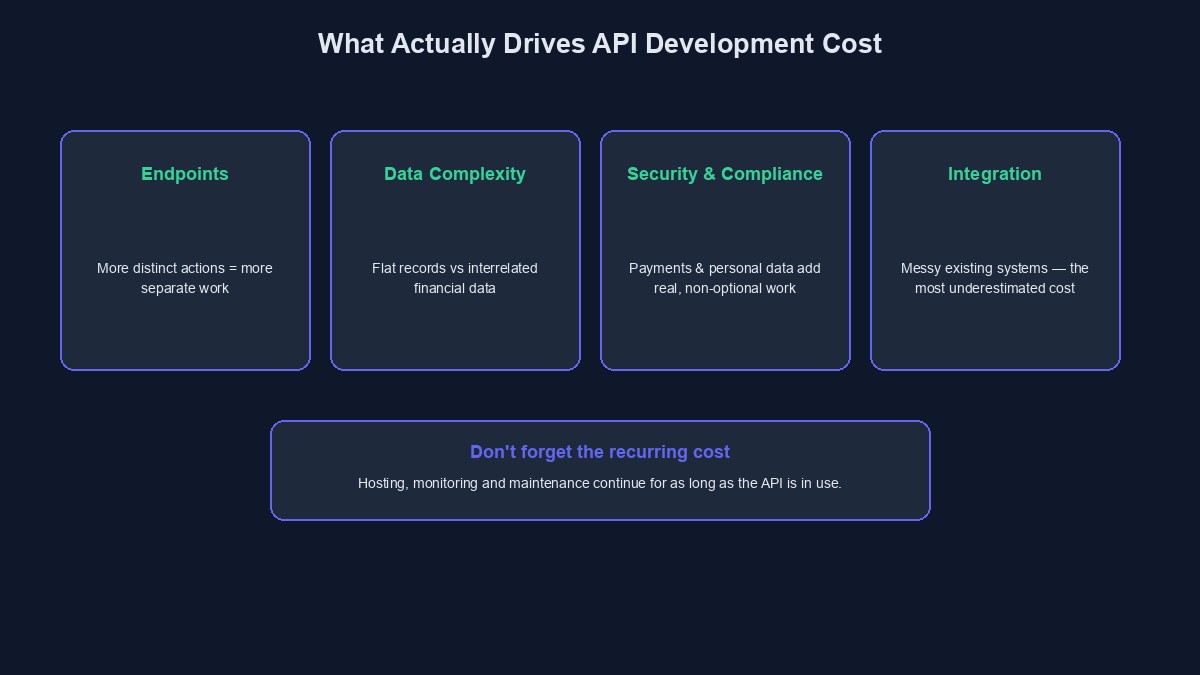
The number of distinct actions the API needs to perform, its endpoints, matters more than almost anything else, since each one is genuinely separate work: authentication, validation, the actual business logic, error handling, and, if the API is meant for outside use, documentation. Data complexity matters nearly as much: an API dealing with simple, flat records is meaningfully cheaper to build than one handling complex, interrelated data, financial transactions with audit trails, multi-step workflows, real-time state.
Security and compliance requirements add real, specific cost, particularly for anything touching payments or personal data, where proper authentication, encryption, and audit logging are not optional extras but necessary, non-negotiable work. And integration with existing systems, especially older, poorly documented ones, is consistently the most underestimated cost driver, since connecting cleanly to a messy existing system is often more work than building the new API logic itself.
Realistic Nigerian pricing bands, stated honestly
A straightforward integration API, connecting your own website or app to a single existing service, a payment gateway, an SMS provider, typically falls in a modest range, often achievable for a few hundred thousand naira with a capable freelance developer or small agency, assuming the underlying service already has clear documentation to build against. A more substantial custom API, built specifically for your business, with proper authentication, several distinct endpoints, and real documentation for others to use, moves meaningfully higher, often into the low millions of naira depending on scope. A complex, multi-system integration project, genuinely connecting several existing platforms together with strict reliability and security requirements, is where costs climb well beyond that, sometimes considerably, depending specifically on how many systems, how messy the existing data is, and how strict the compliance requirements are.
These are genuinely rough bands, not a quote, and the honest, specific answer to "how much will mine cost" depends entirely on the specifics above, which is exactly why a credible developer or agency asks detailed questions before naming a number, and should make you cautious of anyone willing to quote a precise figure without first understanding exactly what you need.
The ongoing cost that a one-time quote usually leaves out
Building an API is not a one-time cost, and treating it as one is a common, expensive mistake. Hosting, monitoring, and ongoing maintenance, security patches, bug fixes, updates as your own business's needs change, are a genuine, recurring cost that continues for as long as the API is in use, and a realistic budget accounts for this from the start rather than being surprised by it a year later. A cheap upfront build with no plan for ongoing maintenance is frequently, in practice, more expensive over its real lifetime than a more properly scoped one.
When building a custom API is genuinely not the right call
This is worth being honest about, even though it works against the instinct to always recommend the fuller, more expensive build. If what you actually need is a specific, common capability, accepting payments, sending SMS, verifying a bank account, selling airtime and data, a ready-made, already-built API from an established provider is very often both cheaper and more reliable than commissioning a custom one from scratch, since you are paying to use infrastructure that already exists and is already proven, rather than paying to build and then maintain your own equivalent. A custom API genuinely makes sense specifically when your actual business logic, not a commodity capability someone else has already solved well, is what needs building.
Where a platform's own built-in developer API changes this calculation
If your actual need is a way for your own app or website to programmatically trigger transactions, check a wallet balance, or vend data and airtime, on a business you are already running through a VTU or ecommerce platform, building a bespoke API for exactly that purpose is very often unnecessary work. Our own platform includes a developer API as a feature of the paid plan tiers, project-scoped API keys, documented endpoints for exactly this kind of transaction, rather than something priced or built as a separate custom project at all. For a business whose actual need is "let my own systems talk to my VTU platform programmatically," this is frequently the entire cost difference between a genuine custom-build project and a feature that is simply already included.
Freelancer, agency, or in-house: what actually changes the cost, beyond the project itself
Who actually builds it shifts the price meaningfully, independent of the project's own complexity. A capable individual freelance developer is typically the most affordable route for a well-scoped, moderate project, assuming you can verify their actual track record, but carries real risk around long-term availability if something needs fixing or extending months later and that specific person has moved on to other work. A small, established agency costs more, often meaningfully more, but generally offers more accountability and continuity, a team rather than one person's availability. Hiring in-house only tends to make sense once your business has enough ongoing API and integration work to justify a full-time salary rather than a project fee, which is a genuinely higher bar than most businesses commissioning their first API have actually reached.
A worked example: pricing two genuinely different requests correctly
Picture two business owners asking, on the surface, a similar question. The first runs a growing logistics business and needs their own internal tracking system to talk to three different existing platforms, their accounting software, a fleet management tool, and a customer notification service, none of which were built to talk to each other. This is a genuine custom integration project, with real complexity in reconciling three different data structures reliably, and a correspondingly real cost reflecting that specific complexity.
The second runs a VTU reselling business and wants their own separate ordering app to be able to trigger data and airtime purchases automatically rather than through the regular dashboard. Rather than commissioning a custom API build, connecting that ordering app to their existing VTU platform's already-built developer API, using a project-scoped key generated directly from their dashboard, solves the actual need in an afternoon, at effectively no separate build cost at all, since the capability was already part of the platform they were already paying for.
Mistakes worth avoiding when budgeting for this
Asking for a quote before being specific about what the API actually needs to do. "Build me an API" is not specific enough for anyone to price accurately, and a vague request tends to produce either a padded, defensive quote or an underscoped one that grows expensive later.
Ignoring ongoing hosting and maintenance costs when comparing quotes. A lower upfront number with no plan for the real, ongoing cost of keeping an API running securely is not actually cheaper, it is simply an incomplete quote.
Commissioning a custom build for a capability a reputable existing provider already offers well. This is consistently the most avoidable overspend in this category, and it is worth a genuine, honest check before committing to a custom project.
Choosing the cheapest quote without checking the developer's or agency's actual track record with similar integrations. A cheap, inexperienced build that has to be redone properly later costs more in total than a correctly scoped one the first time.
A short glossary
Endpoint: one specific action or piece of data an API exposes, and the basic unit most cost estimates are built around. Integration: connecting an API to an existing system or service, often the least predictable part of a project's cost. Custom API: one built specifically for a particular business's own logic, as distinct from using an existing provider's ready-made one. API key: the credential that authenticates who is calling an API, whether it is one you build or one you consume from someone else.
Where to go from here
Our guides to what an API actually is and troubleshooting an API key that isn't working cover the foundational concepts this cost breakdown assumes. If your actual need turns out to be programmatic access to a VTU, ecommerce, or booking business you are already running, rather than a genuinely custom build, you can start building free and see the included developer API directly in your own dashboard before spending anything on a custom alternative.

Comments
No comments yet. Be the first to share your thoughts.