How to Create Original Research That Gets Backlinks
Writers and journalists love numbers. When they write about a topic, they want a fact to point to: "X percent of small businesses do this," "the average price is that." If you are the one who produced the number, they will usually link to you, because they have to credit the source. That is why original research is one of the most powerful link-building methods there is. It is also hard to do well, easy to do badly, and it never guarantees links. This guide shows how to do it honestly, on a small budget, for a Nigerian or African audience.
What counts as original research
It is data that did not exist before you published it. That could be a survey of a group of people, a study of a public dataset, an analysis of anonymised data from your own product, a price comparison across many providers, or a test of several tools with a clear method. It does not need to be big or scientific. It needs to be real, clearly explained and useful to someone writing about your topic.
Step 1: Choose a question people actually ask
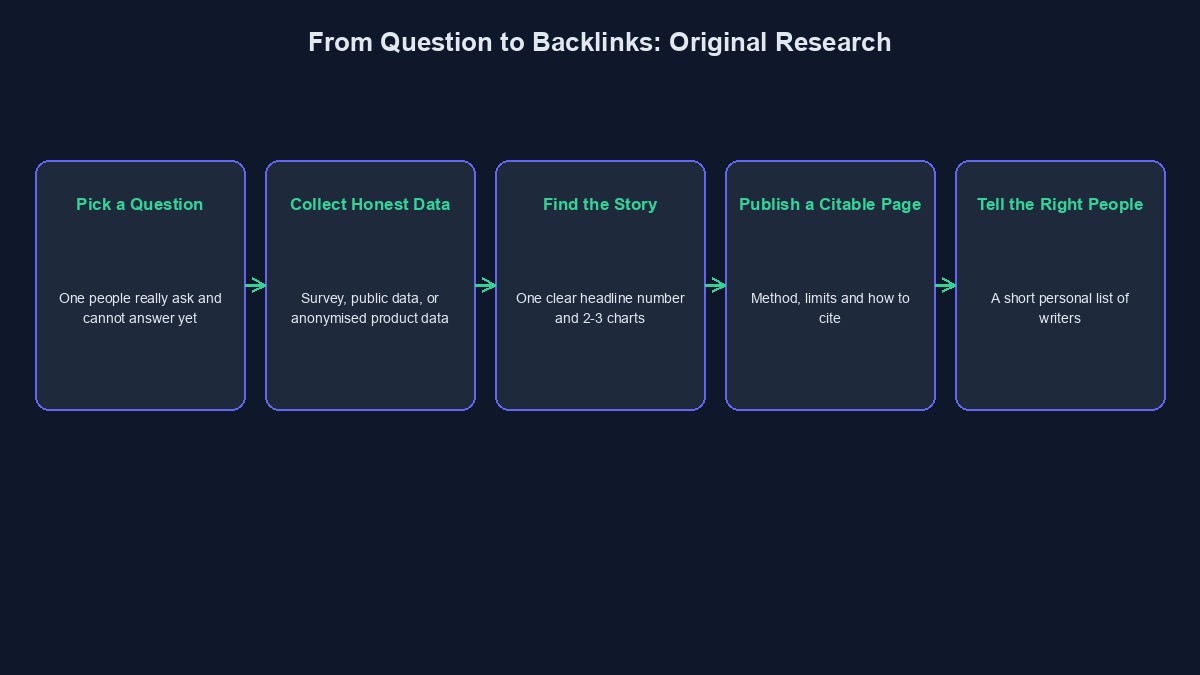
Good research answers a question that writers and readers keep wondering about. In Nigeria, examples include: How much do small businesses spend on marketing? How many sell mainly through WhatsApp? How long does it take to get paid by customers? What do people pay for a website? Look at what people search for, what journalists and bloggers in your field write about, and where the facts are missing or outdated. If a good, recent source already exists, pick a different question.
Step 2: Decide how to get the data
A survey. The most common route. Ask a defined group a small number of clear questions. Public data. Analyse numbers that already exist, such as published statistics or listings, in a new way. Your own data. If you run a platform, you may be able to publish aggregated, anonymised patterns. Be strict about privacy: never publish anything that can identify a customer, check what your terms and the law allow, and get advice if unsure. A test. Compare tools, prices or speeds using a method you describe fully.
Step 3: Design the survey properly
Write short, neutral questions. Avoid leading ones like "How much do you love our product?" Offer clear answer options and a "none of the above" choice. Test the survey with a few friends before sending it. Keep it to five to ten minutes. Free tools such as Google Forms are enough. Decide in advance who you want to hear from, such as small business owners in Nigeria, and make sure the people you reach match that group.
Step 4: How many responses do you need?
You will see advice that says a few hundred or even a thousand responses are needed. Bigger samples are more convincing, but a smaller, honest, well-described survey is far better than a big one with a doubtful method. For a niche group, a couple of hundred good responses can be useful, as long as you say exactly who answered and do not claim the result represents everyone. Never make up numbers, round them up, or pad results. If it ever came out that data was invented, you would lose every link and your reputation.
Step 5: A realistic budget
This is an illustration, not a quote. A do-it-yourself survey with a free tool, shared through your own audience, WhatsApp communities and partner networks, can cost very little. If you offer a small incentive, such as ₦500 airtime to each of 200 respondents, that is about ₦100,000 ($75, or about €66). Add a few days of someone's time for analysis, charts and writing. Paying a research agency or a panel provider costs much more, and the price depends on the audience. Start small and learn.
Step 6: Find the story in the numbers
Do not publish a spreadsheet. Look for the one or two findings that surprise people or confirm a worry. For example: "Seven in ten small shops reply to customers only after one hour," or "Most owners do not know what their ads cost them per sale." Put the headline number at the top and use plain language. Add a few clear charts, a short explanation of the method and its limits, and a downloadable summary. Journalists should be able to understand the main point in about twenty seconds.
Step 7: Publish a page built to be cited
Create a dedicated page with a clear title, the key findings in short bullets, charts that people can copy with credit, a plain "how we did this" section covering who answered, when and how, and a simple line telling people how to cite it. Make the page load quickly and work on mobile. Keep it at a stable address so links do not break later.
Step 8: Tell the right people
Research does not spread by itself. Make a short list of writers, bloggers, newsletter authors and association heads who cover this topic, and write each a short, personal note with the headline finding and the link. Offer them a quote or an extra chart. Tell the people who took part and share the findings with them. Post a summary on your social pages and in relevant communities. Expert-matching services have changed in recent years, so check what is currently available before paying for one. A tight list of the right people works better than a long list of everyone.
Be realistic about what to expect
Some studies earn many links. Many earn only a few. Results depend on the topic, the freshness of the data, how clearly you present it and how well you tell people about it. Treat the first study as a learning project. If it earns a handful of relevant links and several mentions, that is a good start, and a yearly update that people look forward to can build into a steady source of links.
Keep your research honest
State your method and its limits. Do not claim more than the data shows. If your sample came from your own followers, say so, because they may not represent the whole market. Credit sources you used. If you find a mistake after publishing, fix it and say so. Trust is the whole reason people link to research.
A short example
Illustrative example: the people, businesses and numbers in this section are made up to show how this works. They are not real clients or real results.
A small e-commerce software company in Lagos asks 250 online sellers, through its own audience and two seller communities, how they handle customer messages and how fast they reply. It publishes a short report with five findings, three charts and a clear method note. It sends the report personally to a dozen business writers and association leaders. Three of them quote the main statistic and link to the report, and several sellers share it. The following year, the company repeats the survey and compares the results.
Short glossary
Original research: data first published by you. Sample: the group of people who answered your survey. Methodology: a plain description of how you collected and analysed the data. Linkable asset: a page that others have a reason to link to.
Where to go from here
If you have no links yet, begin with how to get your first 10 backlinks. For product companies that can use their own data, see link building for SaaS companies. And if you would like help with research, SEO and outreach, marketing is now part of what our team offers, so contact us through the contact page.


Comments
No comments yet. Be the first to share your thoughts.