Link Building for Software Companies
Software companies have an advantage that most businesses lack: they can build things people want to link to. A good tool, a clear piece of documentation or a useful open-source project can earn links for years without a single outreach email. At the same time, software companies have their own traps, such as writing only for other developers, or hiding their best content behind a login. This guide covers link building for software companies in general: custom software houses, product companies and open-source teams. If you sell a subscription product, our guide on link building for SaaS companies goes deeper on that model.
Start with what you already have
Most software companies are sitting on linkable material and have never noticed. Your documentation, your API reference, your changelog, your engineering notes and your internal tools can all be useful to people outside your company. The question is simply: what would a stranger find valuable enough to point others to? Make a list of the ten pages on your site that a developer or a buyer would bookmark.
Good documentation attracts links by itself
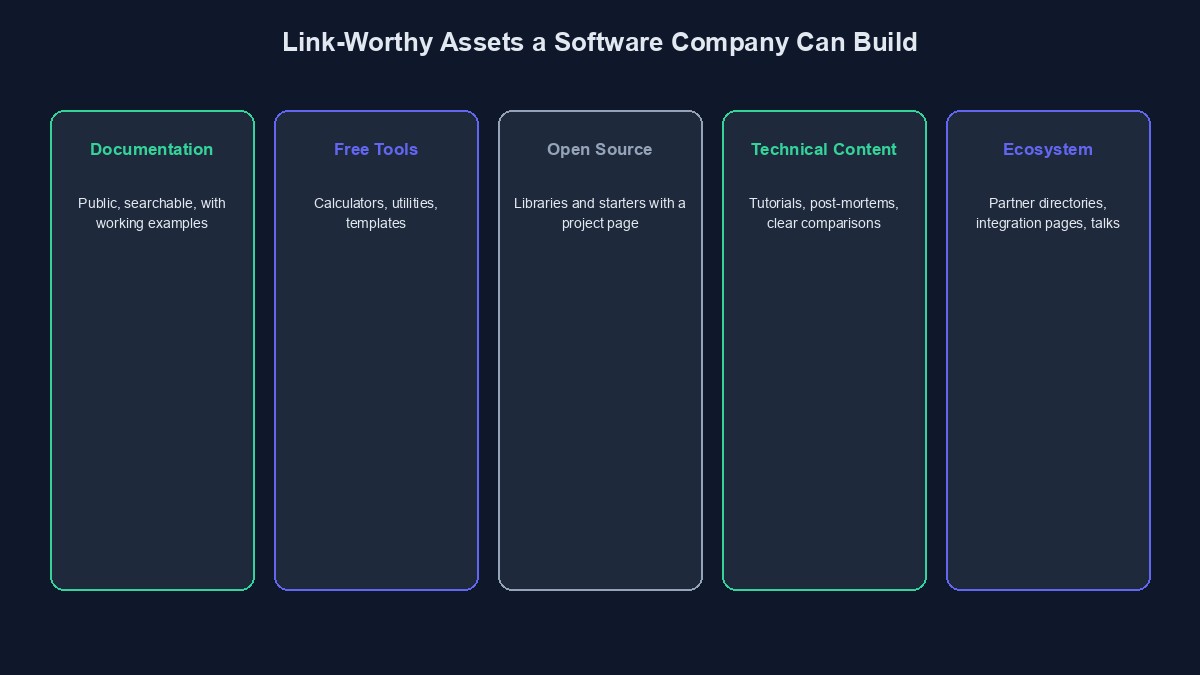
Clear, public documentation is one of the strongest link magnets in software. Developers link to docs in blog posts, forum answers, tutorials and issue threads. Keep your docs open to search engines, give each topic its own page with a clear title, and add short working examples that people can copy. Our guide on creating an API for a website or mobile app explains why good documentation matters, and it applies to links as much as to users.
Release something free and genuinely useful
A free tool, library or template gives people a reason to link. It could be a small utility, a code snippet collection, an open-source library, a calculator, or a starter project. Choose something related to your product and useful on its own. A cost estimator for software projects, a JSON formatter, a pricing calculator or a checklist are all examples. Give it its own page with a clear explanation, so that people have something specific to link to. Be realistic: free tools can take a few months to attract links, and many attract none if they solve a problem nobody has.
Open source brings links and trust
If you publish code under an open-source licence, your repository page, your package listing and your project website can all become points that others link to. Many links from code hosting sites are marked nofollow and so pass little ranking value, but they still send developers, produce mentions and build your reputation, which often leads to links from blogs and tutorials. Write a clear README, keep the project maintained, and link back to a proper project page on your own site.
Write technical content that explains real problems
Developers share posts that help them solve something. Good examples are a detailed tutorial, a post-mortem of an outage that explains what went wrong and what you changed, a performance comparison with your method clearly described, or a guide to a tricky integration. Be specific and honest. Generic posts such as "five benefits of cloud software" rarely earn links. A deep post that solves a real problem often does.
Build links through your ecosystem
Software does not live alone. If your product works with payment gateways, messaging platforms, cloud providers or other tools, those partners often have directories, marketplaces or integration pages. Getting listed on them gives you relevant links and real visitors. Write a clear integration guide for each, and tell the partner about it. You can also contribute to communities, answer questions on developer forums, and give talks at meetups and conferences, which often lead to links from event pages and speaker profiles.
If you build software for clients
Custom software companies earn links differently from product companies. Your best assets are case studies, honest cost and process guides, and a strong profile on review platforms such as Clutch or GoodFirms, where your clients' reviews and your listing can link to you. Publish pricing and process content, since people link to clear numbers. For example, our guides on how much an app costs in Nigeria and how much API integration costs are the kind of practical pages that others may cite. We also cover the agency side in link building for web development companies.
Turn press and launches into links
New features, funding, partnerships and milestones can all be newsworthy, especially to publications that cover technology. In Africa, there are tech news sites that regularly cover startups and software, and many accept pitches. Write a short, factual pitch that explains what is new and why readers should care, and give the journalist access to a founder, a demo or real numbers. Do not expect a link every time, but a good story can bring several.
Fix your own house first
Before reaching out to anyone, make sure your own site is worth linking to. Pages should load quickly, work on a phone, and explain clearly what you do. Make sure old pages that earned links still work, and set up redirects if you change an address. Check Search Console to see which pages already attract links, and improve them.
What to avoid
Do not buy links, join link-exchange networks or mass-submit your site to directories. Google's spam policies warn against these, and the penalties can hurt a young company badly. If you do pay for a sponsored mention, make sure the link is marked sponsored or nofollow. Avoid generating thousands of thin pages just to attract searches, and do not leave junk comments with links on other people's blogs.
A short example
Illustrative example: the people, businesses and numbers in this section are made up to show how this works. They are not real clients or real results.
A small software team in Lagos builds an internal tool for estimating project costs and, after a few months, turns it into a free public calculator with a short guide explaining how the estimates work. They add a clear page for it, mention it in a tutorial on their blog, and share it in two developer communities. Over the following months, a few blogs and a local tech newsletter link to it, and some visitors become enquiries. The calculator needed a few weeks to build and no outreach budget.
A practical monthly rhythm
Each month, publish one genuinely useful technical piece, improve one existing asset, ask one partner for an integration listing, and answer a few questions in a community where your customers hang out. Check your backlinks monthly in Search Console, and write down which assets bring links. Do more of those.
Short glossary
Linkable asset: a page or tool that is useful enough for others to link to. Open source: software whose code is public and can be reused under a licence. Changelog: a public list of product changes. Integration page: a page, often on a partner's site, describing how two products work together.
Where to go from here
If you have no links yet, start with how to get your first 10 backlinks. If you publish studies or data, see how to create original research that gets backlinks. Marketing is now part of what our team offers, and you can talk to us about SEO and outreach on the contact page.



Comments
No comments yet. Be the first to share your thoughts.