How to Get Your First 10 Backlinks
Everyone says you need backlinks, and then they show you a list of two hundred tactics. That is not helpful when you have none. If your website is new, you do not need two hundred links. You need ten good ones, from real places, that you can get this month without paying anyone or breaking Google's rules. This guide shows you where to find them, in the order that usually works.
What a backlink is, and what ten of them can and cannot do
A backlink is a link from another website to yours. Search engines treat a link as a small vote of trust, especially when it comes from a real, relevant site. Ten links will not make a new site rank first for a hard search term. What they can do is help Google find and trust your site, bring a few real visitors, and give you a base to build on. Think of them as the first foundation stones, not the finished house.
First, know where you stand
Open Google Search Console, which is free, and look at the Links report. It shows which sites already link to you. You may be surprised: a supplier, a friend's blog or an old directory may already have mentioned you. Write down what you find, so you do not ask for a link you already have.
Source 1: Places you control, or can easily claim
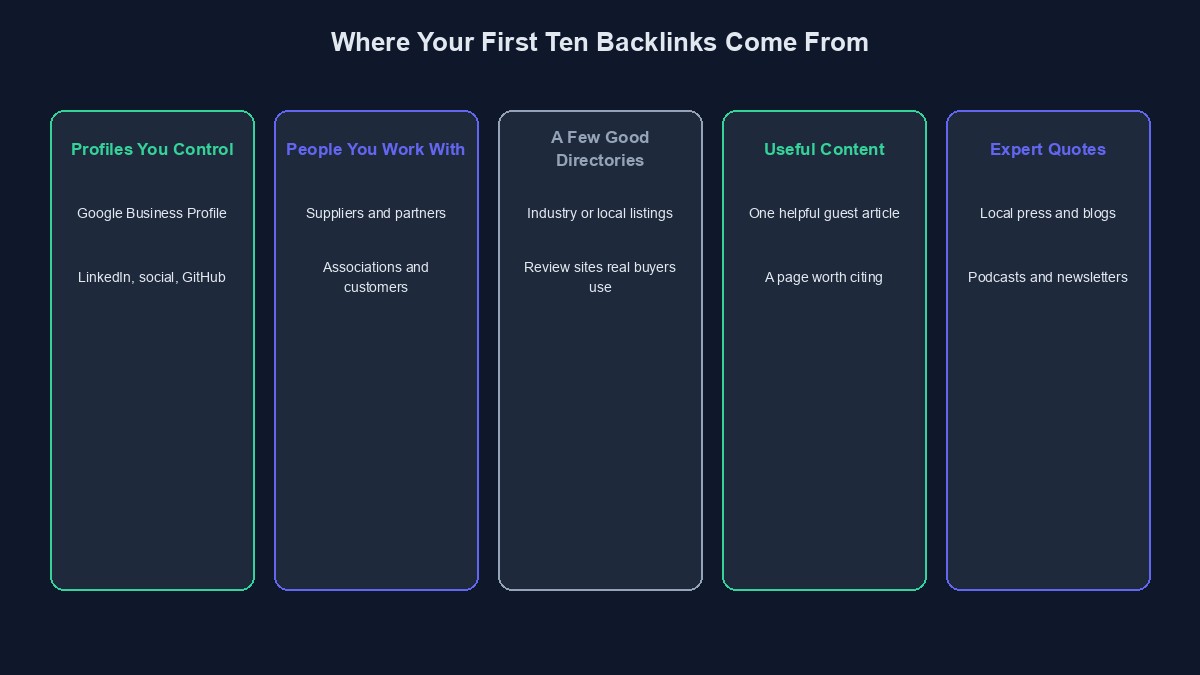
These are the easiest, and a few of them will not pass ranking value, but they are still useful because they make your business look real and give Google clear signals about who you are. Add your website to your Google Business Profile, your LinkedIn page, your Facebook and Instagram pages, your WhatsApp Business profile, and any profile you have on GitHub or similar sites. Many of these links are marked nofollow, which means they pass little or no ranking value. Do them anyway: they take an hour, and they help people and search engines connect the dots. Our guide on Google Business Profile shows how to do the most important one properly.
Source 2: People who already work with you
Suppliers, partners, payment providers, landlords, trade associations, and the school or club you belong to often have a page listing "our partners" or "our members." If you genuinely work with them, ask politely to be listed with a link. This is one of the best sources for a new business, because the link is relevant and the relationship is real. Customers are another source, and we cover them in detail in how to get backlinks from customers.
Source 3: A few good directories, not hundreds
Pick directories that real people in your industry or area actually use. For a service business that might be a respected industry directory or a local business listing. For a software or agency business, review sites such as Clutch can be relevant. Avoid sites that accept anyone and list ten thousand unrelated businesses. Those add no value and can make your profile look spammy. Five good listings beat fifty poor ones.
Source 4: Give something useful to a site that already has an audience
Write one helpful article for a blog or publication that your customers read. It might be a local business site, an industry newsletter or a community blog. Offer something they genuinely lack, such as a practical guide, a checklist or a small piece of data. Keep it honest and useful, and let your short author bio carry the link. Be careful with this one. Google's spam rules warn against large-scale guest posting campaigns with keyword-stuffed links, so do a few high-quality pieces, not a hundred cheap ones. If you want to be cited as an expert, our guide on turning mentions into links explains what to do when someone already mentions you.
Source 5: Be the person journalists and bloggers can quote
Local newspapers, business blogs and podcast hosts often look for people who can answer a question in their field. Offer a short, useful comment on a topic you know well. There are also services that connect experts with journalists. The original HARO service shut down in late 2024, and its brand was taken over and relaunched as a paid platform, while others such as Qwoted and Source of Sources serve a similar purpose, so check current pricing and rules before you join anything. A single quote in a respected article can be worth more than ten directory links.
Source 6: Make something worth linking to
People link to things that help them: a clear price guide, a free template, a calculator, a simple checklist, a useful local statistic. If you have one strong page like this, many of the other tactics get easier, because you now have a reason to ask. Our guide on creating original research goes deeper.
A simple four-week plan
Week one: check Search Console, then claim your profiles and your Google Business Profile. Week two: write to five partners, suppliers or associations and ask for a listing. Week three: submit your site to three relevant directories and write one helpful article to pitch. Week four: send three short, useful comment offers to writers in your field, then follow up on everything. If even half of these work, you will have your first ten.
How to ask without being annoying
Keep your message short and specific. Say who you are, why you are writing to this person, and exactly what you are asking for. Make it easy: give the page you would like linked and a sentence they can copy. Thank them whether or not they say yes, and never send the same message to hundreds of people.
What to avoid
Buying links. Google says paid links should be marked as sponsored or nofollow, and paid links designed to pass ranking value break its rules. It can harm a new site badly.
Link swaps in bulk. Occasional, natural exchanges happen. Large-scale "you link to me, I link to you" arrangements are a known spam pattern.
Keyword-stuffed anchor text. A link that says "best cheap web developer Lagos" looks unnatural. Natural links usually use your brand name, your website address or plain words.
Automated tools and mass directories. They create hundreds of weak links and very little value.
A short example
Illustrative example: the people, businesses and numbers in this section are made up to show how this works. They are not real clients or real results.
A small web design studio in Abuja checks Search Console and finds two existing links. It then adds its website to its Google Business Profile and LinkedIn, asks its hosting provider and a local business association for a partner listing, gets a profile on a respected review site, and writes one practical article on website costs for a local business blog. Within six weeks, it has about ten links, most of them relevant, and a handful of real enquiries.
Short glossary
Backlink: a link from another website to yours. Anchor text: the clickable words of a link. Nofollow: a tag that tells search engines the link should not pass ranking credit, though Google treats it as a hint. Search Console: Google's free tool for seeing how your site performs in search.
Where to go from here
For the full on-site side, read how to build a business website that generates leads from Google. Marketing is now part of what our team offers, so if you would like help with SEO and outreach, you can reach us on the contact page.
Comments
No comments yet. Be the first to share your thoughts.