How to Get Backlinks From Customers
Your customers are the people most likely to say good things about you, and many of them have their own website, blog, social page or business listing. Yet most businesses never ask them for a link. A link from a happy customer is one of the best you can get, because it is real, relevant and based on a real relationship. The trick is to ask in a way that feels natural, gives the customer something back, and does not break any rules. Here is how.
Why customer links are worth more than they look
A link from a customer's site tells search engines and readers that a real business trusts you enough to mention you. It often sits on a relevant page, such as "our suppliers," "our tools" or a blog post about working with you. It also sends visitors who are already warm, since they arrive because someone they trust pointed them to you. These links tend to be more durable than links from random directories.
Ask at the right moment
Timing matters more than wording. The best moment is just after something good happened: a project finished, a problem solved, a positive message from the customer. Do not ask on the first day, and do not ask when they are annoyed. A short, warm message right after a win usually gets a yes.
Method 1: A case study they are proud of
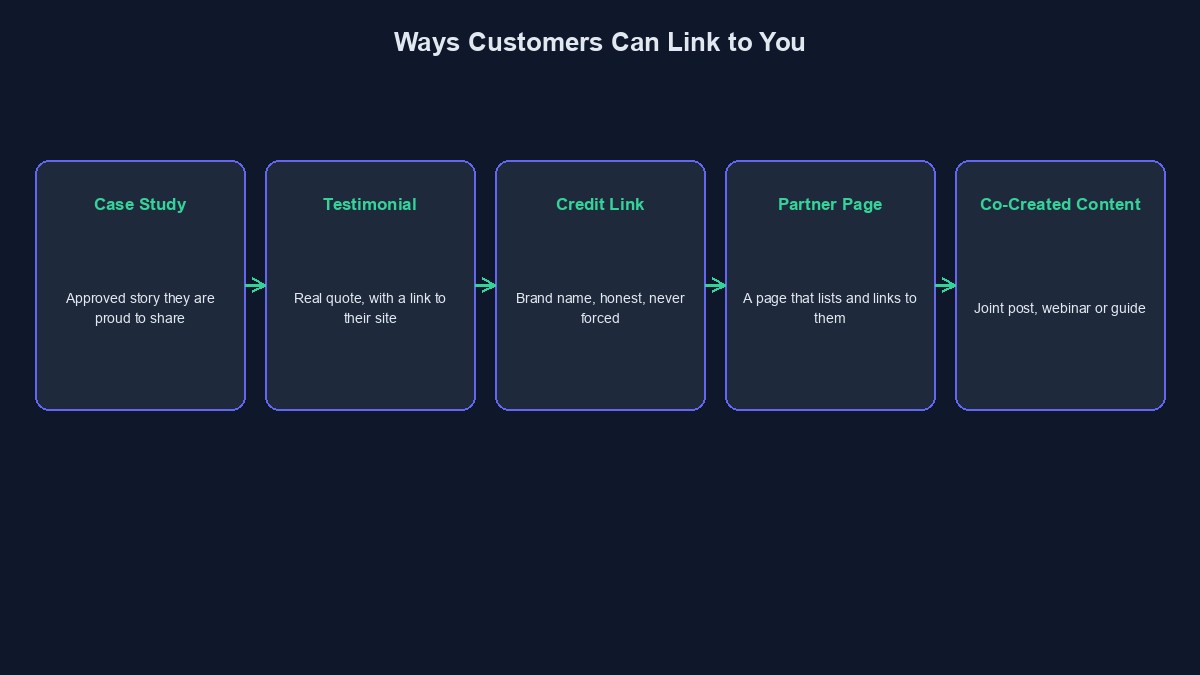
Offer to write a short story about what you did together and the result. Customers like being featured, because it promotes them too. Send them a draft, let them approve every claim, and add their photo, logo or quote if they agree. Publish it on your site and send them the link. Many will share it on their own site or social pages, and some will link to it from their blog or news page. Only use numbers that the customer has confirmed.
Method 2: A testimonial with a link
When a customer sends you a kind message, ask whether you can turn it into a short testimonial with their name, business and website. On your site, link their business name to their website. This is a friendly, reciprocal gesture, and many customers will then link back or share it. Do not write testimonials yourself or invent names. Real customers only.
Method 3: A "built by" or "powered by" credit, done carefully
Agencies and software platforms often add a small credit in a customer's footer, such as "Website by" or "Powered by." This can create many links, so Google has views on it. Its guidance says credit links you control, for example ones you put on client sites, are best marked nofollow, while plain boilerplate credits that come built in with a platform or theme are not something to worry about. Use your brand name as the link text, not a stack of keywords. Never make it a hidden requirement. Google's spam policy specifically warns against requiring a link in a contract or terms of service without letting the other party choose how to qualify it. Our own platform shows a "Powered by" credit using the brand name on customer sites, and businesses on the Enterprise plan can replace it with their own name. That is a good model: a visible, honest credit, with a clear option to change it.
Method 4: A customer or partner page on your site
Create a "Our customers" or "Who we work with" page, with permission, listing each business with a short description and a link to their site. This is a generous act, and it often prompts a reply like "we should list you too." It also gives prospects proof that you have real clients. Do not list anyone without asking.
Method 5: Co-create something
Offer to write a guest post for their blog, run a joint webinar, share a tip sheet, or interview them for a piece on your site. Content that you make together is naturally linkable, because both sides gain from sharing it. This works especially well with customers who have an audience of their own.
Method 6: Celebrate their wins
When a customer opens a new branch, wins an award or launches a product, congratulate them publicly and link to them. People notice that, and it often leads to them mentioning you in return, for example when they thank the team that helped them.
Method 7: Reviews on third-party sites
Ask happy customers to leave an honest review on Google or on a review platform used in your industry. Review links are often marked nofollow or ugc, so they pass less ranking value, but they build trust and send real visitors, and they support your reputation in search. Never offer money for positive reviews, and never review your own business.
What to say: a short template
Hi Tolu, thank you again for the kind message about the new booking system. Would you be open to me writing a short story about how it went? I would send you a draft for approval first. If you like it, it would be great if you could share it on your website or blog. Happy to link to your business in return. It is brief, it offers something, and it does not demand anything. Adjust it to your own voice.
Keep it voluntary, and keep it clean
Do not offer large discounts in exchange for links. If you give a customer something of value in return for a link, Google treats that as a commercial arrangement, and the link should be marked sponsored or nofollow. Keep requests friendly and optional, accept a no gracefully, and let customers choose how they link. This protects you, and it protects the relationship.
A short example
Illustrative example: the people, businesses and numbers in this section are made up to show how this works. They are not real clients or real results.
A small accounting software company in Ibadan finishes setting up a bakery chain. A week later it asks the owner if it can tell the story. The owner approves a short draft, shares it on the bakery's blog, and mentions the software in a post about their new year plans. The software company adds a customers page listing six businesses, with their permission. Over three months it earns a handful of relevant links, plus enquiries from other bakeries who read the story.
Mistakes to avoid
Asking everyone at once with the same message. Customers notice a mass request, and it rarely works.
Making a link a hidden condition of service. It risks trust and breaks Google's guidance.
Using keyword-heavy link text. Brand names look natural, and natural links last.
Short glossary
Case study: a short story showing how you helped a customer, with real results. Credit link: a small link such as "Website by" or "Powered by" in a site's footer. Nofollow / sponsored: tags that tell search engines a link should not pass ranking credit, used for ads, paid arrangements and some other links. Anchor text: the clickable words of a link.
Where to go from here
If you have no links at all yet, begin with how to get your first 10 backlinks. If people already mention you without linking, see how to turn unlinked mentions into backlinks. And if you would like help with SEO and outreach, marketing is now part of our services, so contact us on the contact page.
Comments
No comments yet. Be the first to share your thoughts.