How to Turn Unlinked Mentions Into Backlinks
Here is one of the easiest link-building jobs there is: somebody has already written about you, and all you need to do is ask them to add a link. These are called unlinked mentions. A blogger says your company name in an article, a journalist quotes you, a customer thanks you on their site, but there is no link to your website. Fixing this takes a short, polite message, and the success rate is usually better than cold outreach because the person already knows and likes what you do.
What an unlinked mention is
It is a place on the web where your business, product, founder or work is named, but the text is not clickable and no link points to your site. It might be your brand name in a news story, your product in a "best tools" list, your founder in a podcast description, or your photo or logo used without a link. Readers cannot easily click through, and search engines cannot count it as a link, so you lose both traffic and ranking value.
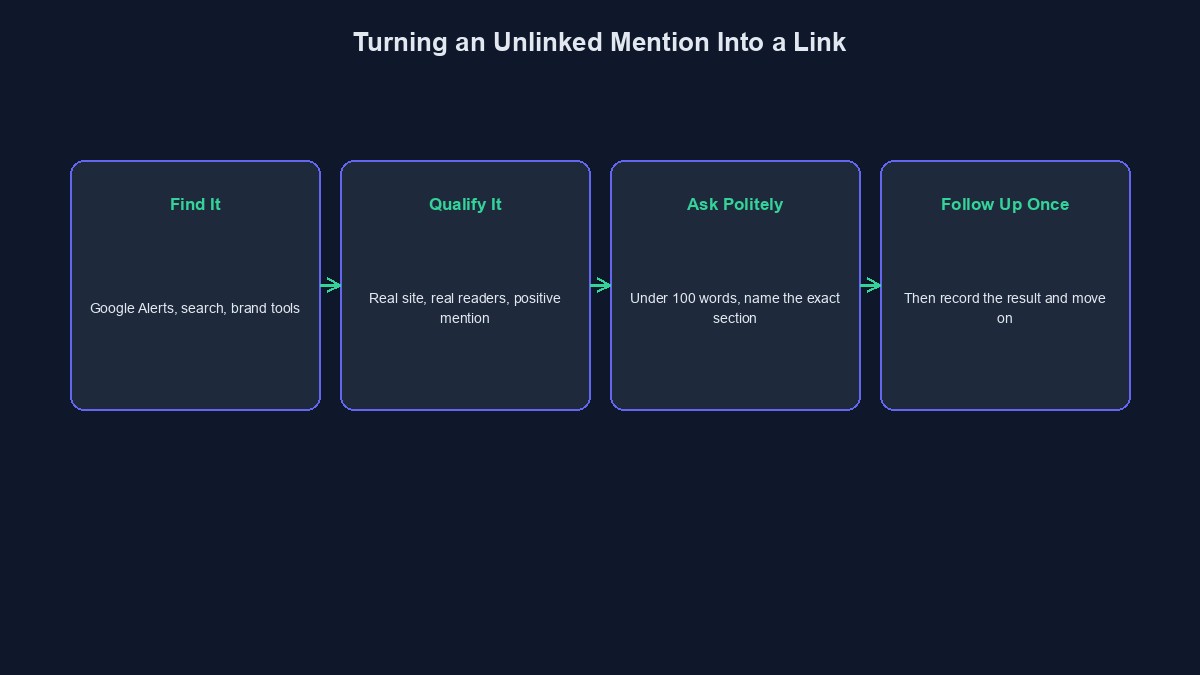
Step 1: Find the mentions
You have free and paid options.
Google Alerts is free. Create an alert for your brand name, your product names and your founders' names, in quotes, and you will get an email when Google finds new pages. It does not catch everything, but it is a good start.
A manual Google search also works. Search for your brand name in quotes and add -site:yourwebsite.com to hide your own pages. Look through several pages of results, and try the "News" and "Past month" filters.
Paid monitoring tools such as Ahrefs, Semrush and Brand24 can find mentions at a larger scale. Ahrefs, for example, has a Content Explorer with a filter that highlights pages that mention you but do not link to your domain. If your business is small, free tools are often enough.
Search for variations too: common misspellings, the short and long version of your name, your product names, and your founders' names. People often write them differently.
Step 2: Decide which ones are worth your time
Not every mention deserves an email. Focus first on pages that are on real sites with real readers, such as news sites, respected blogs, industry sites, university or association pages, and customer sites. Look at whether the page is current and whether the mention is positive or neutral. Skip scraper sites, auto-generated pages and anything spammy. Tools give each site an authority score, and some marketers set a minimum, but use your judgement as well. A small, relevant local blog can be more valuable than a large, unrelated site.
Step 3: Find the right person
Look for the author's name on the article, an "About" or "Contact" page, or the site's editor. Email a real person if you can, not a general inbox. If you cannot find an email, a message on the site's contact form or a professional social profile also works.
Step 4: Write a short, polite message
Keep it under about a hundred words. Name the specific article and the specific place the mention appears. Say thank you. Make the request easy by giving the exact link, and say why it helps readers. For example:
Hi Chioma, thank you for including our booking tool in your article "Five Tools for Small Salons." I noticed the mention in the third section does not link to us. Would you be open to linking the name to our website, https://example.com, so readers can find it easily? Thank you for the kind words, and let me know if I can help with anything for future pieces.
Do not demand, argue or threaten. Do not suggest that they owe you a link. And do not ask for a keyword-heavy anchor. A link on your brand name is perfect.
Step 5: Follow up once, then move on
People are busy. If you hear nothing after a week or so, send one short reminder. If there is still no reply, leave it. You can try again months later if you publish something new that fits the page. Keep a simple sheet with the page, the contact, the date you wrote, and the result, so you do not email the same person twice by accident.
A related quick win: linked mentions that point to the wrong place
Sometimes a page links to you, but to an old or broken address. Ask the writer to update it to the correct page. This is just as polite a request, and the link already exists, so it is easy for them to agree.
Images, logos and quotes count too
If someone uses your photo, your logo or a screenshot of your product, they are likely to be happy to credit and link to the source. Ask for a credit with a link back to the original page.
Be honest about the results
Not everyone says yes, and a link will not make you rank first by itself. But this is one of the cheapest tactics, since the hard work of earning attention is already done. A modest number of replies and links from relevant sites is a good outcome. Never offer payment for a link. If money is involved, the link should be marked sponsored or nofollow under Google's rules, and the request becomes a different matter.
Make it a habit
Set up your alerts once, then spend thirty minutes a month going through new mentions. Over a year, that small habit adds up to many links you would otherwise never have earned. It also helps you spot complaints or misunderstandings about your business early, which is useful in its own right.
A short example
Illustrative example: the people, businesses and numbers in this section are made up to show how this works. They are not real clients or real results.
A small Lagos web agency sets up a Google Alert for its name. Three weeks later it finds a local business blog that praised the agency's work on a restaurant site, without linking. The agency's owner writes a four-line message to the blogger, thanks them, and asks for the link. The blogger adds it the same afternoon. A month later, another alert shows a podcast listing that names the agency's founder. A similar short message gets the link added to the show notes.
Mistakes to avoid
Sending a template with no personal detail. Mention the article and the exact section, or it looks like spam.
Chasing low-quality sites. A link from a spammy page will not help, and can look odd in your profile.
Being pushy. One polite reminder is enough. Your reputation is worth more than one link.
Short glossary
Unlinked mention: a page that names your brand without linking to your website. Brand monitoring: tracking where your name appears online. Outreach: contacting a site owner or writer to ask for something. Anchor text: the clickable words in a link.
Where to go from here
If you are just getting started, read how to get your first 10 backlinks. To earn links from the people you already work with, see how to get backlinks from customers. And if you would like help setting up monitoring and outreach, marketing is now part of what our team offers, so you can reach us on the contact page.
Comments
No comments yet. Be the first to share your thoughts.