How to Hire a Digital Marketer in Nigeria (and What to Pay in Naira)
Many Nigerian business owners hire a digital marketer the same way they buy a used car: they hear a number, trust a smile, and hope for the best. Three months later they have more followers, fewer sales, and no idea what they paid for. It does not have to go this way. Hiring a digital marketer is much easier when you know what you are buying, what it should cost in naira, and how to check that the work is real.
Step 1: Decide what you want, in plain words
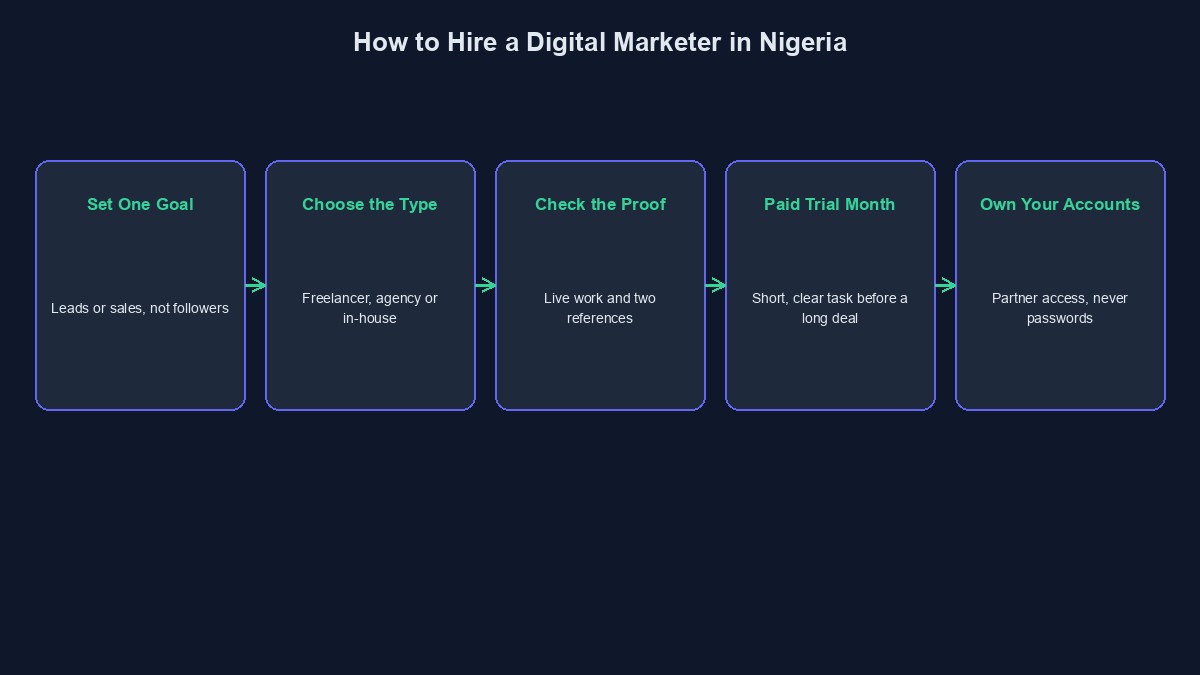
"I want more followers" is not a goal. "I want 30 new customers a month from Instagram and WhatsApp" is. Before you speak to anyone, write down one result that would make you say the money was well spent: more orders, more bookings, more enquiries, more people walking into your shop. A good marketer will work backwards from that number. A weak one will talk about likes.
Step 2: Choose who to hire
You have three real choices in Nigeria, and each one suits a different stage of business.
A freelancer. One person, usually the cheapest and the most flexible. Good for a small business with one or two channels. The risk is that one person cannot be an expert in everything, and if they get busy or travel, your work slows down. Typical prices: social media management about ₦80,000–₦200,000 a month ($60–$150), a Facebook and Google ads specialist about ₦200,000–₦600,000 a month ($150–$450), and an all-in-one freelancer about ₦400,000–₦1,000,000 a month ($300–$750).
An agency. A team: strategist, designer, writer, ads person. More reliable and better for bigger needs, but you pay for the team behind the scenes. Small agencies often charge ₦100,000–₦300,000 a month for a basic package, mid-size ones ₦300,000–₦700,000, and established agencies ₦700,000–₦1,500,000 or more.
An in-house employee. Someone on your payroll. Entry-level pay is around ₦80,000–₦180,000 a month, mid-level (three to five years) about ₦250,000–₦450,000, and a head of digital ₦700,000–₦2,000,000 or more. This makes sense when you have enough steady marketing work to keep a person busy every day.
These numbers come from salary and pricing guides published in 2026 and they vary a lot. Use them to sense-check a quote, not as a fixed price list. At about ₦1,330 to the dollar, ₦200,000 is roughly $150, or about €132.
Step 3: Know what is usually NOT included
The monthly fee pays for the marketer's work. It usually does not pay for the adverts themselves. If you want Facebook or TikTok ads, the ad budget is a separate amount that goes straight to the platform. It also often does not cover photography, video shooting, or influencer fees. Ask what is included and what is not, in writing.
How marketers charge: the pricing models
Prices differ, but so does the way you are charged. Knowing the model tells you what the marketer is incentivised to do.
- Monthly retainer. A fixed fee each month for an agreed list of work, such as a number of posts, one ad campaign and a report. This is the most common arrangement for social media and ongoing management. It is predictable, but make sure the list of deliverables is written down, because "management" can mean very little.
- Fixed fee per project. One price for a defined job: a campaign, an audit, a Google Business Profile set-up, a content plan. Good when the work has a clear end. Check what happens if you ask for changes.
- Hourly or day rate. Common for consultants and specialists. Useful for advice or training, but ask for an estimate and a cap so the bill cannot run away.
- Percentage of ad spend. Some ad specialists charge a share of what you spend on ads. It is easy to understand, but it rewards spending more, not selling more, so pair it with a clear cost-per-lead or cost-per-order target.
- Commission or pay for results. A fee tied to leads or sales sounds fair, and it can be, but only if you agree in advance how a lead or sale is counted and who can check it. Vague definitions are the main source of arguments.
For most small businesses a short retainer with clear deliverables, plus your own ad budget, is the simplest place to start.
Step 4: Find candidates
The best leads are other business owners. Ask someone in your industry who runs their marketing and whether they are happy. Beyond that, you can look on LinkedIn, on freelance sites such as Upwork, and in local business and creator communities. Look at real pages and campaigns the person manages, not only screenshots. Our guide on questions to ask and red flags gives you a full list for the interview.
Step 5: Start with a one-month trial
Do not sign a twelve-month contract on day one. Offer a paid first month with a clear task, for example "set up and run one lead campaign and one weekly content plan." You will learn how they communicate, how fast they work, and whether their ideas fit your business. If it goes well, extend. If not, you have lost one month and not a year.
Step 6: Agree on numbers, not feelings
Decide together what to measure: messages received, leads, orders, cost per lead, cost per sale. Ask for a short report every two weeks in plain language. Clicks and impressions are fine as side information, but they do not pay your rent. If your marketer cannot connect their work to enquiries or sales, keep asking until they can.
Which numbers to agree for your goal
Pick the measures that match what you actually want, and write down how each one is counted.
- If you want orders: orders per month, and cost per order (marketing spend divided by orders).
- If you want enquiries or leads: leads per month, cost per lead (spend divided by leads), and how many leads become customers.
- If you want bookings or walk-ins: bookings per month and where each customer says they heard of you. Ask every new customer.
- If you sell on WhatsApp: conversations started, replies, and orders that came from them.
Be clear what counts as a "lead". A person who tapped an ad and started a chat is not the same as a person who asked a real question about buying. If the marketer is paid on leads, agree a definition that matches real interest. Ask for the same simple table every report so you can compare month to month, and keep your own count of orders to check theirs against.
Step 7: Keep ownership of everything
Your Facebook page, Instagram account, Google Business Profile, ad accounts and website should all be in your name, with your email. Give the marketer a partner or manager role instead of your password. If you part ways, you lose the person, not the accounts. This is the single most important protection, and many owners learn it too late.
What to put in the agreement
Even a one-page agreement protects both of you. It should say:
- What is delivered: for example the number of posts a week, the number of campaigns, the reports and the meetings.
- The fee and what it does not cover, including that the ad budget is separate and paid from your own account.
- The numbers you will track and how often you will get a report.
- Access and ownership: your accounts stay in your name, with the marketer as a partner, and you own the content made for you.
- Reply times on both sides, including how fast you must approve content.
- Term and exit: a short initial term, a notice period, and a handover of logins, files and reports if you stop.
- Confidentiality of your customer lists and prices.
This is general guidance, not legal advice. For anything large or long, have a Nigerian lawyer read it.
What you must do on your side
A marketer cannot fix a business that is not ready to sell. Someone must answer messages quickly, ideally the same day. Your prices, delivery details and photos must be clear. And someone on your team must be able to approve content fast. Many "failed" campaigns are really slow-reply problems: the adverts worked, and the leads went cold waiting.
How long before you see results
Paid ads can bring enquiries within days, although it often takes two to four weeks to learn what works. Social media and content build trust over a few months. Search engine work (SEO) usually takes several months before it pays. Be wary of anyone who promises fast, guaranteed results on everything.
What the first 90 days should look like
- Days 1 to 30: set up and measure. The marketer studies your customers and your current numbers, sets up tracking so orders and leads can be counted, tidies your profiles, and runs a small first test. You should see a written plan.
- Days 31 to 60: test and learn. Two or three ideas are tried at small cost. You should see what worked, what did not and what they will do next, backed by numbers.
- Days 61 to 90: decide. Put more behind what worked, drop what did not, and decide whether to continue. If after three months you still cannot connect their work to enquiries or sales, it is time to change something.
A short example
Illustrative example: the people, businesses and numbers in this section are made up to show how this works. They are not real clients or real results.
Bisi sells ankara bags in Ibadan. She wanted "more customers on Instagram." Her marketer asked what that meant, and together they chose a goal: 25 WhatsApp orders a month. They started with a one-month trial at ₦120,000, plus a separate ad budget of ₦30,000. The marketer posted three times a week and ran one lead ad that opened WhatsApp. She replied to every message within an hour. At the end of the month they could see exactly which posts brought orders. She renewed with a clear plan.
Signs it is not working, after you have hired
- Reports full of impressions and likes, with nothing about leads or orders.
- No plan for the next month, and no explanation of what was learned from the last.
- Missed deadlines, slow replies, or a different person doing the work each month.
- Asking for more ad budget without showing what the last budget produced.
- Blaming your slow replies without showing the data, or the opposite: you replying slowly while blaming the marketer.
- Reluctance to show you the accounts, or to add you as an admin.
If you see these, ask in writing for a plan and a set of numbers within two weeks. If it does not improve, use your notice period. That is exactly why you started with a short trial and kept ownership of your accounts.
A hiring checklist you can copy
- I wrote one goal as a number.
- I decided between a freelancer, an agency and an employee, and I know what each costs.
- I know what the fee covers, and what it does not.
- I looked at real, current work, and spoke to at least one current client.
- I asked the interview questions and noted the red flags.
- We agreed which numbers to track and how a lead or sale is counted.
- The agreement is in writing, with a short term and a notice period.
- My accounts stay in my name, with the marketer added as a partner.
- I have someone ready to reply to messages the same day.
- I will review the results at 30, 60 and 90 days.
Common mistakes
Hiring on price alone. A very cheap marketer often does generic work. A very expensive one is not always better. Check the work.
Not separating fee from ad budget. Many people are surprised by the second bill.
Giving away passwords. Use partner access so you can remove people at any time.
Further reading
Compare costs across countries in how much a digital marketer costs, and learn the different roles in social media manager vs digital marketer vs agency. Marketing is also part of what our own team offers now. You can read about our marketing service, or if you would like to talk about your business, use our contact page. We are not neutral here, so ask us the same questions you would ask anyone else.
Software engineer with over 9 years of experience in software development and digital technology. B.Sc. in Industrial Chemistry from Adekunle Ajasin University. Has worked across web development, mobile applications, e-commerce platforms, VTU and fintech solutions, API integrations and custom software.
Comments
No comments yet. Be the first to share your thoughts.