How to Hire a Digital Marketer: 15 Questions to Ask and Red Flags to Avoid
Interviewing a digital marketer is hard if you are not one. The good ones sound confident, and so do the bad ones. The difference shows up months later, when you are paying every month and cannot tell what you are getting. These fifteen questions, plus the warning signs after them, help you tell the difference in a single conversation. They work in Nigeria, Ghana, the UK or anywhere else.
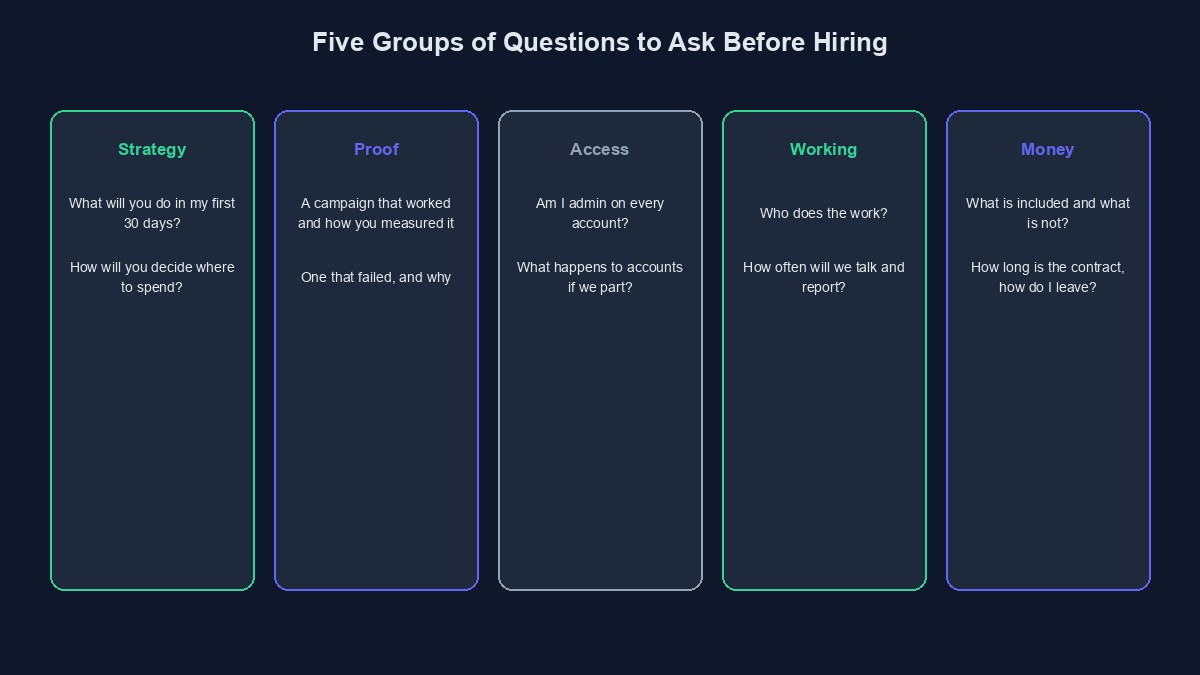
Questions about strategy
1. What would you do in my first 30 days? A good answer includes looking at your business, your customers and your current numbers before posting anything. If the answer is "I will start posting," they have no plan.
2. How will you decide where to spend my money? You want to hear about testing small, learning, and then putting more behind what works.
3. What results can I realistically expect in three months? An honest marketer gives a range and explains what could change it. Be careful with anyone who gives you one big promise.
4. What do you need from me? Good marketers need quick replies, product details, photos and decisions. If they need nothing, they are not planning to do much.
Questions about proof
5. Tell me about a campaign that worked. How did you measure it? Listen for real numbers connected to leads or sales, not "we got lots of impressions."
6. Tell me about one that failed. Everyone has one. A good answer is honest and shows what they changed.
7. Can I speak to a current client? Real marketers are happy to connect you. Ask the client whether the numbers were shared, whether replies were fast, and whether they would hire again.
8. Have you worked with a business like mine, in a market like mine? Experience with your type of customer matters more than a long list of famous logos.
Questions about access and ownership
9. Will I be an admin on every account you manage? The answer must be yes: your ad accounts, analytics, social pages and website tools.
10. What happens to the accounts, content and data if we stop working together? Everything should stay with you.
11. Do I pay the advertising platform directly? Safer practice is for your own card or payment method to be attached to your own ad account, with the marketer given partner access. You want to see the ad spend yourself.
Questions about how you will work
12. Who will actually do the work? With agencies, the person who sells to you is often not the person who works on your account. Ask to meet them.
13. How often will we talk, and what will your reports contain? Look for regular check-ins and reports that connect to messages, leads or orders.
Questions about money
14. What is included in your fee, and what is not? Ask about ad spend, design, video, tools, and changes. See also our guide on getting an accurate quote, which uses the same logic for any project.
15. How long is the contract, and how do I leave? Prefer monthly or short terms, with a clear notice period. Long contracts with penalties are the marketing version of lock-in.
Red flags
Guaranteed results. Nobody can guarantee first-page Google rankings, a number of followers, or a fixed number of sales. Anyone who does is guessing or planning something risky.
Only talking about vanity numbers. Likes, views and impressions are easy to produce and do not pay bills. Ask about leads, customers and revenue.
Buying followers or fake engagement. It makes a page look bigger and then damages its reach and trust.
No access to your own accounts. If they run the ad account under their name and will not add you, walk away.
Asking for your passwords. You should be able to add them as a partner or manager through the platform, such as Meta Business Manager, without sharing a password. Please also read our guide on recovering a hijacked ad account to see what is at stake.
A "secret formula." Good marketing is mostly testing, patience and clear thinking. Secrecy is usually a sign there is nothing behind it.
Pressure to sign today. A fair offer will still be there tomorrow.
Green flags
They ask about your business before quoting. They give ranges and risks. They explain things in plain words. They show you real, current work. They put the first month on a short, clear trial. And they are comfortable with you having full control of your accounts.
A small scoring sheet
After each interview, give a score from one to five for each of these: understood my business, clear about numbers, honest about risks, gave real proof, fair about ownership and contract. Write the scores down. It helps you stay fair when one candidate is simply the most charming.
A disclosure, and a challenge
Marketing is now part of what our team offers, so we are not a neutral writer here. Ask us all fifteen of these questions too. If you would like to talk, you can reach us on our contact page, and we will answer them in writing.
Short glossary
Vanity metric: a number that looks good but does not connect to sales, such as likes or impressions. Partner access: a way to let someone manage your account without sharing your password. Retainer: a fixed monthly fee for ongoing work.
Where to go from here
For Nigerian prices and the full hiring process, see how to hire a digital marketer in Nigeria. To understand the different job titles you will meet, read social media manager vs digital marketer vs agency. The same checking mindset applies when hiring a developer, which we cover in evaluating a developer if you don't code.


Comments
No comments yet. Be the first to share your thoughts.