How to Reduce Cart Abandonment in a Nigerian Online Store
A visitor adding a product to their cart and then leaving without paying feels like a mystery every time it happens, and it genuinely is not one. Cart abandonment has well-understood, largely predictable causes, and the causes that actually matter for a Nigerian online store are meaningfully different from the generic advice written for a store selling to shoppers in a market with reliable delivery, universal card trust, and fast home broadband. This guide covers what genuinely drives abandonment for Nigerian shoppers specifically, and the concrete fixes, not generic checkout-optimisation tips that assume a different market's conditions.
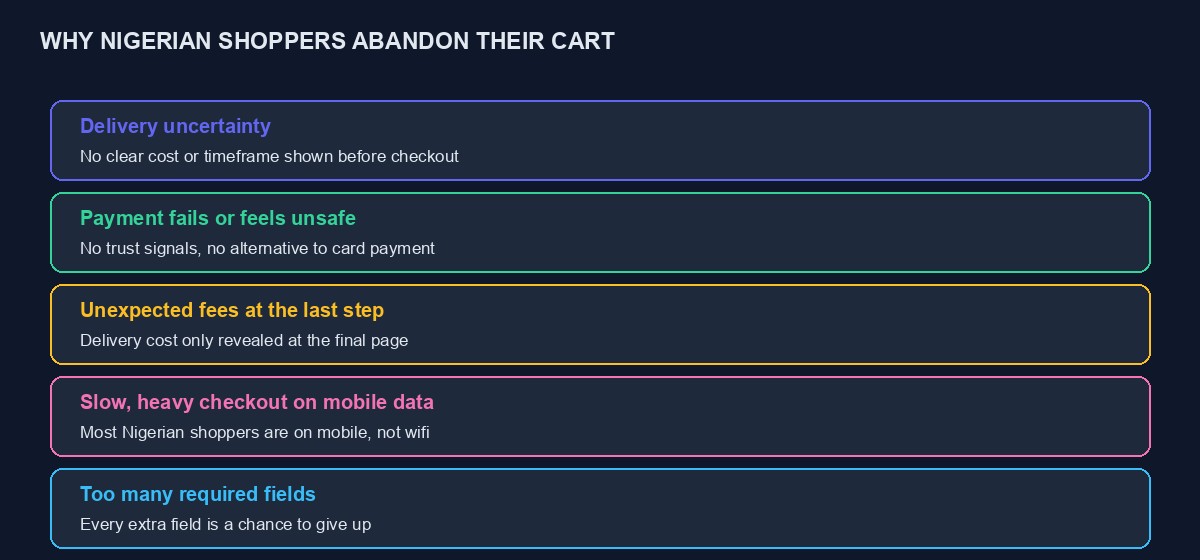
Delivery uncertainty: the single biggest Nigeria-specific cause
A shopper who reaches checkout without a clear, specific answer to "when will this actually arrive, and what will it cost" is a shopper genuinely unsure whether to commit, and this uncertainty is worse in Nigeria than in markets with more standardised, predictable delivery. Show delivery cost and a realistic timeframe as early as possible, ideally on the product page itself, not revealed for the first time at the final checkout step, following the honesty principle covered in our guide to reducing failed deliveries. A shopper who knows upfront that delivery to their area costs a specific amount and takes a specific number of days can decide confidently; one who discovers this only after filling in their details has already invested effort they may not want to abandon, and yet frequently does anyway when the number surprises them unpleasantly.
Payment trust: why "just add a payment gateway" is not the whole answer
A working payment gateway, covered in our guide to accepting online payments in Nigeria, solves the mechanics of taking money. It does not automatically solve a hesitant shopper's underlying question: is this specific, unfamiliar store safe to pay. Real trust signals, a findable address, a working phone number, genuine reviews, matter as much as the payment mechanism itself, and a store with a smooth checkout and no visible trust signals still loses hesitant, first-time shoppers who simply are not yet confident enough to complete a payment to a business they cannot independently verify.
Offering more than one payment method, specifically
A checkout offering only online card payment excludes shoppers who prefer, or in some cases genuinely need, another method: bank transfer, which many Nigerian shoppers trust more than entering card details on an unfamiliar site, or pay-on-delivery, which removes the upfront trust requirement entirely for a shopper still deciding whether to trust a new store. Offering a genuine choice at checkout, rather than a single, rigid payment path, directly recovers a share of shoppers who would otherwise abandon specifically because their preferred method was not available.
Unexpected fees at the final step
Nothing produces a faster abandonment than a shopper reaching the final confirmation page and discovering the actual total is meaningfully higher than what they saw on the product page, delivery, a service charge, a payment processing fee added late in the flow. Show the genuinely complete, final total as early in the checkout process as you reasonably can, and if a fee is unavoidable, state it clearly before the final step rather than letting it arrive as a last-moment surprise a shopper reasonably experiences as a bait-and-switch, however unintentional it actually was.
Mobile-first checkout, because that is genuinely how most shoppers arrive
The large majority of Nigerian online shopping happens on a phone, frequently on mobile data rather than wifi, and a checkout designed and tested primarily on a desktop browser, then assumed to work fine on mobile because it is technically responsive, often has real, specific friction a desktop test never surfaces: small tap targets, a heavy page that loads slowly on a weaker connection, a form field that triggers the wrong keyboard type on a phone. Test your actual checkout on a real phone, on mobile data specifically, not wifi, and time how long it genuinely takes, since every additional second of loading during checkout is a moment a hesitant shopper can decide to simply leave instead of waiting.
Too many required fields
Every additional field a checkout requires is a small, cumulative cost in effort and a small, cumulative opportunity for a shopper to reconsider and leave. Review your checkout honestly and remove any field that is not genuinely necessary for that specific order, offer guest checkout rather than forcing an account creation step for a first-time buyer, and where a field genuinely is necessary, explain briefly why it is being asked for if it is not immediately obvious, since an unexplained, seemingly unnecessary request for information reads as suspicious to a cautious shopper rather than merely inconvenient.
Recovering an abandoned cart, once it happens
Not every abandonment is final. A shopper who leaves mid-checkout, having provided a phone number or email, is worth a genuine, well-timed follow-up: a short, specific WhatsApp or SMS message, sent within a few hours rather than days, asking simply whether they ran into a problem completing their order, works better in the Nigerian context than a generic automated email, given how much higher WhatsApp and SMS open rates run compared with email here. Keep this follow-up genuinely helpful rather than purely a sales push, offering to answer a question or resolve whatever caused the hesitation, which recovers a meaningfully larger share of abandoned carts than a message that reads as simply "you forgot to pay us."
Cash on delivery: recovering a shopper who does not trust upfront payment yet
Offering cash or pay-on-delivery as an explicit checkout option is one of the most effective single levers for a newer Nigerian store specifically, since it removes the trust requirement entirely for a shopper who is genuinely interested in the product and simply not yet confident enough in an unfamiliar business to pay before receiving it. This is not a permanent solution for every store forever, since it carries its own real operational cost and risk, covered in our guide to reducing failed deliveries, but for a store still building its reputation, it converts a meaningful share of hesitant shoppers who would otherwise abandon at the payment step specifically, and it is worth offering deliberately during your early months even if you plan to phase it out or restrict it once a stronger track record and more established trust signals are in place.
The specific psychology of an unfamiliar Nigerian online store
It is worth understanding, specifically, what a hesitant shopper is actually weighing at the moment of abandonment, since the fix follows directly from the real concern rather than a generic assumption. A shopper is rarely worried about the product itself at this stage, they have already added it to cart, showing genuine interest. What they are weighing is a specific, concrete risk: will this unfamiliar business actually deliver what was promised, and if something goes wrong, will there be any real recourse. Every trust signal covered throughout this guide, a real address, a working phone number, genuine reviews, a clear returns policy, exists specifically to answer that underlying question, and a checkout optimised purely for speed and fewer clicks, without addressing this genuine underlying hesitation, will still lose shoppers who simply were never convinced enough to proceed regardless of how few fields the form required.
Testing your checkout the way a genuinely hesitant shopper would
Beyond the technical testing covered above, run your own checkout the way a cautious, first-time visitor actually would: read your own product and checkout pages as if you had never heard of your business before, and ask honestly whether you would trust it with your own money at this exact moment. If the answer is uncertain even to you, a founder who already trusts the business completely, a genuinely unfamiliar visitor is considerably less likely to feel confident, and this exercise often surfaces a missing trust signal, an absent phone number, a vague or missing returns policy, more clearly than any analytics dashboard would on its own.
A note on payment failures specifically, distinct from abandonment
Not every checkout departure is a genuine choice to leave. Some are a payment that genuinely failed, covered in depth in our guides to what happens when a payment fails but money appears deducted and how to accept online payments in Nigeria, and a shopper whose card was declined or whose bank transfer did not process correctly may have wanted to complete the purchase and simply hit a technical wall. Distinguish this category from genuine, voluntary abandonment where possible, since the fix is different: a payment failure needs a clear, specific error message and an easy way to retry or choose a different method, not the trust-building and friction-reduction changes that address voluntary abandonment.
A worked example: an imagined skincare store's checkout audit
Picture a small skincare store noticing a high share of visitors adding products to cart and never completing checkout, with no clear sense of why. Reviewing the actual checkout flow honestly, rather than assuming the products themselves are the problem, surfaces three specific issues: delivery cost is calculated and shown only after a shopper has already entered their full address and payment details, a WhatsApp button exists but is buried at the bottom of the page rather than visible during checkout for a hesitant shopper wanting to ask a quick question first, and the checkout form asks for eight fields, including several, like a full delivery address entered twice for confirmation, that add friction without adding genuine value.
Three specific, low-cost changes follow directly: delivery cost now shows on the product page itself, calculated by the shopper's selected area before they ever reach checkout, the WhatsApp button becomes visibly present throughout checkout rather than only on the homepage, and the redundant confirmation field is removed, cutting the form from eight fields to five. Within a month, the share of visitors completing checkout after adding a product to cart rises meaningfully, not through a different product range or a discount campaign, but through removing the specific, identified friction that was quietly costing sales the owner had not previously been able to see clearly.
Mistakes that keep abandonment high without anyone noticing why
Assuming a lower price fixes abandonment caused by trust, not price. Discounting a product that shoppers were never actually hesitant about the price of does nothing for the real, underlying delivery or trust concern driving the departure.
Only reviewing total sales, never the specific checkout drop-off point. Total revenue can look stable while a genuinely fixable friction point quietly costs a meaningful share of otherwise-interested shoppers every single day, invisible unless you look at the checkout funnel specifically.
Treating a recovery message as purely promotional. A follow-up that reads as "buy now" rather than "did something go wrong, can I help" performs noticeably worse at actually recovering a genuinely hesitant shopper.
Measuring this properly, not just guessing
Basic analytics showing where in your checkout process shoppers actually stop, covered in our broader guide to getting more customers online, turns cart abandonment from a vague, frustrating mystery into something you can genuinely diagnose. A checkout where shoppers consistently drop at the same specific step is telling you something concrete and fixable about that step, and reviewing this data periodically, rather than only looking at total completed sales, is what actually reveals which of the causes covered in this guide is your store's specific, dominant problem.
A short checklist for your own checkout
Show real delivery cost and timeframe as early as possible, ideally before checkout begins. Offer more than one payment method, including at least one alternative to online card payment. Show the genuinely complete total early, with no late surprises. Test your actual checkout on a real phone, on mobile data. Remove any field that is not genuinely necessary. Keep a visible, easy way to ask a quick question during checkout, not just before it. And follow up on an abandoned cart quickly and helpfully, through WhatsApp or SMS, not a generic, sales-only email days later.
Where this connects to running your store
Reducing cart abandonment sits alongside the other operational details covered in our guides to starting an ecommerce business in Nigeria and reducing failed deliveries, and it is one of the highest-leverage improvements available to an existing store, since fixing a specific, identified friction point in an already-working checkout typically costs far less than acquiring new visitors to replace the ones quietly being lost at that step.
If you are building or running your store on our ecommerce builder, delivery pricing by area, multiple payment gateway options, and a visible WhatsApp integration are already built into the standard checkout flow, giving you the foundation this guide assumes rather than requiring you to build each piece separately. You can start building free to see it directly.


Comments
No comments yet. Be the first to share your thoughts.