How to Sell Products Online Without a Physical Shop
The idea of selling products online without ever renting a shop is not new, but a surprising number of people who could genuinely do it hold back, assuming it requires more infrastructure, more capital, or more technical skill than it actually does today. The real requirements are more modest than most people assume, and the real challenges are different from what most people worry about.
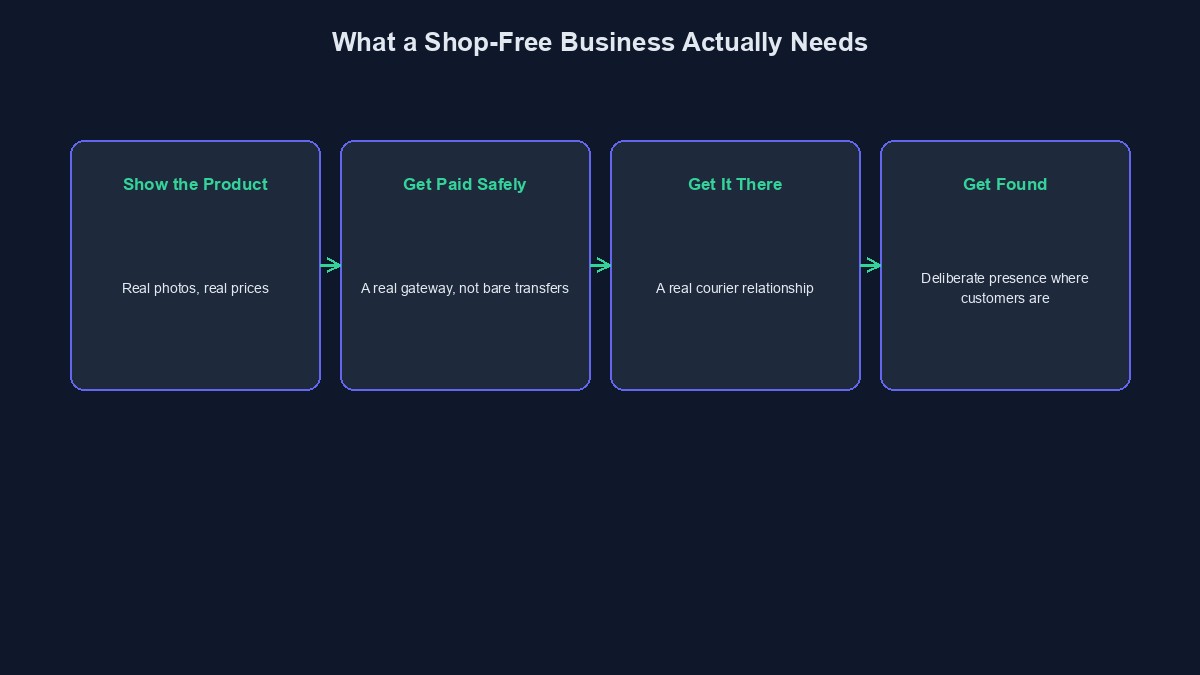
What you genuinely need, stripped to the essentials
A way for customers to actually see what you are selling, with real photos and real prices. A way for them to pay you, reliably and safely, without needing to meet in person or trust a bare bank transfer with no receipt trail. A way to get the product to them once they have paid. And a way for people to actually find out you exist in the first place. That is the genuine list. Everything else, a fancy custom-built platform, a large starting inventory, a formal registered office, is optional infrastructure that can come later, once the core loop above is actually proven to work with real customers.
Where the products themselves actually come from, without a shop to store them in
Holding your own stock at home is a genuinely reasonable starting model for many products, and it is worth not overcomplicating this choice unnecessarily. But for businesses wanting to start with less upfront capital tied up in inventory, dropshipping, where a supplier ships directly to your customer and you never personally handle the product at all, is a real, workable model many small Nigerian sellers already use successfully, provided the supplier relationship is genuinely reliable, since your own reputation depends entirely on a fulfilment process you do not directly control. Either model can work; the honest answer to which one fits depends on your specific product, your available starting capital, and how much control over quality and delivery speed genuinely matters for what you are selling.
Payment: the part that has to be trustworthy before anything else works
A customer paying a stranger online, with no physical shop to visit if something goes wrong, needs a genuine reason to trust the transaction, and a real, properly integrated payment gateway, not a bare request for a bank transfer with no receipt or confirmation, is the single biggest trust signal available to a business with no physical presence. Our guide to accepting online payments in Nigeria covers the practical setup, and getting this right early is worth more than almost any other single decision in this specific business model.
Building genuine trust when a customer cannot walk into your shop
Without a physical location a customer can visit, trust has to be earned through other, deliberate signals: real, honest product photos rather than only manufacturer stock images, genuine customer reviews, a real, responsive way to reach you with a question before they commit to buying, and consistent, honest communication about delivery timelines rather than optimistic guesses. A new, unproven seller can meaningfully accelerate this trust-building by offering pay-on-delivery for genuinely hesitant first-time customers, even if the goal is eventually phasing it out once a real track record and real reviews exist.
Delivery: where a shop-free business's real operational challenge actually lives
Without a physical location, every single order depends entirely on a delivery process working correctly, and this deserves real, deliberate attention rather than being treated as an afterthought. Getting genuine quotes from real courier services for the specific areas you actually expect to serve, being honest with customers about realistic delivery windows rather than optimistic ones, particularly for areas outside major cities, and having an actual, clear policy for what happens when a delivery fails, covered in more depth in our guide to reducing failed deliveries, together determine whether the absence of a physical shop feels like a genuine limitation to customers or simply an invisible detail of how the business operates.
Getting found: the part a shop's physical location used to handle for free
A physical shop on a busy street gets a certain amount of passive discovery simply by existing where people walk past. A shop-free online business has no equivalent, and getting found requires deliberate effort: a genuinely findable website, covered in our broader guide to getting more customers online, an active, consistent presence wherever your specific customers actually spend time, Instagram, WhatsApp status, relevant Nigerian marketplace platforms, and word of mouth deliberately encouraged through genuinely good early customer experiences rather than left to chance.
The legal and financial basics worth not skipping
Operating without a physical shop does not mean operating without any formal footing, and a few unglamorous basics genuinely protect the business as it grows: registering the business itself, even at a small scale, since this becomes necessary the moment you want a real business bank account or a genuine payment gateway account in your business's own name rather than a personal one. Keeping honest, separate records of business income and expenses from day one, before the habit becomes harder to build once volume increases. And understanding, even briefly, your actual tax obligations as a genuine business, rather than assuming a small, home-based operation is automatically exempt from anything.
A worked example: a realistic first six months
Picture someone starting a small business selling locally sourced skincare products, with no shop, working from home, starting deliberately narrow with six products rather than the full twenty-item range eventually planned. A real payment gateway is connected from day one, rather than relying on bare bank transfers, and delivery is quoted honestly, based on real conversations with two actual courier services rather than an optimistic guess. The first genuine sales, mostly from people already loosely connected through social media, surface two real, fixable problems early, one product's photos undersold how it actually looked in person, and a courier's delivery estimate for one specific area was consistently, noticeably too optimistic. Both are fixed within weeks, cheaply, specifically because they were caught with a handful of real early orders rather than after a much larger volume had already experienced the same friction. Six months in, the business has real, if modest, revenue, no shop, and no accumulated debt from unnecessary upfront infrastructure.
Mistakes that show up repeatedly in this specific business model
Relying purely on bare bank transfers instead of a genuine, trust-building payment gateway. This costs real conversions from customers who simply do not trust an unverified transfer request from a stranger with no physical shop to visit.
Advertising delivery windows based on hope rather than a real courier quote. This converts a first order's genuine excitement into disappointment before the customer relationship has even properly started.
Trying to launch with a very wide product range before proving the core model works at all. A narrow, well-executed starting range outperforms a wide, thin one for a genuinely new, unproven seller.
Underestimating how much deliberate effort "getting found" actually requires without a physical location's passive foot traffic. This does not happen automatically and deserves real, ongoing attention, not a one-time setup task.
A short glossary
Dropshipping: a fulfilment model where a supplier ships directly to your customer, and you never personally hold the product. Pay on delivery: a payment option where a customer pays upon receiving their order, often used to build trust with new, hesitant customers. Fulfilment: the process of actually preparing and getting a paid order to a customer. Conversion: the share of interested visitors who actually complete a purchase.
Where to go from here
Our ecommerce builder provides the real catalogue, payment and order-management foundation this entire business model runs on, ready to configure rather than build from scratch, and our broader guide to starting an online business in Nigeria covers the wider foundations this shop-free-specific guide sits alongside. You can start building free to see the store builder directly.
Comments
No comments yet. Be the first to share your thoughts.