
Marketing Your VTU Website: Your First 100 Customers
Your platform is live and priced to win. Now you need people. The good news is that the first hundred customers rarely come from ads. They come from effort, consistency and a few simple habits, and most of them cost little more than your time. This guide gives you a practical plan for getting there, in the order that usually works.
First, decide what "a customer" means
Do not count visitors, followers or people who said "I will try it." Count someone who has funded their wallet and bought at least once. That is a real customer. Write the number on a piece of paper where you can see it, and keep a simple list: name, how they found you, the date of their first purchase, and whether they came back. This list is your most valuable early tool, because it shows you which efforts bring real people.
Start with your circle
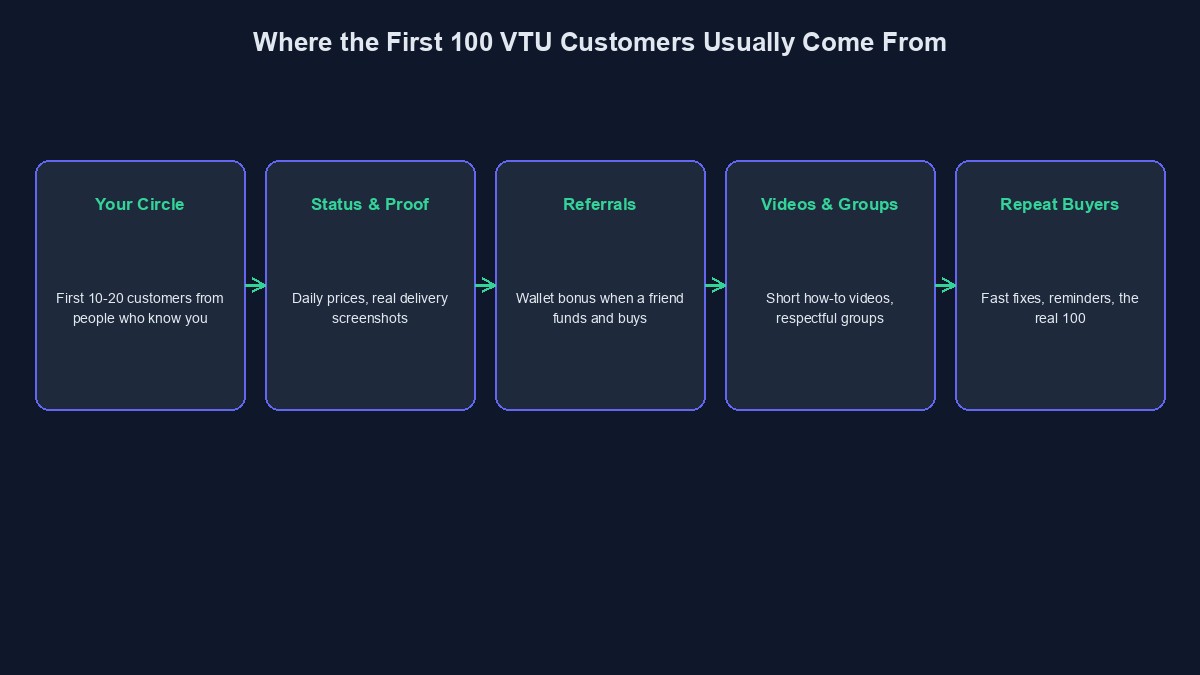
Tell your contacts, classmates and church or work groups. Your first customers almost always come from people who already trust you. Do not send one message to everyone. Message people one by one, or in small batches, with a short, friendly note: what you are offering, one clear benefit, and how to try it. For example: "I have started a data and airtime service. Delivery is within seconds and I reply on WhatsApp any time. Want me to set you up? Your first top-up can be small." A personal message from someone they know is worth far more than a broadcast.
Aim for ten to twenty customers from this circle in the first week or two. If you cannot get your closest contacts to try it, stop and find out why before spending anything else. They will tell you honestly if the price, the process or the trust is the problem.
Win on price and speed
Lead with your sharpest bundle and the promise of fast delivery. Pick the two or three bundles that people buy most, usually the small, popular data sizes and airtime, and price them competitively. That earns you the first look. But be honest with yourself about what keeps customers: price gets them to try you, and reliability makes them stay. If your service fails once and you fix it quickly and politely, the customer remembers that. If it is cheap and unreliable, they leave for the next cheap option. Our guide on pricing your data plans shows how to keep a healthy margin while staying competitive.
One warning about first-purchase bonuses. Margins on VTU are thin, often in the range of 3 to 8 percent. On a ₦2,000 data purchase, a 5 percent margin is about ₦100. If you give a ₦100 bonus on the first purchase, you earn nothing from it. Rewards work better on the second purchase or on wallet funding, when the customer has shown they will stay.
Make trusting you easy
Funding a wallet means a stranger's money moves before they get anything back, so trust is the real barrier for new customers. Show a real name and a real phone number. Have a short "About us" page. Make your payment details clear and consistent. Explain in two or three lines what happens if a transaction fails and how quickly you refund or fix it. Our guide on branding your VTU site covers how to look credible from the first visit, and setting up your wallet and payment gateways helps you make funding smooth.
Turn on referrals
Reward customers for bringing friends. A small bonus per funded referral compounds quickly once a few people share. Keep the rule simple enough to explain in one sentence, for example: "When your friend funds their wallet and buys, you both get a bonus on your next purchase." Pay in wallet credit rather than cash, tell people exactly when it will arrive, and pay on time. A referral programme that is confusing or slow damages your name faster than having none at all.
Referrals usually take over from your own circle around weeks three and four. Many small VTU businesses find that a quarter to a third of their first hundred customers come from other customers, which is why it is worth setting up early.
Post proof daily
Share successful transactions and happy customer messages on WhatsApp status and social media. Social proof sells. Hide phone numbers and any personal details before you post a screenshot, and always ask a customer before sharing their message. Post your current prices every morning too, so people know what to expect. If you want a simple routine for this, our guide on WhatsApp marketing for small businesses has one you can follow.
Be reachable
Put your WhatsApp front and centre. Fast replies convert browsers into buyers and buyers into regulars. Save quick replies for the questions you get most: price, how to fund the wallet, how long delivery takes, what to do if a transaction fails. Try to answer within minutes during the day, and tell people your hours so they are not left waiting at night. Most new customers decide whether to trust you in the first few messages.
Go beyond your circle, carefully
Once friends and early referrals are working, add one or two other channels, not ten. Short, practical videos on TikTok or Reels do well: how to buy data in under a minute, how to fund your wallet, what to do if a top-up does not arrive. You do not need to be funny or polished. You need to be clear and consistent. Joining local community groups can help too, but read the group rules first and never post your prices into every group you find. Spamming gets you muted and reported, which is the opposite of trust.
A realistic path to 100
These numbers are an illustration, not a promise, and your own results will differ. Imagine roughly 15 customers from your circle in the first two weeks, 20 more from daily status posts and word of mouth by week four, 30 from referrals by week six, 20 from videos and community groups, and the rest from customers who simply tell someone. That adds up to about a hundred in six to eight weeks for someone who is consistent. The point is not the exact split. It is that most customers come from simple, repeated actions, and each one makes the next easier.
What matters more than reaching 100
A hundred people who bought once are worth far less than forty who buy every week. Watch how many of your customers come back for a second and third purchase. Fix failed transactions quickly, remind regulars when they usually need data, and thank people. If you want to go deeper on the money side, our guide on how to market a VTU or data reselling business explains how to work out what a repeat customer is worth and how much you can afford to spend to win one.
Mistakes to avoid
Promising what you cannot deliver. "Instant, always" is a promise. Only say it if your setup makes it true, and be ready to explain what you do when it is not.
Promising people easy income. If you recruit agents or resellers, describe earnings honestly. People who were promised easy money will lose trust fast and say so publicly.
Spending on ads too early. Ads multiply what you already have. If customers do not yet trust you or replies are slow, ads will only waste money. Get the basics working first.
Not keeping track. If you do not know where your customers came from, you cannot do more of what works.
A short example
Illustrative example: the people, businesses and numbers in this section are made up to show how this works. They are not real clients or real results.
Amina starts a small VTU site in Kaduna. She messages forty people she knows, one by one, and eleven fund their wallets in the first ten days. She posts her prices and two real delivery screenshots on Status each morning, with permission. She offers a small wallet bonus for referrals and pays it the same day. She answers messages within minutes. By week seven she has about a hundred customers on her list, and thirty of them buy every week. She spent almost nothing on ads, and she knows exactly where each customer came from.
Where to go next
If you have not built your site yet, you can start on our VTU solution. When you are ready to put more behind your marketing, marketing is now part of what our own team offers, and you can talk to us on the contact page.
Software engineer with over 9 years of experience in software development and digital technology. B.Sc. in Industrial Chemistry from Adekunle Ajasin University. Has worked across web development, mobile applications, e-commerce platforms, VTU and fintech solutions, API integrations and custom software.



Comments
No comments yet. Be the first to share your thoughts.