SIM Hosting Explained: A Practical Alternative to Bulk SMS APIs for Nigerian Businesses
If you run a Nigerian business that sends SMS confirmations, runs USSD-based data or airtime purchases, or needs to trigger a network action automatically, you have almost certainly priced out a bulk SMS provider and found the maths uncomfortable. Bulk SMS in Nigeria is billed per message, the rate depends on the destination network, and at any real transaction volume the cost compounds fast. There is a lesser-known alternative that a small, specific niche of Nigerian VTU and automation businesses already use: SIM hosting. This guide explains what it actually is, how it genuinely differs from a bulk SMS API, and the honest limits of the approach.
What SIM hosting actually is, in plain terms
A bulk SMS API works by routing your message through the provider's own commercial connection to the networks, and you pay their per-message rate for that routing. SIM hosting works completely differently: you, or your business, own a real, physical SIM card on a real network, MTN, Airtel, Glo or 9mobile, inserted into an ordinary Android phone. A small app on that phone stays connected to a central service and listens for instructions. When an instruction arrives, telling it to send a specific SMS or dial a specific USSD code, the phone does exactly what a human holding it would do, sends the text message or dials the code, using the SIM's own ordinary airtime or bundled SMS allowance, and reports back what happened.
The practical effect is that you are not paying a bulk SMS provider's per-message markup at all. You are paying for the SIM's own airtime or SMS bundle, at ordinary retail rates, the same rate any individual customer on that network pays, and often considerably less per message than a commercial bulk SMS rate once real bundles are involved.
The specific mechanics: devices, slots and services
The building blocks are straightforward once you see them laid out. A device is the physical Android phone itself, paired once using a short-lived pairing code generated in your dashboard, after which it authenticates every future request with a long-lived key rather than needing to be re-paired. A slot is one physical SIM card inside that device, dual-SIM phones can host two slots at once, each recorded with its carrier and, where known, its own phone number. A service is the actual, reusable action you define once and trigger repeatedly: an SMS to a specific shortcode with a specific message format, or a full USSD sequence, dial this code, wait for this response, then send this next input, exactly mirroring how a person would actually navigate a USSD menu by hand.
Both SMS and USSD services support a simple templating pattern: you write a placeholder like {{PHONE}} or {{AMOUNT}} directly into the message text or USSD steps, and when the service is actually triggered, you supply the real values for those placeholders and they are substituted in automatically. This is what makes a single defined service reusable for thousands of different individual transactions rather than needing to hand-write a fresh message every time.
How a service actually gets triggered
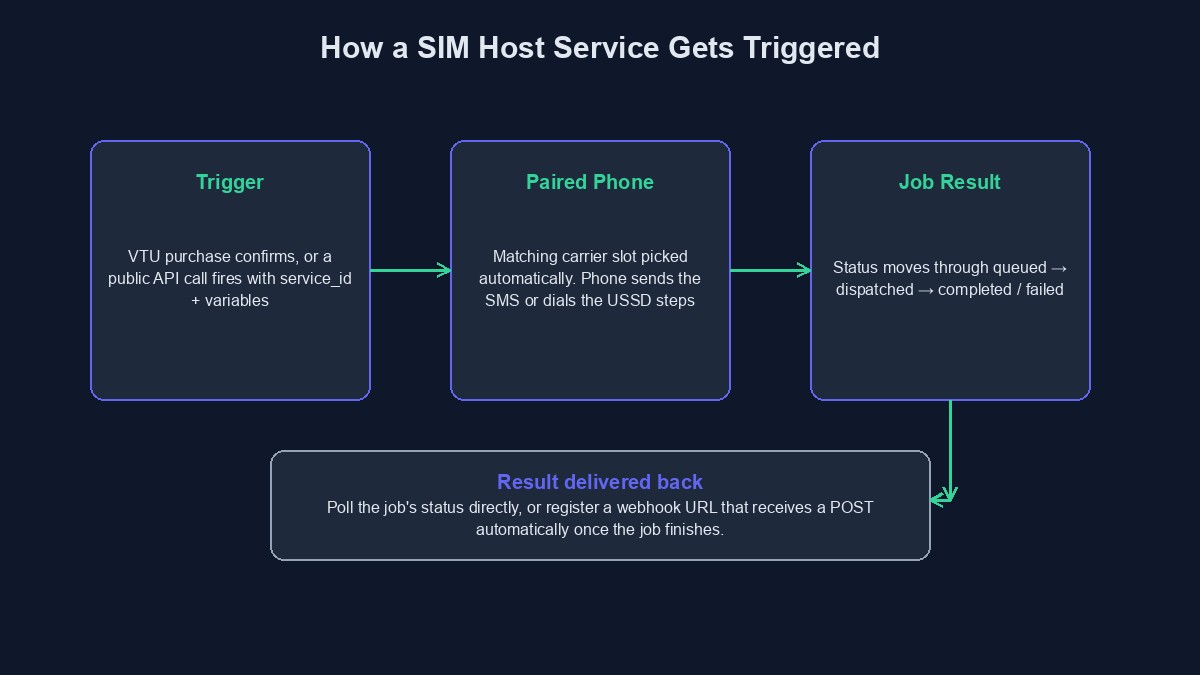
There are two realistic ways a service gets used. The first is internal: if you already run a VTU platform, a defined SIM host service can be wired directly into your own data or airtime purchase flow, so a specific product triggers a specific USSD sequence automatically the moment a customer's payment is confirmed, with no manual step in between. The second is external, through a public developer API: any of your own systems, a website, an internal tool, a third-party integration, can trigger a service directly by sending its service ID and the variable values it needs. Which physical SIM slot actually handles the request is resolved automatically at that moment, by matching the service's required carrier against your currently active, online slots, so you do not need to manually track which phone is online or which SIM is free.
Getting the result back: polling or webhooks
Triggering a service does not happen instantly the way an API call to a payment gateway does, since a real phone genuinely has to dial a real USSD code or send a real text and wait for a real network response, which can take a few seconds to (occasionally) longer. Every triggered action becomes a job with a clear status, queued, dispatched, processing, completed, failed or timed out, and you can either poll that job's status directly, or, more practically for most integrations, register a webhook URL that gets a POST request automatically the moment the job reaches its final state, so your own system finds out the result without needing to repeatedly ask.
Why this genuinely suits certain businesses and not others
SIM hosting is not a universal replacement for a bulk SMS provider, and being honest about where it fits and where it does not is more useful than an oversold pitch. It fits well for a business that already has, or is willing to maintain, a small number of dedicated phones with active SIMs, whose messaging or USSD volume is modest enough that retail airtime rates genuinely beat commercial bulk pricing, and who specifically need USSD automation, dialling and navigating a real USSD menu programmatically, which a standard bulk SMS API simply cannot do at all, since USSD is not SMS and most bulk SMS providers do not offer it.
It fits poorly for a business sending genuinely enormous message volumes, tens of thousands of messages a day, where a small number of physical SIMs becomes a real operational bottleneck, phones needing power, a stable connection, and occasional physical attention, in a way a pure API integration never does. It also is not the right tool if you need guaranteed, near-instant delivery at scale with a formal service-level agreement, since you are ultimately depending on an ordinary consumer phone's real network conditions, not a commercial telecom relationship.
An honest note on carrier coverage
Because a SIM host service ultimately depends on a phone actually dialling a real USSD code or sending a real SMS on a real network, and different network operators occasionally change their own USSD menu structures without notice, this is a category where coverage is actively expanded and verified carrier by carrier, service by service, rather than something any provider can honestly claim works identically and permanently across every network and every possible USSD menu on day one. If you are building on this pattern, test the specific service and specific carrier combination you actually need before relying on it for real customer transactions, the same discipline you would apply to any live integration.
A worked example: automating a data-gifting flow
Picture a small VTU business that currently gifts data bundles to customers by having a staff member manually dial a specific carrier USSD gifting code on a personal phone every time an order comes in, copying the customer's number and the bundle size by hand from a spreadsheet. This works, barely, at ten orders a day, and becomes unmanageable well before a hundred.
The business pairs a dedicated Android phone with an active SIM for the network in question, defines a single SIM host service for that carrier's gifting USSD sequence with {{PHONE}} and {{AMOUNT}} placeholders standing in for the specific values, and wires that service directly into their existing VTU purchase flow. From that point, the moment a customer's payment for that specific data bundle confirms, the correct USSD sequence dials automatically on the paired phone, with no staff member touching a phone at all, and a webhook fires back into their own order system the moment it completes, updating the order's status without anyone needing to check manually.
Mistakes worth avoiding when setting this up
Assuming one phone can carry unlimited transaction volume. A single SIM and a single phone has a real, physical throughput limit, network response time, one action at a time. Plan your number of paired devices around your actual expected volume rather than assuming one phone scales indefinitely.
Not testing the exact USSD sequence for the exact carrier before relying on it live. Carriers occasionally adjust their own USSD menus. A sequence that worked perfectly last month deserves a quick manual re-check before you assume it still matches exactly, particularly after you notice a sudden run of failed or timed-out jobs on one specific carrier.
Leaving a hosting phone without power monitoring or a stable connection. Since the entire mechanism depends on a physical device actually being online, a phone left on unreliable wifi, or allowed to run out of charge, silently stops fulfilling every job routed to it until someone notices, which is why checking a device's online status is worth building into your own regular monitoring, not just assuming it if nobody has complained yet.
Relying only on polling in a system that could use webhooks instead. Since a USSD job can genuinely take longer than a typical API call, repeatedly polling for status wastes both your own request volume and introduces needless delay compared to registering a webhook and simply reacting the moment the result actually arrives.
A rough cost comparison worth actually running for your own numbers
Because the honest answer to "is this cheaper" depends entirely on your own carrier, bundle size and volume, it is worth running the comparison yourself rather than trusting a generic claim either way. Look up your specific network's current SMS bundle or USSD gifting cost per unit, at ordinary retail rates, the same price any customer on that SIM would pay, and compare it directly against your current bulk SMS provider's per-message rate for the equivalent destination network. At low-to-moderate volume, retail bundle pricing on a dedicated SIM very often comes out ahead, sometimes considerably, since bulk SMS pricing carries the provider's own margin on top of the underlying network cost. At very high volume, the maths can flip, since a bulk provider's marginal cost per message stays flat while a physical SIM setup eventually needs more phones, more SIMs and more oversight to keep pace, and that operational overhead has a real cost even when it does not appear as a per-message fee.
Setting this up: a realistic step-by-step overview
Pair your first Android device using the short-lived pairing code generated from your dashboard, confirming it shows as online once the app is installed and connected. Insert and confirm the SIM you intend to use, checking it shows the correct detected carrier. Define your first service, whichever single SMS or USSD action you actually need automated first, using the exact wording and exact USSD sequence you would use manually, with placeholders substituted in wherever a value genuinely changes per transaction. Trigger it manually once, as a direct test, using a real phone number you control, and confirm both that the physical action actually happened correctly on the phone and that the job's result and status reported back accurately. Only once that single service is proven reliable, wire it into either your live VTU purchase flow or your external system's trigger calls, and register a webhook so your own system reacts to the result automatically rather than needing to be checked by hand.
A note on security and account access
A device key and a public API key are both real credentials, and treating them with the same care as a payment gateway's secret key is worth stating plainly rather than assuming is obvious. A device key that leaks lets someone else's instructions reach your physical phone and your real SIM's airtime. A public API key that leaks lets someone else trigger your defined services, and your SIM's airtime, on your account, without your involvement. Keep both out of any client-side code, any public repository, or any place a competitor or a malicious actor could plausibly find them, exactly as you would with any other integration credential this guide's companion articles on API security and general web security already cover in more depth.
A short glossary
SIM host device: the physical Android phone running the pairing app, identified by its own long-lived device key once paired. Slot: one physical SIM card inside a device, recorded by carrier and, where known, its own number. Service: a reusable, admin-defined SMS or USSD action with templated placeholders, triggered repeatedly with different real values. Job: one specific triggered instance of a service, with its own status and result. Webhook: an automatic notification sent to your own system the moment a job finishes, instead of you having to repeatedly check.
Where this is already built for you
If you are running a project on our platform, this entire mechanism, device pairing, slot management, service definitions with templating, the public trigger API, and webhook delivery, is already built, and can be wired directly into your own VTU project's purchase flow or triggered from any external system you control. You can read the fuller technical breakdown, including the exact API request and response shapes, on our SIM Hosting service page, and start building free to see it directly in your own dashboard. If you are integrating this alongside a VTU platform, our guides to setting up your VTU wallet and connecting a vending API cover the surrounding integration this feature is designed to slot into.

Comments
No comments yet. Be the first to share your thoughts.