Flutterwave Payment Failed but Money Was Deducted: What's Really Happening
It is one of the most alarming messages a customer can send you: "your site says my payment failed, but the money left my account." From a business owner's side, this looks like a serious, potentially embarrassing failure. From a developer's side, it can look confusing, because your own system genuinely shows no successful payment, and yet the customer is not lying about what they saw on their bank statement. This guide explains what is actually happening in this situation, why it is rarely as alarming as it first appears, and exactly what to do, and say to the customer, when it comes up.
The core thing to understand: a bank hold is not the same as a completed payment
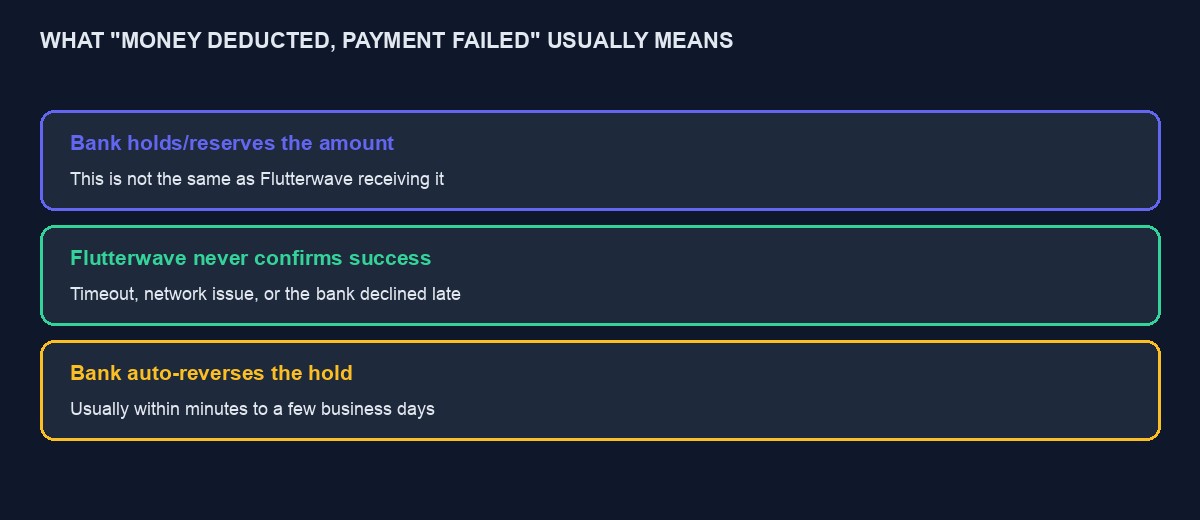
When a customer's card is charged, the process usually happens in at least two separate steps, even though it feels instantaneous to the person paying. First, the customer's bank places a hold, or authorisation, on the funds, essentially reserving that amount and temporarily reducing what the customer can spend elsewhere. Second, the transaction is actually captured, meaning the funds genuinely move from the customer's bank to the payment processor and onward toward you. Almost every case of "payment failed but money was deducted" is really a case where the first step happened, the hold was placed and is visible on the customer's statement or balance, and the second step, capture, never completed, because of a timeout, a network interruption, a fraud check, or a declined authorisation that happened after the hold was already visible to the customer.
From the customer's point of view, their available balance dropped, which looks and feels exactly like a completed payment. From the bank's and Flutterwave's point of view, no money has actually moved to you, and the hold will, in the near-term, be released automatically, returning the funds to the customer without anyone needing to process a refund, because a refund implies money that was genuinely transferred and now needs to be transferred back, which is not what happened here.
Why this happens more often than people expect
Network interruptions between a customer's bank, Flutterwave, and your own server are the most common cause: a mobile connection drops for a few seconds at exactly the wrong moment, and the confirmation message that would have told everyone the transaction completed successfully simply never arrives, even though the underlying authorisation had already happened. A customer closing the browser tab or app immediately after entering their card details, before the full confirmation cycle finishes, produces the same appearance. And occasionally a bank's own fraud system authorises a transaction initially and then declines it a moment later during a secondary check, after the hold has already become visible to the customer.
How to confirm what actually happened, rather than guessing
The first, essential step is checking the specific transaction directly in your Flutterwave dashboard, searching by the customer's email, phone number, or the approximate time they describe, rather than trusting either your own system's silence or the customer's understandable alarm as the full picture. If Flutterwave's own record shows the transaction as failed, abandoned, or simply does not show it as successful, this confirms the hold-without-capture explanation, and the customer's bank will release the hold on its own schedule. If, less commonly, Flutterwave's own record actually shows the transaction as successful, and your own system simply failed to register it, the problem has moved from "a normal bank hold" to a genuine gap in your own integration, most likely a webhook that never arrived or was never properly verified, covered in depth in our guides to diagnosing webhook delivery failures and the Flutterwave API, and in that specific case, you do owe the customer whatever they paid for, since the payment genuinely succeeded.
What to actually tell the customer, in plain, reassuring language
The single most important thing you can do in this situation is respond quickly and clearly, because the alternative, silence while a worried customer waits, does far more damage to trust than the underlying technical hiccup ever would. A calm, specific explanation works far better than a vague, generic apology: explain that what they are seeing is a temporary hold their bank placed during the payment attempt, that the attempt itself did not complete successfully on your end, and that the hold will be released automatically by their bank, typically within a stated, realistic timeframe rather than a vague "soon." Avoid technical jargon in this specific message, since a customer worried about their money does not need to understand webhooks or authorisation cycles, they need to understand that their money is not actually gone and roughly when they will see it back.
Setting realistic timeframes, based on how banks actually behave
How quickly a released hold disappears from a customer's visible balance depends on their specific bank, not on you or on Flutterwave, and this is worth stating honestly rather than promising a specific timeframe you cannot actually control. Some banks release holds within minutes. Others, particularly for card transactions rather than direct bank transfers, can take several business days to fully clear the hold from a customer's statement, following their own internal processes that Flutterwave and your business have no direct influence over. Give the customer a realistic range rather than a precise promise, and let them know they are welcome to follow up if it has not cleared after a reasonable period, which shows you are taking their concern seriously without setting an expectation you cannot guarantee.
When it is genuinely your responsibility to act, not just wait
There is one category within this situation that does require you to act rather than simply explain and wait: if Flutterwave's own dashboard shows the transaction actually settled successfully into your account, the money genuinely reached you, and your own system failed to register it correctly. In that case, the customer is owed whatever they paid for, immediately, and the priority shifts from explaining a bank hold to fixing your own broken order-matching logic, using the debugging approach covered in our guide to diagnosing failed webhook delivery, which applies to Flutterwave's webhook system in the same way it applies to Paystack's.
Distinguishing a genuine hold from an attempted scam
Not every "I was charged but got nothing" message is a genuine bank hold, and it is worth knowing the difference, because the response, and the level of scrutiny, should differ. A genuine confused customer is usually specific: they can describe roughly when they paid, which payment method they used, and are often willing to share a screenshot of their banking app showing the hold. A fraudulent claim, someone hoping you will simply take their word and deliver a product or service without checking, tends to be vaguer, resistant to specifics, or pushes urgently for an immediate resolution without wanting to wait for you to actually check the transaction record.
The fix for both situations is the same first step, and it is worth applying consistently rather than only to claims that feel suspicious: check Flutterwave's own transaction record before taking any action, refunding, releasing a product, or crediting an account. A genuine customer is reassured by you checking properly, since it shows you take the situation seriously rather than dismissing it. A fraudulent claim collapses the moment you ask for the specific transaction reference or timestamp needed to actually look it up, since that information does not exist for a payment that was never genuinely attempted.
Reconciliation: catching the rare genuine gap before a customer even asks
Beyond responding well to individual customer messages, build a regular, deliberate habit of reconciling your own order records against Flutterwave's actual settlement records, weekly for a smaller business, daily for a busier one. This catches the rare, genuinely concerning case, a transaction that settled successfully on Flutterwave's side and was never correctly registered in your own system, before a customer even has to notice and complain, which is both better for the customer's experience and a useful early warning that something in your webhook or verification logic needs attention, following the debugging approach covered in our guide to diagnosing webhook delivery failures.
What this looks like from the bank's side, briefly
It can help, when explaining this to a worried customer, to understand roughly what their own bank is doing during this window, even in simplified terms. Many banks process an authorisation hold as a separate ledger entry from a settled transaction, meaning the customer's available balance is reduced immediately, while their actual account balance, and any record the bank would show as a completed outgoing payment, is not affected until, and unless, the transaction is actually captured and settled. This is why the hold typically disappears entirely, rather than requiring a separate incoming refund transaction to reverse it, once it expires or is cancelled: nothing was ever actually removed from the account in the way a completed payment would be, only reserved and then released.
Mistakes businesses make handling this situation
Refunding immediately without checking Flutterwave's record first. If the transaction genuinely never succeeded, there is nothing on your side to refund, since you never received anything, and attempting to process a refund against a transaction that does not exist as a successful payment on your end usually just fails or creates confusing, incorrect records.
Telling the customer it is "their bank's problem" and nothing more. While technically true that the release timing is outside your control, this response, delivered without the specific, reassuring explanation covered above, reads as dismissive and does real damage to trust, even when the underlying facts are accurate.
Assuming every such report is a scam attempt. The overwhelming majority of these messages are genuine, confused customers experiencing a normal, if confusing, part of how card payments work, not fraud attempts, and treating every one with suspicion damages trust with the honest majority for the sake of catching an occasional dishonest minority who are, in any case, caught by the simple check-the-record step regardless of your initial attitude.
Not following up proactively. If you promised a customer the hold would clear within a certain window and it has not, reaching out yourself, rather than waiting for them to chase you again, meaningfully rebuilds any trust the original confusing moment may have cost.
Building a standard process for this, rather than handling it ad hoc each time
Because this situation recurs, it deserves a standard, prepared response rather than improvising a new explanation every time a worried customer messages you. Prepare a short, clear template message in advance, explaining the hold-versus-capture distinction in plain language, and train whoever handles customer messages to check the actual Flutterwave dashboard record first, before responding, rather than guessing or reassuring a customer based on incomplete information. This turns a recurring, anxiety-inducing situation into a routine, quickly resolved one for both your team and your customers.
A short script your team can actually use
Having a ready, adaptable response prepared in advance removes both the delay and the inconsistency of improvising a fresh explanation every time. A reasonable starting template: thank the customer for flagging it, confirm you have checked the specific transaction and can see it did not complete successfully on your end, explain that what they are seeing is a temporary hold rather than a completed charge, give a realistic range for when their bank will release it, and offer a clear next step, retrying the payment, using a different method, or simply waiting, whichever suits their situation. Adjust the specific wording to sound like your own business rather than a generic script, but keep the structure: acknowledge, confirm you checked, explain plainly, set a realistic expectation, offer a next step. A customer reading a response built on this structure feels heard and informed, which is the entire goal.
A worked example: a real-feeling scenario, start to finish
Picture a customer completing checkout on a small online store, entering card details on a mobile connection that briefly drops just as the payment is being processed. Their banking app immediately shows a reduced available balance. Your store's confirmation page never loads, since the connection dropped before the response returned, and they message you within minutes, understandably alarmed, saying the payment failed but the money is gone.
Checking Flutterwave's dashboard for a transaction matching their email around that timestamp shows an abandoned, incomplete transaction status, no successful capture, confirming this is a hold that will release on its own. You reply within the hour with a clear, specific explanation: their bank placed a temporary hold during the attempt, which did not complete successfully, and it should clear automatically within a few business days depending on their specific bank, and you invite them to retry the payment, or offer an alternative payment method, and to follow up if the hold has not cleared within a reasonable window. The customer, reassured by a specific, prompt, confident explanation rather than a vague apology, retries successfully a few minutes later using a stable wifi connection instead.
Where this fits into a broader trust strategy
How your business handles a moment like this says more to a customer about whether you are trustworthy than almost anything else on your site, because it is precisely the moment their money and their trust are both, genuinely, uncertain. A fast, specific, calm response converts this from a trust-damaging incident into, often, an opportunity to demonstrate exactly the kind of reliability that earns a repeat customer. A slow, vague, or defensive response does lasting damage that no amount of good product or good pricing easily repairs.
Where this is already handled for you
If you are running a store, VTU platform or booking site on our platform, this category of confusion is minimised by the dual-path verification pattern already built into our payment handling, checking transaction status directly through the gateway's API in addition to relying on webhooks, and our customer-facing order status pages are written to explain exactly this kind of temporary hold clearly, rather than showing a bare, alarming "failed" status with no context. You can start building free to see this directly, and our fuller Flutterwave API tutorial and guide to accepting online payments in Nigeria cover the wider integration this article assumes you already have in place.



Comments
No comments yet. Be the first to share your thoughts.