How to Build a School Website With Online Registration and Payments
A Nigerian school looking to build a website with genuine online registration and payment collection runs into a specific gap fast: most website builders are designed around selling products or booking rooms, not around the particular mix a school actually needs, a real admissions form, term fees, sibling discounts, part-payment plans, and parent communication, all tied together. This guide covers what a school website in this category genuinely needs, honestly, including where a ready-made template stops being enough.
What "online registration" actually needs to capture, beyond a simple form
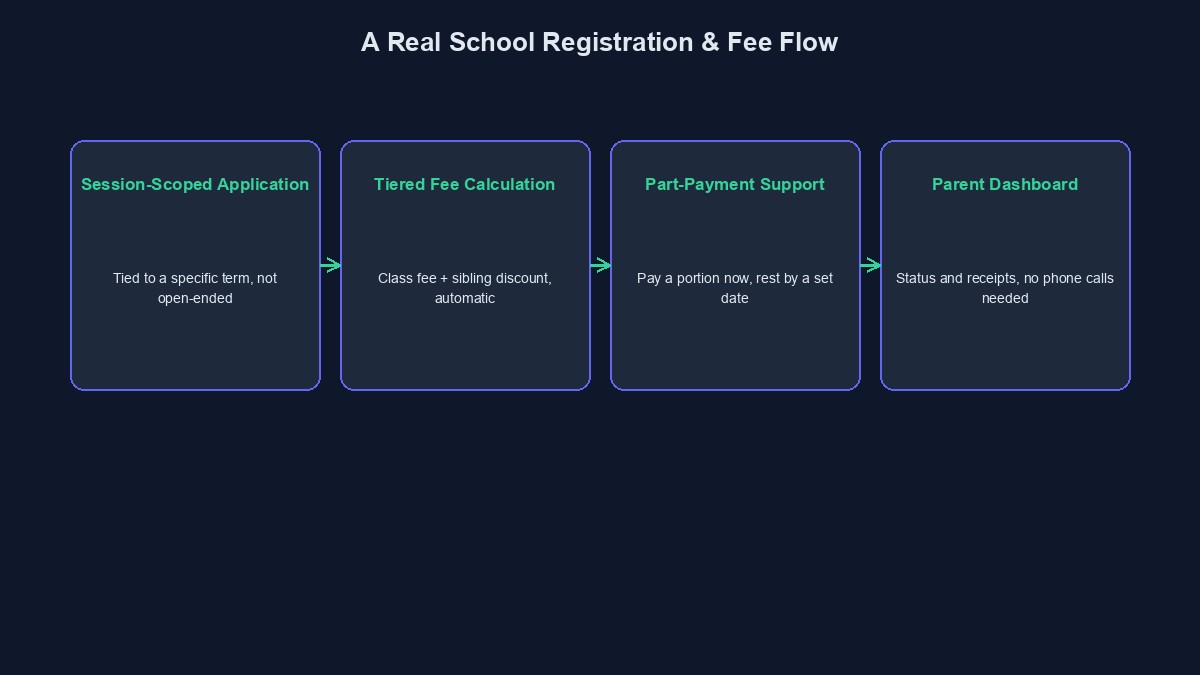
A genuine school admissions form is meaningfully more involved than a typical contact form: the child's details, the class or level being applied for, parent or guardian contact information, sometimes previous school records or an entrance assessment result, and, critically, a clear record of which specific term or academic session the application is actually for, since a school genuinely runs different admissions cycles at different times, not one continuous open form. Getting this structure right matters more than it first appears, since a form that does not cleanly separate applications by session becomes genuinely difficult to manage once real families start using it.
Fee payment: where this differs most from a normal online payment
School fees are rarely a single flat price. Different classes have different fees, siblings often receive a discount, and many Nigerian schools genuinely need to support part-payment, a parent paying half a term's fees now and the remainder by a set date, rather than requiring the full amount upfront. This is a materially different payment structure from a typical ecommerce checkout, closer in shape to the tiered, per-plan pricing a subscription business needs than to a simple one-price product purchase, and it is worth designing for honestly from the start rather than trying to force it into a generic single-price checkout.
What genuinely already exists as a ready foundation, and what does not
The underlying pieces, a real payment gateway integration, secure handling of payment information, a working checkout flow, are solved, proven capabilities our own platform genuinely provides, the same foundation covered in our guides to integrating Paystack and recurring and part-payment billing. What does not exist as a ready-made, pick-it-off-the-shelf template is the specific combination a school needs, tiered per-class fees, sibling discounts, session-based admissions tracking, and a parent-facing dashboard showing a specific child's payment status, together, in one coherent system. Being honest about this distinction matters: the payment plumbing is genuinely solved technology, the specific school-admissions structure on top of it is a real, custom build.
Parent communication: the part schools consistently underestimate in advance
Once fees and registration move online, parents genuinely expect to be able to check a child's payment status, receive a receipt, and get a reminder before a payment deadline, without calling the school office for every question. Building this expectation into the system from the start, a simple parent login showing exactly what has been paid and what is outstanding, and automated reminder messages as a deadline approaches, prevents a meaningful amount of manual admin work the school's own staff would otherwise absorb by hand.
Data sensitivity: a genuinely higher bar than most small business websites
A school website handles children's personal information, which deserves real, deliberate care beyond what a typical small business site needs to think about. Our plain-English guide to what NDPR actually requires covers the general principles, and a school specifically should be even more deliberate than the guide's baseline recommendations: collect only the information genuinely needed for admissions and fee management, be explicit with parents about how their child's information is used and stored, and treat access to this data, who on the school's own staff can see it, with real, specific restriction rather than broad, unrestricted access.
A realistic path: what to build first, and what to add once it is proven
A sensible first version handles the two genuinely core needs, an admissions form tied to a specific term or session, and fee payment supporting the school's actual real pricing structure, tiers and sibling discounts included, without trying to build every possible feature, a full learning management system, detailed academic records, attendance tracking, from day one. Prove the registration and payment flow works reliably for one real admissions cycle first, then expand deliberately based on what the school's own staff and parents actually ask for next, rather than guessing every possible feature upfront.
Handling the family that genuinely cannot pay on time
A real school's fee system inevitably encounters a family requesting a genuine extension or a special arrangement outside the standard part-payment structure, and it is worth deciding in advance how the system, and the school's own admissions staff, should handle this rather than improvising under pressure each time it happens. A sensible approach keeps the standard automated flow strict and consistent for the majority of families, while giving the school's own staff a genuine, manual override capability for the real, individual exceptions that any fee system eventually needs, logged properly so there is a clear record of exactly which arrangements were made and why, rather than an informal exception nobody else at the school can later see or explain.
A worked example: a realistic first build for a mid-sized private school
Picture a private school with three fee tiers across its class levels and a genuine sibling discount policy, building its first proper online registration and payment system ahead of a new admissions cycle. The build focuses specifically on two things done well: a registration form clearly scoped to the upcoming session, collecting exactly the information the school's own admissions office actually needs, and a payment flow correctly calculating each family's real fee, tier plus sibling discount automatically applied, with a genuine part-payment option for families who need it. A simple parent login, showing payment status and issuing a receipt automatically, replaces what had previously been a steady stream of phone calls to the school's front office asking "did my payment go through." The system deliberately does not attempt a full academic records module in this first version, that is left for a genuinely separate, later phase once the registration and payment core is proven working through one real cycle.
Mistakes worth avoiding specifically in this category
Trying to force school-specific fee logic, tiers, discounts, part-payment, into a generic single-price ecommerce checkout. This produces a system that technically works for the simplest case and breaks down, or requires constant manual workarounds, the moment real fee complexity shows up.
Not scoping admissions to a specific session from the start. A form with no clear session boundary becomes genuinely difficult to manage once multiple admissions cycles' worth of applications accumulate with no clean separation.
Underestimating how much manual admin work a parent-facing status dashboard actually saves. Schools that skip this consistently find their own office staff spending real time on questions the system itself could have answered automatically.
Treating children's data with the same casualness as ordinary customer data. This deserves a genuinely higher standard of care, not the same default treatment a typical small business website applies.
A short glossary
Admissions cycle: a specific, bounded period during which a school accepts applications for a specific term or academic session. Fee tier: a distinct fee amount tied to a specific class or level, as opposed to one flat price across the whole school. Part-payment: paying a portion of a fee upfront with the remainder due by an agreed later date. Sibling discount: a reduced fee applied when more than one child from the same family is enrolled.
Where to go from here
The payment and billing foundation this guide describes is real, proven technology already powering real Nigerian businesses on our platform, covered in our guides to accepting online payments in Nigeria and recurring billing. The specific, complete school admissions and fee system described here, honestly, is a custom build rather than an off-the-shelf template today, and our custom development team is the right place to have that specific conversation, bringing your school's actual fee structure and admissions process to the discussion rather than a generic brief.


Comments
No comments yet. Be the first to share your thoughts.