
What NDPR Actually Means for Your Small Nigerian Website
Search "NDPR compliance Nigeria" and you will land, almost exclusively, on pages built by compliance software vendors and consulting firms, written in the dense, alarmed language of a sales pitch aimed at large enterprises with dedicated legal teams. If you run a small Nigerian website, an online store, a booking site, a simple business page with a contact form, that content is not really written for you, and reading it tends to leave small business owners either anxious about a vague, undefined risk, or dismissive of the whole subject because it sounds like it could not possibly apply to something as modest as their own site. Neither reaction is quite right. This is a plain, practical explanation of what NDPR actually requires from a genuinely small website, without the sales pitch and without the panic.
What NDPR actually is, without the jargon
The Nigeria Data Protection Regulation, and its successor legislation, the Nigeria Data Protection Act of 2023, exist to require that anyone who collects personal information, a name, an email, a phone number, an address, treats that information with basic, reasonable care: collecting it honestly, telling people what it is used for, storing it reasonably securely, and not sharing it with third parties without a legitimate reason. Read at that level, rather than through a compliance vendor's dramatized framing, it is closer to a codified version of "do not be careless or dishonest with people's personal information" than a complex enterprise regulatory regime.
It applies to essentially any organisation, business or individual that processes the personal data of people in Nigeria, and there is no meaningful size exemption that lets a small business simply ignore it. That said, what compliance actually looks like scales enormously with what you are actually doing, and a five-page business website with a contact form has a genuinely small, achievable set of real obligations, not the enterprise-grade compliance programme most of the search results imply.
What actually counts as personal data on a typical small website
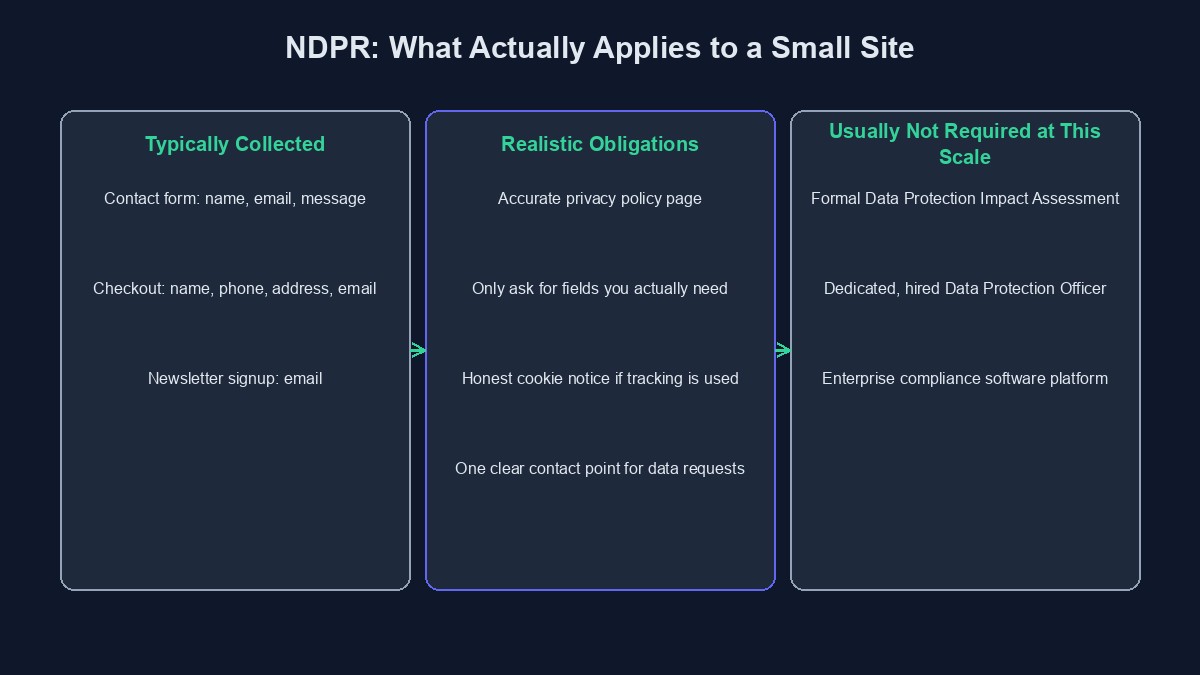
If your site has a contact form, a newsletter signup, a customer account system, or a checkout that captures a name, email, phone number or delivery address, you are processing personal data, and NDPR applies to you. If your site is purely informational, describing your business with no form of any kind collecting visitor information, your practical exposure is genuinely minimal, since there is very little personal data actually being processed in the first place. Most small Nigerian business sites sit somewhere in between: a contact form, and often little else, which is the situation this guide focuses on.
The realistic, actually-achievable checklist
Have a real, honest privacy policy page, stating plainly what information you collect, why you collect it, and what you do with it, rather than a copied generic template that describes practices your business does not actually follow. Only collect what you genuinely need for the stated purpose, a contact form asking for a home address when all you need is an email and a message is collecting more than necessary, and doing so needlessly increases both your compliance exposure and, honestly, your own liability if that extra data is ever compromised. Store what you collect somewhere reasonably secure, meaning not, for instance, an unprotected spreadsheet emailed around freely or a database left publicly accessible through a misconfigured setting. Do not sell or hand over customer data to a third party without a genuine, disclosed reason and, where required, the customer's consent. And respond reasonably if someone asks what data you hold on them or asks you to delete it, which for a small business with a modest customer list is usually a manageable, occasional request rather than a burdensome, frequent one.
Cookies and tracking: the part that trips people up
If your website uses cookies or similar tracking beyond the strictly necessary kind needed to make the site function, analytics tools like Google Analytics being the most common example on a small business site, NDPR expects a visitor to be told this is happening and given a real, meaningful choice about it, not a banner with only an "Accept" button and no genuine way to decline. A simple, honest cookie notice, explaining what is tracked and offering a real accept-or-decline choice, satisfies this for the overwhelming majority of small sites, and is a far smaller undertaking than the compliance-vendor content typically implies, which often pitches an entire consent-management platform for a problem a well-built banner genuinely solves on its own.
What a Data Protection Officer actually means for a small business
Larger organisations processing data at real scale are expected to formally designate a Data Protection Officer, a named person responsible for data protection compliance. For a genuinely small business, this usually does not mean hiring a dedicated specialist, it typically means one person, often the owner, is the clearly identified point of contact for data-related questions and concerns, which a line in your privacy policy, stating who to contact about data privacy questions and how, satisfies in practice for most small operations. Treat this as a clarity requirement, someone is accountable and reachable, rather than a hiring requirement.
What genuinely does not apply to a small website
It is worth being equally clear about what the compliance-vendor content tends to imply applies to everyone, but genuinely does not, at small scale. Formal Data Protection Impact Assessments, detailed, documented risk analyses required before certain large-scale or high-risk data processing activities, are aimed at organisations processing sensitive data at real volume, not a small business's contact form. Mandatory breach notification to the regulator within a strict timeframe applies, but the practical likelihood of a small, simple website experiencing a reportable breach in the first place is genuinely low if basic security practices, covered in our guide to securing a PHP website, are already in place. Registration with the Nigeria Data Protection Commission as a Data Controller is required at certain processing volumes and categories, not automatically for every website that has ever collected an email address, and it is worth checking the commission's own current threshold rather than assuming it applies by default.
How this differs from GDPR, since the two get confused constantly
Nigerian small business owners who have encountered data protection content online have usually encountered far more written about Europe's GDPR than about NDPR specifically, since GDPR is older, more heavily covered, and backed by a much larger compliance industry. The two share the same underlying philosophy, personal data deserves honest, careful handling, and much of the practical advice genuinely overlaps. But they are legally separate regimes with separate regulators, separate specific requirements, and separate penalty structures, and a Nigerian business assuming that being "GDPR compliant" automatically satisfies NDPR, or the reverse, is making an assumption worth checking rather than trusting by default. If your customer base is purely Nigerian, NDPR is the regime that actually governs you. If you also serve customers in the European Union directly, both may apply simultaneously, and that specific situation is exactly the kind of case worth a real conversation with a data protection professional rather than guessing.
A note on using foreign-hosted tools and services
Most small Nigerian websites rely on at least a few foreign-hosted third-party tools, an email service, an analytics platform, a hosting provider, a payment gateway, all of which may store or process customer data outside Nigeria as a normal part of how they operate. This is not automatically a violation, but it is worth being aware that NDPR does have provisions around transferring personal data outside Nigeria, generally expecting that the destination country or the specific arrangement offers an adequate level of protection. For the overwhelming majority of small businesses using well-established, reputable international tools, Google, well-known email providers, major payment gateways, this is a genuinely low-risk area in practice, since these providers already build their own compliance into how they operate. It becomes a more meaningful question specifically if you are handing customer data to a smaller, less established, or less transparent third party, which is worth a moment's honest scrutiny before doing so, rather than an assumption that every tool is automatically fine simply because it is widely used elsewhere.
A worked example: what this looks like for an actual small store
Picture a small Nigerian online store selling handmade goods, with a checkout capturing name, phone number, delivery address and email, and a newsletter signup on the homepage. A realistic, achievable compliance pass looks like this: a genuinely accurate privacy policy page describing exactly this data collection and its actual purpose, order fulfilment and, where opted in, occasional promotional emails; a checkout that only asks for the fields genuinely needed to ship an order, not extra fields collected "just in case"; a newsletter signup with a clear, separate opt-in rather than data being silently added to a marketing list because a customer happened to check out; a cookie banner if analytics tracking is in use, with a real decline option; and one clearly stated contact point, an email address, for anyone asking what data is held about them or asking for it to be deleted.
None of this requires a lawyer, a compliance consultant, or a paid compliance platform for a business at this scale. It requires an honest half-day of reviewing what is actually collected, writing a privacy policy that actually describes it accurately, and making a few small, concrete adjustments to the checkout and signup forms.
Mistakes small businesses actually make around this
Copying a generic privacy policy template that describes practices the business does not actually follow. A policy claiming data is never shared with third parties, while an embedded analytics or advertising script quietly does exactly that, is arguably worse than having a shorter, less polished policy that is actually accurate, since an inaccurate policy is itself a compliance problem, not a shortcut around one.
Collecting far more data than the business actually uses. Every additional field on a form is both a small extra piece of friction for the customer filling it in and a small extra piece of liability sitting in your database, and it is worth periodically asking, honestly, whether every field a form collects is genuinely used for something.
Treating this as a one-time task rather than an ongoing habit. A privacy policy that accurately described your practices a year ago can quietly become inaccurate as your business adds a new tool, a new analytics script, a new third-party integration, without anyone updating the policy to match, and it is worth a brief periodic review rather than assuming a policy written once stays accurate indefinitely.
Panicking and either over-investing in enterprise-grade compliance tooling a small site does not need, or ignoring the subject entirely out of the belief it could not possibly apply to a business this size. Both reactions are common, and both are avoidable with the realistic, proportionate approach this guide describes.
A short glossary
Data Controller: the organisation that decides why and how personal data is collected and used, which, for a small business with its own website, is simply the business itself. Data Processor: a third party that processes data on the controller's behalf, a hosting provider or email service being common examples. Personal data: any information that can identify a specific person, directly or indirectly. Consent: a person's clear, informed, freely given agreement to a specific use of their data, which must be genuinely optional, not a disguised requirement to use the site at all.
Where this fits into building your site properly from the start
If you are building or rebuilding a website on our platform, the required pages, a genuine privacy policy, terms of service and a working contact page, are already part of every project rather than an afterthought bolted on separately, and our own guide to starting an online business in Nigeria covers the wider set of foundational steps this compliance checklist assumes you already have in place. You can start building free to see this directly, and if your specific situation genuinely involves processing sensitive or large-scale personal data, beyond the small-website scope this guide covers, a proper consultation with a Nigerian data protection professional is worth the investment at that point, which this guide is not a substitute for.


Comments
No comments yet. Be the first to share your thoughts.