Pricing Your VTU Platform for Customers in Other African Countries
A Nigerian VTU or reselling platform that starts getting visits, or direct requests, from people in Ghana, Kenya, or elsewhere in Africa faces a genuinely awkward pricing question that most guides never actually address, because most guides assume you are selling generic physical products, not Nigeria-specific mobile network services. Airtime and data plans are priced and vended per network, per country, and a Nigerian platform expanding to serve customers elsewhere in Africa is not simply "adding a currency toggle," it is connecting to entirely different underlying vending relationships while still needing prices, and a checkout, that feel native and trustworthy to a customer in another country. This guide covers what that actually involves, honestly, including where it gets genuinely harder than a currency symbol swap.
Why this is a different problem from a normal multi-currency store
A store selling physical goods across African countries mostly needs to solve one problem: display the right currency and charge the right amount, with shipping the same practical complication regardless of the specific product. A VTU platform selling network services has a second, deeper problem underneath the pricing question: the actual product, a data bundle on a specific Kenyan network, for instance, is not something a Nigeria-based vending relationship can fulfil at all. Nigerian VTU vending APIs, the kind that let a Nigerian platform sell MTN or Airtel Nigeria data programmatically, are built specifically for Nigerian networks. Serving a genuinely different country's networks means either a separate vending relationship with a provider that covers that specific country, or a cross-border airtime and data aggregator that already has those relationships built, which is the practical route most small platforms actually take rather than negotiating individual country-by-country vendor relationships themselves.
Getting the currency and price right, once fulfilment is solved
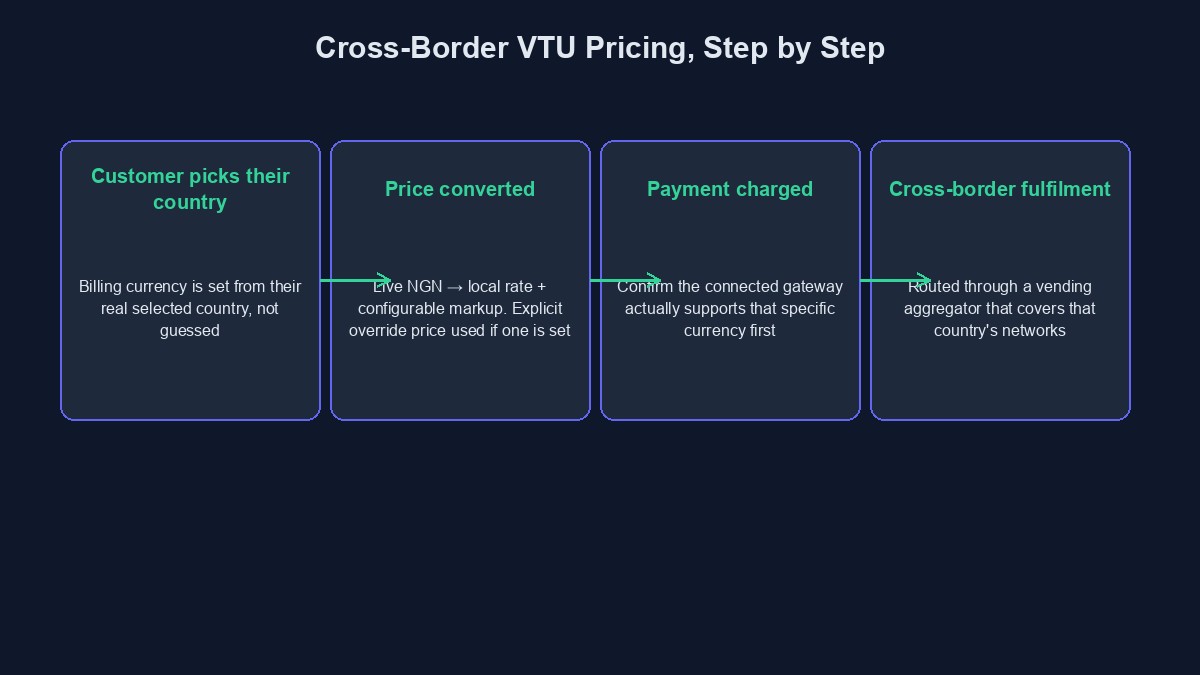
Once you have a genuine way to fulfil the product for a customer outside Nigeria, the pricing side has a reasonably solved shape. A customer's billing currency should be tied to their actual selected country, not guessed from their browser or IP address alone, since a Ghanaian customer visiting from a Nigerian VPN, or the reverse, should still see pricing in the currency that matches their real situation, which they explicitly confirm. Prices shown to that customer should be converted from your base NGN pricing using a live, regularly refreshed exchange rate, not a rate set once and forgotten, since currency markets move meaningfully over weeks and months and a stale rate either overcharges or undercharges your actual margin without you noticing.
A deliberate markup on top of the raw converted rate is standard practice, not something to feel uncomfortable about, since it covers the real cost and risk of cross-border fulfilment, and most cross-border-capable platforms build this in as a simple, configurable percentage rather than a hidden or unclear adjustment. Where a specific product's true cost does not track a simple percentage conversion cleanly, a currency-specific gifting or airtime bundle with genuinely different underlying economics in its destination market, setting an explicit, manually confirmed price for that specific currency, rather than relying purely on automatic conversion, is worth the extra setup for your highest-volume products specifically.
What happens when the exchange rate service is temporarily unavailable
Live exchange rate data depends on an external service, and that service being briefly unreachable is a real, if infrequent, operational situation worth planning for rather than discovering during an actual outage. A sensible approach caches the last known good rate for a reasonable window, so a brief outage does not immediately break pricing for non-Nigerian customers, and falls back to a safe default, continuing to serve Nigerian-currency pricing rather than showing a broken or blank price, if a fresh rate genuinely cannot be fetched at all. This is a small detail that is easy to overlook while building the happy path and genuinely important the one time it actually matters.
The checkout and payment side: not every gateway sees every currency
Once pricing in a customer's own currency is solved, the payment step has its own real constraint: not every payment gateway your platform supports necessarily handles every non-Naira currency your customers might be billed in, and some gateways that do support foreign currencies are meaningfully better suited to card-based international payments than to the mobile-money-first payment habits common in many other African markets. Confirm, specifically and per gateway, which currencies each of your connected payment providers actually processes before advertising a currency to customers, rather than assuming universal support and discovering the gap at a real customer's checkout.
Trust signals that matter more for a cross-border customer than a domestic one
A first-time customer in another country, buying from a platform based in Nigeria, is taking a bigger trust leap than a Nigerian customer buying from a Nigerian platform, since the usual local cues, a familiar bank, a shared understanding of how Nigerian ecommerce generally works, are not available to them in the same way. Showing the price plainly in their own currency before they commit to checkout, being transparent about typical fulfilment time for their specific country and network, and offering genuinely responsive customer support during the hours their own market is actually active, matter disproportionately for winning that first cross-border sale compared to a domestic one, where trust is more often already assumed.
Deciding whether cross-border expansion is actually worth pursuing yet
Before building any of this, it is worth honestly measuring whether the demand is real rather than assumed. A handful of visits from another country in your analytics is not the same as genuine, repeatable demand, and the setup cost here, a new vending relationship, currency handling, gateway verification, is real enough that it deserves more than a hunch. Look specifically at how many actual enquiries, not just page views, you have received from outside Nigeria, whether they cluster around one or two specific countries rather than being thinly spread across many, and whether those enquiries came with a genuine willingness to pay rather than a casual "do you support my country" message. A cluster of real demand from one specific country is a far stronger, cheaper signal to act on than a vague, thin spread across a dozen countries, since it lets you build and verify one cross-border route properly rather than attempting several at once, none of them well tested.
Tax and regulatory considerations worth being aware of, honestly
Selling across a border, even a service as small as airtime and data, can carry tax and regulatory implications that vary genuinely by country and change over time, and this is an area where a general guide like this one should be honest about its own limits rather than pretending to offer complete answers. What is broadly true across most of the situations a small Nigerian platform is likely to encounter: keep clear records of cross-border transactions, revenue and the country they relate to, since this is the foundation any later tax conversation, with your own accountant or a tax professional, will need regardless of what the specific rules turn out to require. Do not assume that because a transaction is small, individually, or that because the customer is not Nigerian, it falls entirely outside any tax obligation on your own business, since that assumption is exactly the kind of thing worth confirming with a qualified professional rather than guessing, particularly once cross-border volume becomes a meaningful share of your overall revenue rather than an occasional transaction.
A worked example: expanding a Nigerian VTU platform into Ghana
Picture a Nigerian VTU platform that starts noticing a small but real trickle of visits and direct enquiries from Ghana, customers who found the platform through a shared link or social post and want to buy Ghanaian mobile data, not Nigerian. The platform enables country-based currency, so a Ghanaian customer selecting Ghana as their country is billed in Ghanaian cedi rather than naira from that point forward, with prices for Ghanaian network plans converted from the platform's NGN base pricing using a live rate plus a modest, transparent markup.
Fulfilment for those specific Ghanaian network plans routes through a cross-border vending aggregator already connected to Ghanaian network operators, rather than the platform's existing Nigerian-only vending relationships, since those simply cannot deliver a Ghanaian network's product at all. The platform confirms, before advertising this publicly, that its connected payment gateway genuinely supports processing a charge in Ghanaian cedi, tests the full flow with a real, small transaction, and only then begins actively mentioning Ghanaian data plans in its own marketing, rather than advertising a capability it has not yet actually verified end to end.
Mistakes worth avoiding specifically in this expansion
Advertising a country's plans before confirming the cross-border fulfilment route actually works for that specific country and network. A currency toggle that shows a price but cannot actually deliver the underlying product creates a far worse customer experience than never having offered it, since it converts a curious visitor into a genuinely disappointed one.
Letting a converted price go stale. A price built once from a favourable exchange rate and never revisited quietly erodes real margin as the rate moves, and is worth checking is actually refreshing on the schedule you intended, not assumed to be working correctly indefinitely.
Assuming every payment gateway you already use for Nigerian customers automatically also handles every other currency you plan to bill in. Confirm this specifically, per gateway, per currency, before it becomes a real customer's failed checkout rather than a caught assumption during setup.
Under-pricing out of an instinct to seem generous to a new market. A markup exists to cover real, specific costs, currency conversion risk, cross-border vending fees, additional support overhead, and pricing without it, in an attempt to win early goodwill, tends to produce growth that is not actually profitable once the real costs are accounted for honestly.
A short glossary
Base currency: the currency your own prices are fundamentally set in, NGN for a Nigerian-founded platform, with other currencies derived from it. FX markup: a deliberate percentage added on top of a raw currency conversion, covering real conversion and fulfilment cost and risk. Cross-border vending: fulfilling a network product, airtime or data, for a country your platform does not have a direct, native vending relationship with, typically through an aggregator that already covers multiple countries. Africa mode: a platform configuration that ties a customer's billing currency to their selected country and converts pricing accordingly, rather than billing every customer in a single fixed currency regardless of where they are.
Where this is already built for you
If you are running a VTU project on our platform, this entire mechanism, per-country currency, live exchange-rate conversion with a configurable markup, explicit per-currency price overrides for your highest-volume plans, and the cross-border vending route needed to actually fulfil a non-Nigerian network's products, is already built as our Africa mode feature, rather than something you would need to wire together yourself from separate services. You can start building free to see it directly, and our guides to setting up your VTU wallet and payment gateways and connecting a vending API cover the domestic foundation this cross-border expansion builds on top of.

Comments
No comments yet. Be the first to share your thoughts.