SIM Swap Fraud: Protecting Your Nigerian Business
Most coverage of SIM swap fraud in Nigeria reads like a news report: a dramatic case, a large sum lost, a warning that it can happen to anyone. That is true, and worth knowing, but it is not, on its own, useful to a business owner trying to work out what to actually change about how their business operates. This guide skips the news framing and focuses specifically on what SIM swap fraud means for a Nigerian VTU or online business, why business owners are a genuinely more attractive target than an individual, and the concrete, specific steps that actually reduce your exposure.
How a SIM swap actually happens, in the order it happens
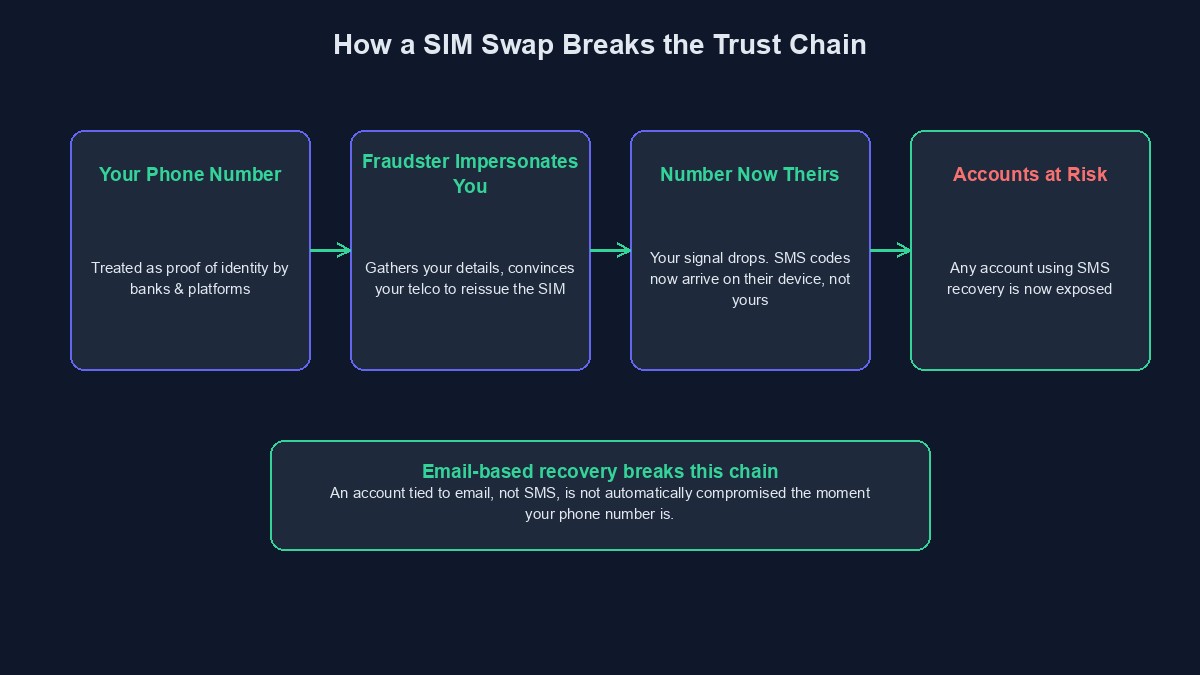
A SIM swap is not a technical hack in the way a database breach is. It is, almost always, a social engineering attack aimed at a telecom company's own customer service process. A fraudster who has already gathered enough of your personal information, your full name, date of birth, sometimes your National Identification Number, often collected from a previous data leak, a phishing message, or simply careless oversharing, contacts your mobile network pretending to be you, claims your SIM is lost or damaged, and asks for it to be reissued onto a new SIM they control. If the telecom's verification process is successfully fooled, your real phone number, the one every bank, payment gateway and platform you use treats as proof it is really you, now belongs to someone else, and your own phone loses signal entirely, often the first, and sometimes the only, warning sign before real damage is done.
Why a business owner is a specifically more attractive target than an individual
An individual's phone number typically unlocks one or two personal bank accounts. A business owner's phone number is very often the single number tied to a business bank account handling meaningfully larger and more frequent transactions, a payment gateway dashboard capable of initiating payouts, a VTU or ecommerce platform's admin login, and the WhatsApp number customers and suppliers already trust and recognise. A successful SIM swap against a business owner is not one theft, it is potentially several, executed in the same short window before the swap is discovered, which is exactly why business owners specifically, not just individuals in general, are a meaningfully more attractive target.
The warning signs, in the order they usually appear
Sudden, complete loss of phone signal, with no obvious cause like being in a known dead zone, is the first and most reliable warning sign, and it deserves an immediate, urgent reaction rather than a wait-and-see approach, since the window between a completed swap and real financial damage is often measured in minutes. A text message from your network confirming a SIM change or number port you did not request, if it arrives before your signal drops entirely, is an even clearer signal, and should be treated as a live emergency. Unexpected password reset or login notification emails, arriving in quick succession, for accounts that use your phone number as a recovery method, are a related, slightly later warning sign worth watching for even if your phone signal itself seems fine.
What to do in the first minutes, if you suspect it is actively happening
Contact your bank and payment gateway providers directly through a number you already have saved or know independently, never a number from a message you just received, and ask them to place a hold or freeze on your accounts while you investigate. Contact your mobile network's fraud or customer care line, again through an independently known number, to report the suspected unauthorised SIM swap and request it be reversed and blocked. Change the password on any account that does not depend on your phone number for its own login, your email account especially, since email is often the next thing an attacker pivots to once they control your number. Log into your VTU or business dashboard from a device that is still genuinely yours and review recent activity, funding requests, and, if your platform supports it, active sessions, for anything you did not initiate.
Prevention: the specific, concrete steps that actually reduce your exposure
Ask your specific mobile network directly whether they offer a SIM swap restriction or additional verification requirement for your line, some Nigerian networks now offer this on request, and it is worth the ten-minute conversation rather than assuming it is unavailable. Never share your BVN, NIN, date of birth, or other identity details in response to an unsolicited call or message claiming to be from your bank or network, since this is exactly the raw material a SIM swap attempt is built from, and a genuine bank or network representative never needs you to read these details back to them over an inbound call you did not initiate. Where a service offers a choice between SMS-based and email-based verification for account recovery, prefer email specifically for your highest-value business accounts, since an email account, protected by its own separate password, is not automatically compromised the moment your phone number is, in the way an SMS-based recovery flow is.
Where your XpiriaTech account specifically stands in relation to this attack
It is worth being precise here rather than vague. Account verification and password reset on our platform are handled entirely through email-based one-time codes, never SMS, which means a successful SIM swap against your phone number does not, on its own, give an attacker a path into your XpiriaTech dashboard login. It does not make you immune to every consequence of a SIM swap, your email account is still worth protecting with its own strong, unique password, and any other service you use that does rely on SMS-based recovery remains genuinely exposed, but it does mean one specific, high-value door in your business is not unlocked by the same key a SIM swap steals.
A note on NIN-SIM linkage, and why it helps less than people assume
Nigeria's mandatory linking of SIM registration to a National Identification Number is sometimes assumed by business owners to make SIM swap fraud meaningfully harder, and it is worth being honest that this assumption only partly holds. NIN-SIM linkage genuinely helps trace a fraudulent swap back to whoever executed it after the fact, which supports investigation and prosecution, and this is a real, worthwhile benefit. It does comparatively little to prevent the swap from happening in the first place, since a sufficiently prepared fraudster, one who has already gathered your personal details from a leak or phishing attempt, can often still convincingly impersonate you through the same customer service process this entire guide is about, NIN requirement included. Treat NIN-SIM linkage as a genuine, useful part of the wider system, not as a reason to relax the specific prevention steps in this guide.
Business lines versus personal lines: a decision worth making deliberately
Many Nigerian business owners run their entire business, customer communication, payment gateway verification, banking alerts, off the same personal phone number they have used for years, without ever deciding this deliberately, it simply became the default over time. There is a real, concrete argument for a dedicated business line instead, specifically for this risk: a dedicated line used only for business-critical verification and communication is a narrower, more deliberately protected target, easier to notice something is wrong with quickly since you are not also using it for unrelated personal messaging all day, and its loss, however serious, does not simultaneously cut you off from your own personal accounts and contacts while you are actively responding to the incident. This is not a step every business genuinely needs, a very small, early-stage operation may reasonably decide the extra complexity is not yet worth it, but it is worth an active, considered decision rather than simply never having thought about it.
A worked example: what a fast, correct response actually looks like
Picture a VTU business owner whose phone suddenly loses all signal mid-afternoon, with no obvious explanation. Rather than assuming a network fault and waiting it out, which is the natural but costly instinct, they immediately use a spare device to call their bank through the number printed on their own bank card, not a number from any recent message, and request an immediate freeze pending investigation. They separately call their mobile network's fraud line, also from a saved, independently known number, and report a suspected unauthorised SIM swap. Within the hour, the network confirms an unauthorised swap had indeed been requested and blocks it before it fully completes. The bank confirms no unauthorised transaction reached their account in that window. The entire incident, from signal loss to full resolution, takes under two hours, specifically because the response was immediate and used independently verified contact channels rather than anything from the incident itself.
Mistakes that turn a SIM swap attempt into an actual loss
Assuming a signal loss is a network fault and waiting to see if it resolves on its own. The cost of being wrong in this specific direction, treating a real attack as a minor inconvenience, is far higher than the cost of being wrong the other way, treating an actual network fault as a false alarm and losing a few minutes confirming your accounts are fine.
Calling a number from a suspicious message to "verify" an account, rather than a number you already had saved. A fraudster executing a SIM swap has often already prepared a fake support number to hand you next, precisely anticipating that a worried customer will want to call someone immediately.
Using the same phone number as the SMS-based recovery method for every single account, personal and business alike. This maximises exactly how much a single successful SIM swap can compromise in one attack, compared to spreading recovery methods, email where available, an authenticator app where offered, across your most important accounts.
Not knowing your own bank's and network's genuine fraud contact numbers in advance. Looking this up for the first time while already in the middle of a suspected attack costs precious minutes you do not have; saving these numbers now, while nothing is wrong, is a small, five-minute task worth doing today.
A short glossary
SIM swap: transferring a phone number to a new SIM card, legitimately when you genuinely lose your SIM, fraudulently when an attacker impersonates you to your network. SMS-based recovery: an account recovery method that sends a code to your phone number by text, which a successful SIM swap directly intercepts. Email-based recovery: an account recovery method tied to your email account instead, which a SIM swap does not directly compromise, though your email's own password security still matters. BVN/NIN: Nigerian identity numbers that a SIM swap attempt typically needs, gathered in advance, to successfully impersonate you to your network.
Where the rest of your business's security fits alongside this
SIM swap protection is one piece of a wider security posture, not a replacement for the rest of it. Our guide to securing your VTU business covers the broader practical checklist this specific guide sits alongside, and our deeper website security guide covers the technical side if you run a custom-built site rather than a managed platform. If you are building or running your business on our platform, you can start building free to see the email-based account security this guide describes directly in your own dashboard.
Comments
No comments yet. Be the first to share your thoughts.