How VTU Business Owners Actually Get Scammed (And How to Spot It)
Search for how VTU business owners actually get scammed and you will find surprisingly little useful, specific content, mostly general fraud-prevention advice written for enterprise ecommerce, or unrelated stories about crypto wallets and government data breaches. That gap is worth filling directly, because VTU businesses in Nigeria face a specific, recurring set of scams that look different from generic online fraud, and knowing the actual patterns is far more useful than a generic "be careful" warning.
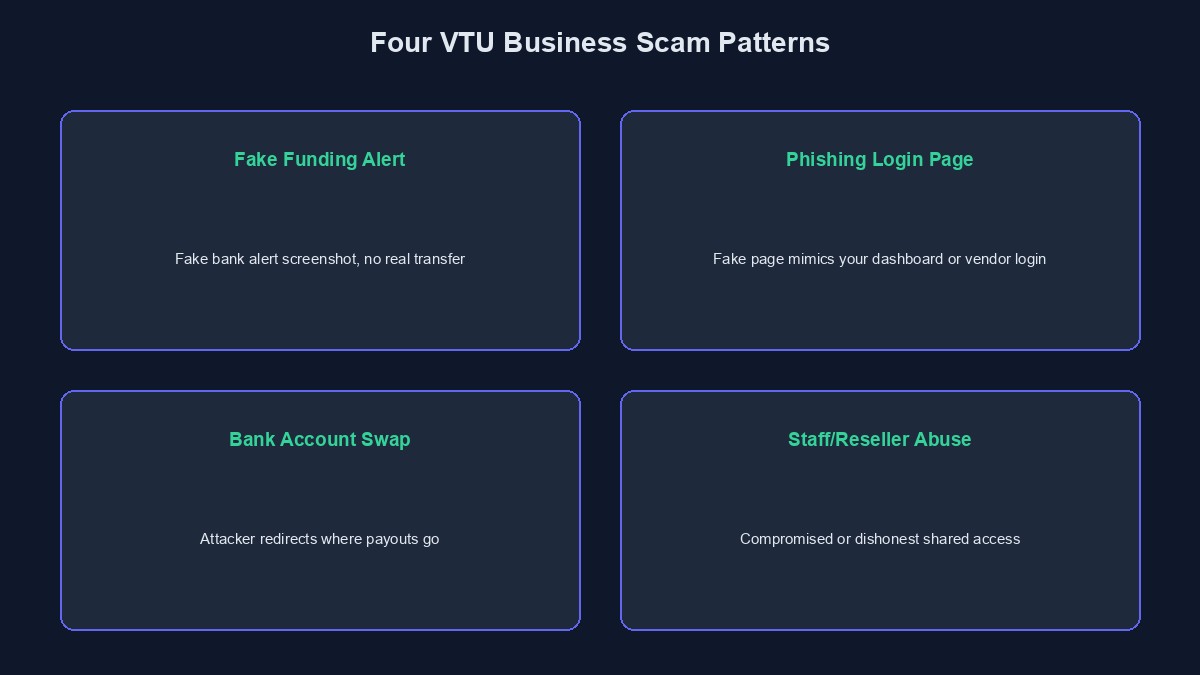
Pattern one: the fake funding alert
This is, by a wide margin, the most common scam a VTU business owner encounters, and it specifically targets the manual bank transfer funding option many platforms offer alongside automated payment gateways. A customer, or someone posing as one, sends a screenshot or forwarded message that looks exactly like a genuine bank alert, claiming they have just transferred a specific amount, and asks for their wallet to be credited immediately, often while pressing urgency, they need to make a purchase right now, they are in a hurry, they will leave a bad review otherwise. The screenshot is fake, generated by widely available fake-alert apps, or the underlying transfer was reversed or never actually completed, and a business owner who credits the wallet based on the message alone, without checking their actual bank account or dashboard for a genuinely confirmed, matching transaction, has just given away free credit.
The defence is simple and non-negotiable: never credit a wallet based on a screenshot, a message, or a claim alone. Confirm the transaction in your own bank account or, if your platform supports automatic transfer confirmation through a real banking integration, wait for that confirmation specifically, not a customer's own account of what happened.
Pattern two: phishing pages mimicking your own dashboard or a vending provider's login
A more targeted version of this scam sends a business owner, sometimes through a compromised contact's account, a link claiming to be an urgent notice from their VTU platform or their underlying vending provider, an account suspension warning, a required verification step, a claimed policy update, leading to a page built to look identical to the real login page. Entering credentials there hands them directly to the attacker, who then logs into the real account and, depending on what that specific access allows, can drain a wallet balance, redirect settlement payouts, or lock the real owner out entirely.
The defence here is a habit, not a tool: never log into any business-critical account by clicking a link in an unsolicited message, regardless of how urgent or official it looks. Navigate to the real site directly, by typing the address yourself or using a saved bookmark, every single time, and treat any message creating artificial urgency around a login as an immediate red flag rather than a reason to move faster.
Pattern three: the settlement bank account swap
This is the more serious, higher-effort version of VTU fraud, typically attempted only after an attacker has already gained some level of account access, through a phishing success, a SIM swap, or a genuinely weak, reused password. The goal is changing where the business's withdrawal payouts actually go, quietly redirecting a legitimate, ongoing revenue stream to an account the attacker controls, rather than a single one-off theft.
This is specifically the pattern our own platform's settlement bank account protections are built to stop. Changing a project's settlement bank account requires strict, dedicated authentication, a fresh one-time code and the account owner's own password re-entered at the moment of the change, and a project's regular builder-level admin access alone is never sufficient to make this specific change. Beyond that, a cooldown period after any genuine change blocks new withdrawals against the newly added account for a set window, so that even a fully successful account compromise cannot both change the payout destination and immediately drain the balance in the same sitting, giving a legitimate owner a real window to notice and intervene.
Pattern four: the trusted staff or reseller account
Not every VTU scam comes from an external stranger. A business with multiple staff members, or sub-resellers with their own dashboard access, carries a real, different risk: a staff member's own compromised password, or, less often, genuine insider dishonesty, being used to approve fraudulent funding requests, manipulate pricing to their own benefit, or quietly siphon small amounts across many transactions in a way that is individually easy to miss.
The defence is a combination of access discipline and habit: give each staff member or reseller their own distinct login rather than a shared one, so activity is genuinely traceable to a specific person, remove access immediately when someone leaves the business rather than "getting around to it," and review your platform's transaction and funding logs on a real, regular schedule, not only when something already feels wrong.
Pattern five: the too-good discount on airtime or data conversion
A less common but genuinely costly pattern specifically targets VTU businesses that also buy or exchange airtime and data in bulk, or deal with resellers below them in a wider chain: an offer of airtime or data at a price meaningfully below what any legitimate vending relationship could realistically sustain, paid for upfront, with the promised product never actually delivered, or delivered once genuinely, to build trust, before a much larger second payment disappears entirely. This preys specifically on a business owner's own margin pressure, the same instinct that makes a genuinely better wholesale rate attractive is exactly what makes an impossibly better one dangerous.
The defence is a simple, disciplined rule: treat any pricing offer meaningfully below your existing, verified vending relationships with real suspicion rather than excitement, verify a new supplier's actual track record and reputation independently before any payment, ideally through people you already trust rather than only the supplier's own claims, and never send a large payment to a new, unverified source based on one small, successful trial delivery alone, since building exactly that false confidence before the real theft is a well-understood part of how this specific scam is run.
Building the habit of actually reviewing your own transaction logs
Nearly every pattern in this guide is genuinely easier to catch early than late, and the single habit that catches all of them fastest is one many business owners never actually build: a real, scheduled review of your own transaction and funding logs, not only when a customer complaint or a low balance already suggests something is wrong. A short, weekly pass through recent activity, looking specifically for funding amounts that do not match your own bank records, purchases at unusual hours or unusual volumes for a specific customer, or account access from a location or device you do not recognise, catches small, early-stage fraud while it is still small, rather than after it has quietly continued for weeks. This does not need to be elaborate; fifteen genuinely focused minutes on a fixed day each week outperforms an occasional, unscheduled glance whenever something already feels wrong.
A worked example: catching a fake funding alert before it costs anything
Picture a VTU business owner who receives a WhatsApp message from an unfamiliar number, with a screenshot that looks exactly like a bank alert for fifteen thousand naira, and an urgent request to credit the sender's wallet immediately because they need to buy data for an emergency. Rather than crediting the wallet on the strength of the screenshot, the owner checks their own bank app directly and finds no matching incoming transaction at all. They reply, calmly, that they check their bank account directly rather than screenshots before crediting any wallet, and the sender, predictably, stops responding entirely, confirming what the missing bank transaction had already shown.
Mistakes that turn a scam attempt into an actual loss
Crediting a wallet under time pressure, "just this once," without checking the actual bank account first. Every fake funding alert scam depends entirely on skipping this one specific check, and it is worth treating as a genuinely non-negotiable step regardless of how convincing or urgent the message seems.
Reusing the same password across your VTU dashboard, email, and other business accounts. A single leaked password from an unrelated, unimportant service becomes a master key into your actual business the moment it is reused anywhere that matters.
Sharing dashboard login credentials among multiple staff members instead of giving each their own account. This makes it genuinely impossible to trace unusual activity back to a specific person, which is precisely the accountability a shared login quietly removes.
Not reviewing transaction and funding logs on any regular schedule. Many of these patterns are easiest to catch early, a handful of small, carefully sized fraudulent transactions, before they escalate into a large one, but only if someone is actually looking at the logs regularly rather than exclusively reactively.
A short glossary
Fake funding alert: a fabricated or fraudulently manipulated bank transfer notification, used to request wallet credit for a payment that never genuinely arrived. Phishing page: a fake login page built to look identical to a real one, designed to capture credentials when entered. Settlement bank account: the real-world bank account a platform pays a business's withdrawal balance out to, a high-value target for a sophisticated attacker. Cooldown period: a deliberate delay before withdrawals are permitted against a newly changed payout account, specifically to give a legitimate owner time to notice and stop an unauthorised change.
Where this is already defended for you
If you are running a VTU project on our platform, the settlement bank account protections described in pattern three, strict dedicated authentication, a fresh one-time code, password re-entry, and a real cooldown period, are already built in and active, not something you need to configure separately. Combined with the broader checklist in our guide to securing your VTU business and the account-specific guidance in our SIM swap fraud guide, this covers the great majority of the real, specific scam patterns VTU businesses in Nigeria actually encounter. You can start building free to see these protections directly in your own dashboard.


Comments
No comments yet. Be the first to share your thoughts.