What Is a Vending API? How Airtime and Data Reselling Actually Works
If you have looked into starting a VTU or data reselling business in Nigeria, you have almost certainly run into the phrase "vending API" without anyone actually explaining what it means in plain terms. Search for it and you land almost exclusively on the marketing and documentation pages of the vending providers themselves, VTU.ng, Paygold, Reloadly, Interswitch, each one assuming you already understand the underlying concept and are just comparing specific providers. This is the explanation that comes before that comparison.
The plain-English version
A vending API is a programmatic way to buy airtime, data, or other billable services, cable subscriptions, electricity tokens, exam pins, in bulk from a provider who already has a real, working relationship with the telecom networks and billers, and then resell that access to your own customers, automatically, without you personally needing your own direct relationship with MTN, Airtel, Glo or 9mobile at all. The provider has already done the hard, slow part, negotiating bulk purchasing terms directly with the networks, and the API is simply the technical door they leave open for you to buy through that relationship programmatically instead of manually.
How this actually differs from just buying airtime yourself
You can, of course, buy airtime or data for a friend manually, through your own banking app's bill payment feature or a USSD code, one transaction at a time. A vending API exists specifically because that manual, one-at-a-time process does not scale into an actual business. A VTU platform serving even a modest number of customers a day needs purchases to happen automatically, the moment a customer pays, at wholesale rates rather than retail ones, and recorded properly for accounting, none of which a manual USSD purchase can do. The vending API is what turns "buying airtime for people" into an actual, automatable business rather than a manual chore repeated endlessly by hand.
What actually happens, step by step, when a customer buys data on a VTU site
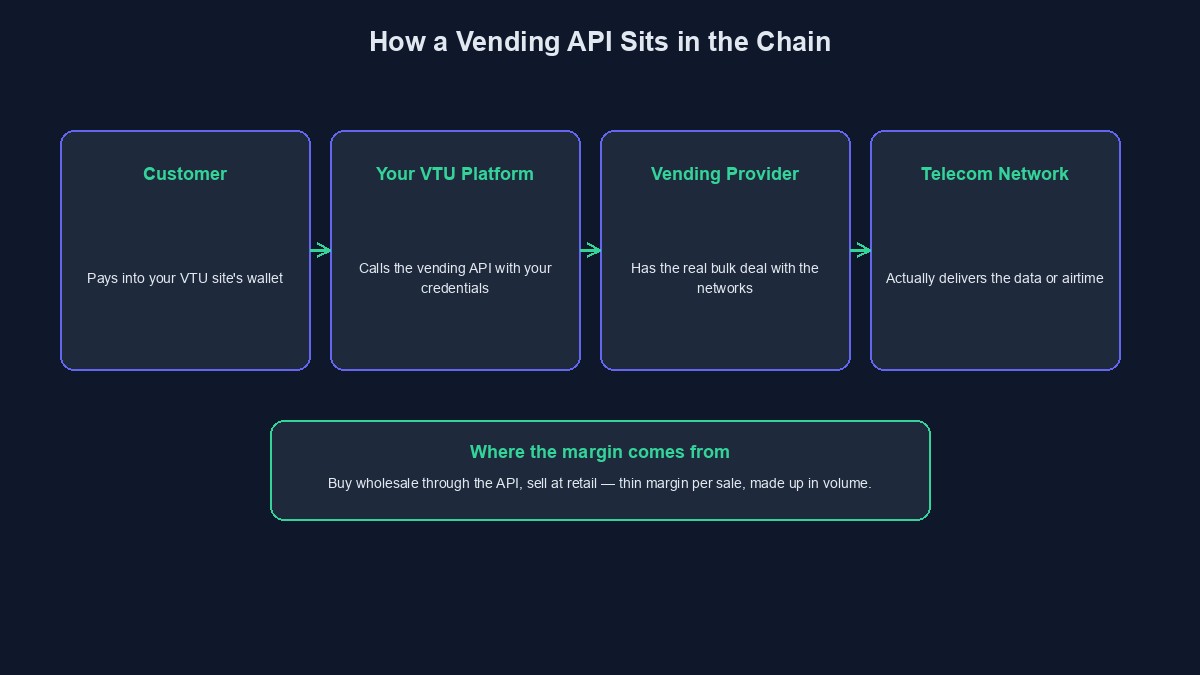
Understanding the real flow makes the whole concept click. A customer visits a VTU website, selects a data plan, and pays, usually into a wallet the site itself manages. The site's own backend then makes a request to the vending provider's API, specifying the network, the plan, and the customer's phone number, using API credentials that identify the site owner's own account with that provider. The vending provider, which has the genuine, established relationship with the actual network, processes that request against the network directly and returns a response confirming success or failure. The VTU site then updates its own records and notifies the customer, the entire sequence typically completing in seconds, with no human being involved at any point after the customer's own initial purchase.
Where the actual profit margin comes from
This is the part that makes the business model make sense, and it is worth being explicit about it rather than treating it as an implied mystery. A vending provider sells data and airtime to its own registered resellers at a wholesale rate, below the retail price an ordinary customer would pay directly, precisely because of the provider's own bulk purchasing relationship with the networks. A VTU site owner buys at that wholesale rate through the API and sells to their own customers at a retail, or near-retail, price, keeping the difference as margin. This margin is typically modest per individual transaction, a genuinely small amount on a single data bundle, which is exactly why a real VTU business depends on volume, many transactions, rather than a large margin on any single one.
The specific things a vending API actually gives you access to
Beyond the core "buy data and airtime" function, a genuine vending API typically exposes several other, related capabilities worth knowing about specifically. A way to check current wholesale prices and available plans programmatically, so your own site's pricing stays accurate as a provider's own rates change. A way to verify a specific service before charging for it, confirming a meter number is valid before selling electricity units against it, for instance, reducing failed transactions. A way to check the real-time status of your own wallet balance with that provider, since you are typically required to pre-fund your account with the provider before vending against it. And, for services with a delay between purchase and confirmation, a way to check a specific transaction's status after the fact, or receive a webhook notification the moment it resolves.
Why VTU businesses commonly connect to more than one vending provider
A single provider rarely covers every network reliably at the best rate all the time, and pricing between providers shifts over time as their own underlying deals with the networks change. Serious VTU businesses commonly connect to two or more vending providers, routing a purchase to whichever one currently offers the best combination of reliability and rate for that specific network and service, rather than depending entirely on a single relationship. This also provides a practical fallback: if one provider's API is temporarily down or unusually slow, purchases can route through an alternative rather than failing outright for every customer at once.
What genuinely differs between vending providers, worth checking before committing
Not every vending provider is interchangeable, and the differences that actually matter are rarely the ones advertised most loudly. Actual reliability, how often the API genuinely works without unexpected failures or unexplained delays, matters more over time than a slightly better advertised rate, since a marginally cheaper provider that fails regularly costs you far more in refunds and lost customer trust than the margin difference is worth. Real settlement speed, how quickly a failed transaction's funds are actually returned to your wallet, matters considerably for cash flow at real volume. And genuine documentation quality, whether the provider's own technical documentation is accurate, current, and complete, directly determines how much of your own development time gets spent working around gaps or errors in what they have published, rather than actually building your business.
Funding your wallet: the part that catches new resellers off guard
A detail that surprises many people new to this business model: you typically cannot vend against a provider's API on credit. You fund your own wallet with that specific provider first, through a bank transfer or an accepted payment method, and the API then debits that pre-funded balance with every purchase you make through it, refusing further transactions once the balance runs out. This means real, upfront capital is genuinely required to run a VTU business at volume, not just a working integration, and a new reseller who has built a technically perfect connection to a vending API but underestimated how much working capital it takes to keep a wallet funded at real transaction volume will hit this ceiling quickly regardless of how well the technical side works.
A worked example: what actually happens on a failed transaction
Picture a customer purchasing a data bundle on a VTU site, paying successfully into their wallet, but the subsequent vending API call to the provider times out, no clear success or failure response returned within the expected window. A properly built VTU platform does not simply assume success or silently do nothing here: it records the transaction as pending, holds the customer's payment rather than losing track of it, and either polls the provider's transaction-status endpoint shortly afterward or waits for a webhook confirming the actual outcome, only then crediting the data, refunding the customer, or flagging the transaction for manual review, depending on what actually happened on the provider's side. This handling, invisible when everything works normally, is precisely what separates a genuinely reliable VTU platform from a fragile one, and it depends entirely on the vending API actually exposing a reliable way to check a transaction's real status after the fact.
Mistakes businesses make when they misunderstand this concept
Assuming a vending API purchase is instantaneous and guaranteed, with no need to handle a pending or failed state. Real network conditions occasionally produce genuine delays or failures, and a VTU platform that does not handle this properly ends up crediting nothing while having already charged a customer, or the reverse.
Committing to a single vending provider without a fallback. A provider's own API being briefly down, which happens to every provider occasionally, becomes a complete business outage rather than a manageable, routed-around inconvenience.
Not understanding that the margin is genuinely thin per transaction. A new VTU business owner sometimes expects a larger per-sale profit than this business model actually offers, and the realistic expectation, thin margin at real volume, is worth understanding from the start rather than discovering with disappointment later.
Choosing a provider purely on advertised rate without checking real reliability. The cheapest advertised rate from a provider with poor actual uptime costs more in refunds, support time, and lost customer trust than a slightly more expensive, genuinely reliable one.
A short glossary
Vending API: a programmatic interface letting a reseller buy airtime, data or other billable services at wholesale rates and resell them automatically. Wholesale rate: the discounted price a vending provider charges its own registered resellers, below ordinary retail price. Settlement: the process of a provider actually returning funds for a failed or reversed transaction to a reseller's wallet. Webhook: an automatic notification a vending provider sends the moment a transaction's real status resolves, rather than requiring the reseller to repeatedly check.
Where this fits into actually building a VTU business
Understanding what a vending API is conceptually is the first step; our practical guide to connecting a vending API to your VTU website covers the actual, hands-on steps for wiring one up. If you are building on our platform, this connection, credential entry, network and plan matching, test purchases, is handled through your dashboard's own guided setup rather than requiring you to write the integration code yourself, and you can start building free to see it directly.


Comments
No comments yet. Be the first to share your thoughts.