How Much Does API Integration Cost?
"How much does API integration cost" is a genuinely different question from "how much does it cost to build an API," even though the two get mixed up constantly. Building an API means creating one from nothing for others to use. Integration means connecting your own system to an API that already exists, a payment gateway, an SMS provider, a delivery partner. This guide covers real, honest numbers for that second, more common situation, in naira, dollars and euros.
What actually drives the cost, before any numbers
How well documented the provider's own API is matters more than almost anything else, since a clear, well-written guide with real examples turns a day's work into an afternoon, while a poorly documented one turns an afternoon into a week of guesswork. How many distinct actions you actually need, just checking a balance versus checking a balance, sending payments, and handling refunds, multiplies the real work involved. Whether the provider expects a webhook set up on your side, so they can reach you when something finishes, adds a genuinely separate piece of work beyond the basic request-and-response connection. And how much your own existing system's data needs reshaping to match what the provider expects is consistently the most underestimated factor of the four.
Real, honest cost bands
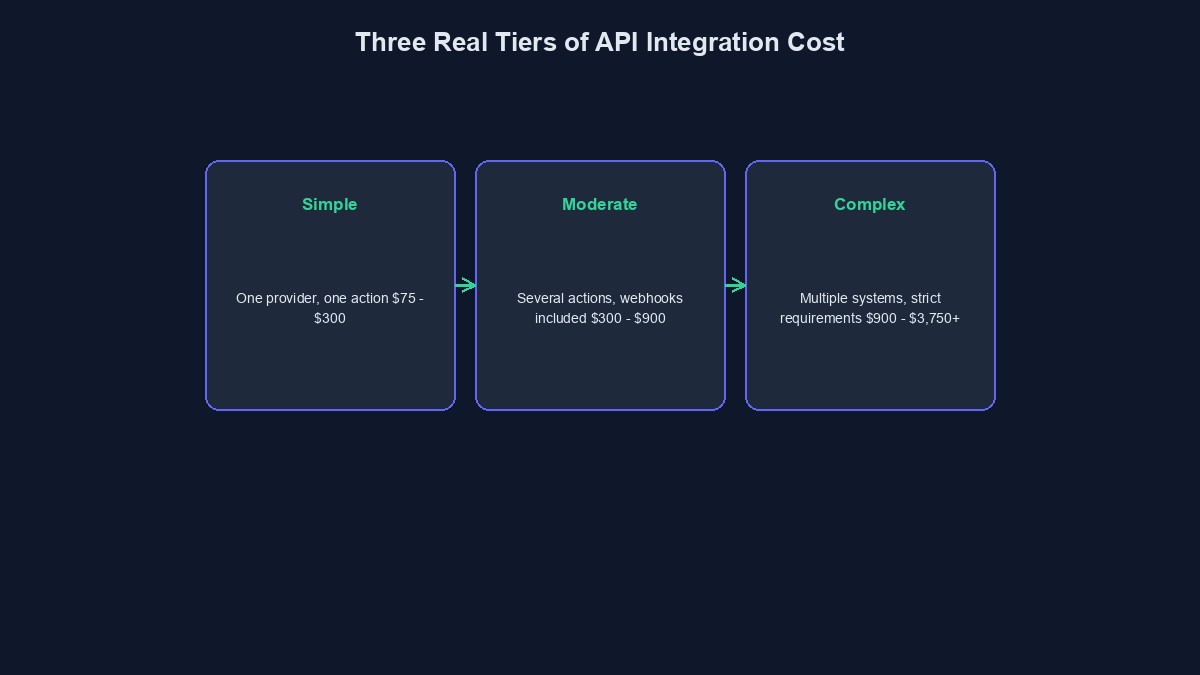
A simple, single-purpose integration, connecting to one well-documented provider for one clear action, checking a delivery status, sending a single SMS, verifying a bank account, typically costs ₦100,000 – ₦400,000 ($75 – $300, or €66 – €265) with a capable freelance developer, and is often finished within a few days.
A moderate integration, handling several related actions with the same provider, payments plus refunds plus webhook confirmations, with proper handling of both success and failure, typically runs ₦400,000 – ₦1,200,000 ($300 – $900, or €265 – €795), and reasonably takes one to three weeks depending on how much testing the provider's own sandbox environment allows for.
A complex, multi-provider integration, connecting several different systems together, your own platform, a payment gateway, an accounting tool, each with their own quirks and their own authentication, is where cost climbs well past that, often ₦1,200,000 – ₦5,000,000+ ($900 – $3,750+, or €795 – €3,300+), depending heavily on how many systems are involved and how well, or badly, each one is documented.
Why "free" API access does not mean free integration
Many providers genuinely do not charge you to access their API itself, only per transaction once you are actually using it. This is a real, important distinction, but it is easy to mistakenly assume it means the integration work costs nothing too. The API being free to access says nothing about how many hours it takes a developer to correctly connect your system to it, handle its specific errors, and test it properly, and that development time is the actual cost this guide is describing.
The ongoing cost a one-time integration fee often hides
An integration is rarely finished the day it goes live. Providers update their APIs, sometimes introducing changes that quietly break an integration nobody is actively watching. Your own business's needs change, a new refund policy, a new required field. A realistic budget sets aside a small amount for ongoing maintenance, rather than assuming the integration, once working, stays working forever without anyone occasionally checking on it.
Freelancer, small agency, or building it yourself
A capable freelance developer is typically the most affordable route for a single, well-documented integration, assuming you can verify they have actually done something similar before. A small agency costs more but brings more accountability if the work spans several systems at once. And for a common, well-covered need, accepting payments, sending SMS, verifying identity, checking whether a ready-made platform already includes the integration is very often the cheapest option of all, since you are not paying to build something that already exists elsewhere as a finished, tested feature.
A worked example: pricing two different real requests
Picture two business owners. The first runs a car rental service and wants their own booking system to automatically check a customer's driver's licence against a government verification API before confirming a booking. This is one clear action, against one documented provider, and lands comfortably in the simple tier, a few days of a freelance developer's time.
The second runs a logistics company and wants orders to automatically flow from their own system into three separate places at once, a payment gateway, an accounting platform, and a delivery partner's tracking system, each confirming back independently through its own webhook. This is a genuinely complex, multi-provider integration, and pricing it as if it were the first business's simple, single-action request would badly underestimate the real work involved.
Mistakes worth avoiding when budgeting for this
Assuming every integration costs the same regardless of how many providers or actions are involved. A single, well-documented connection and a five-system integration are not remotely the same project, and should not be priced as if they were.
Ignoring the provider's documentation quality when estimating time. Two integrations that sound identical on paper can differ enormously in actual hours if one provider's documentation is clear and the other's is not.
Forgetting to budget for ongoing maintenance. A working integration today is not a guarantee of a working integration in a year, especially once the provider itself changes something on their end.
A short glossary
Integration: connecting your own system to an API that already exists, as distinct from building a new API from scratch. Sandbox: a safe, test version of a provider's API, used to build and test an integration before it touches real money or real customers. Webhook: a way for a provider to notify your system automatically once something finishes, rather than your system repeatedly asking. Provider: the company whose existing API you are connecting to, a payment gateway, an SMS service, a delivery partner.
Where to go from here
If your actual need is building your own API for others to use, rather than connecting to someone else's, our guide to how much it costs to build an API in Nigeria covers that separate question. Our tutorials on the Paystack API, Flutterwave API and WhatsApp Cloud API are real, worked integrations you can learn from directly. And if your business runs on VTU, ecommerce, or booking, many of the integrations this guide prices out are already built and already live if you start building free on our platform instead.
Comments
No comments yet. Be the first to share your thoughts.