How Much Does It Cost to Build a Delivery App?
A delivery app looks simple from the outside, a customer orders something, a rider picks it up, it arrives. Underneath, it is a genuinely real piece of software with several moving parts that all have to work correctly together. This guide breaks down what a delivery app actually costs, honestly, by explaining what is actually being built, not by throwing out one guessed number.
A delivery app is really three apps in one system
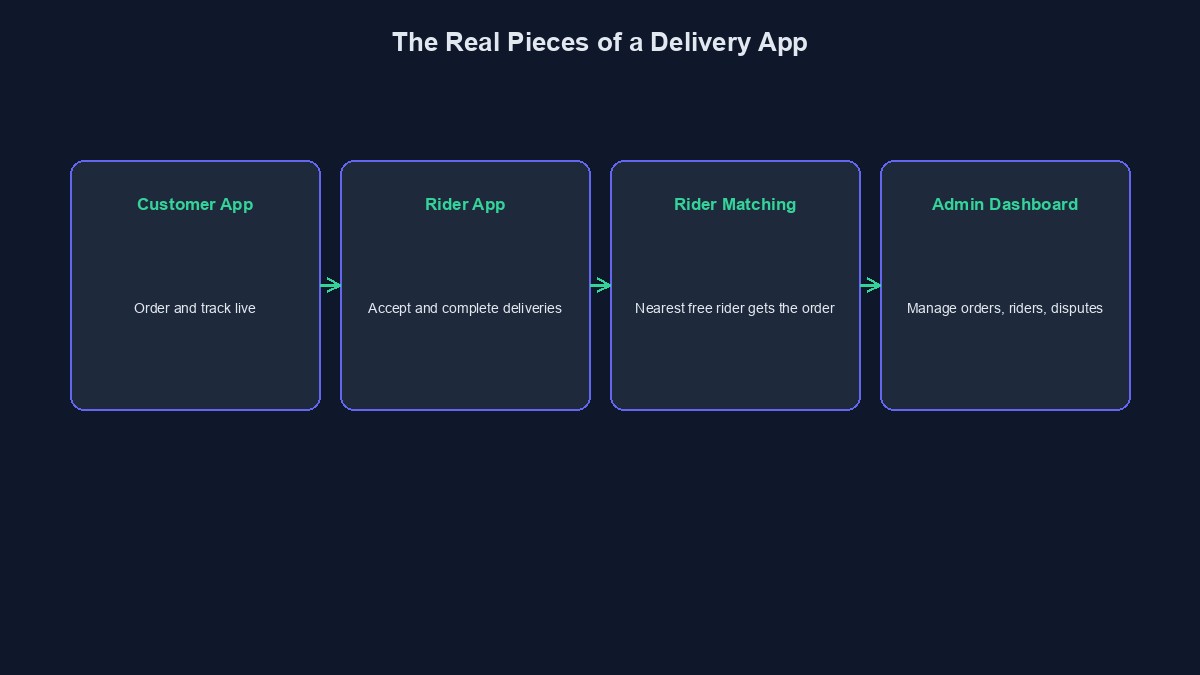
Just like a ride-hailing app, a real delivery platform is not one single app, it is three connected pieces. A customer app, for placing and tracking an order. A rider or driver app, for accepting deliveries and navigating to the destination. And an admin dashboard, for the business to manage orders, riders, and any problems that come up. Each piece is real, separate software, and the total cost is genuinely the cost of building and connecting all three properly.
The genuinely hard, expensive parts, named honestly
Live order tracking, letting a customer watch their delivery move on a map in real time, is technically demanding to build correctly and keep reliable, the same real challenge a ride-hailing app faces. Assigning the right rider to the right order, based on who is nearest, who is free, and how many deliveries they can reasonably handle at once, is a real, specific piece of logic, not a simple, obvious task. Calculating an accurate delivery fee, based on distance, and sometimes item weight or urgency, needs to be genuinely correct, since a wrong fee is an immediate, direct money problem. And, specifically for a food or grocery delivery app, connecting to a restaurant or store's own real menu and stock so a customer cannot order something that is actually unavailable is its own real, separate piece of the system.
What actually changes the price, in order of real impact
Whether you are delivering one specific type of thing, food from restaurants, for example, or a genuinely general delivery service handling many different kinds of items, since general delivery often needs more flexible, adaptable logic. Whether riders are your own employees using a company-provided system, or independent riders using their own personal phones, which changes some of the real onboarding and verification requirements. Whether you need both a customer and rider app on both Android and iPhone from day one, or are starting with one platform to prove the concept first. And how sophisticated your order-to-rider matching needs to be, a simple "first available rider" approach costs meaningfully less to build than a smarter system properly balancing distance, current rider load, and delivery urgency together.
Three realistic tiers, honestly described
A genuinely minimal version, order placement, simple rider assignment, basic live tracking, and straightforward payment, is real, substantial software, but a meaningfully smaller undertaking than a fully-featured platform. A more complete version, adding smarter rider matching, real-time chat between customer and rider, and better admin reporting and analytics, moves meaningfully higher. A version genuinely built for real scale, handling a high daily order volume reliably, with sophisticated matching, strong analytics, and robust dispute-handling tools, is a serious, major software investment, the kind a genuinely funded logistics business budgets for over time, not a single starter project.
The ongoing costs that quietly add up after launch
Live map and location services from a provider like Google Maps, priced by real usage, meaning this cost genuinely grows as your order volume grows, not a fixed, one-time fee. SMS and notification costs for order updates and rider alerts, scaling directly with your actual order volume. Payment gateway fees on every single transaction processed through the app. And continuous development, since real riders and real customers will surface real problems and real feature requests only after genuine, live use, not before.
Deciding between your own riders and independent riders
Some delivery businesses hire and manage their own riders directly, like employees. Others let independent riders sign up and work whenever they choose, more like a loose network than staff. Your own riders are easier to train and hold to a consistent standard, but cost more to maintain, since you pay them whether orders are busy or slow. Independent riders cost you less when things are quiet, since you are not paying anyone idle, but are harder to hold to a consistent standard of service. Neither choice is automatically right. It depends on how steady your real order volume actually is in the beginning.
A worked example: scoping a realistic first version honestly
Picture a founder wanting to launch a food delivery service in one specific Nigerian city, partnering initially with a genuinely manageable number of real local restaurants rather than attempting to onboard hundreds from day one. A realistic first version includes order placement from those specific partner restaurants, simple rider assignment based on who is nearest and currently free, live order tracking, and payment through a real, established Nigerian payment gateway. A more advanced, load-balanced rider-matching system and deeper analytics are deliberately planned as a genuine second phase, added only once the core service is actually proven working reliably with real orders and real riders in one real market, rather than trying to build every advanced feature before ever testing whether the core idea works at all.
Mistakes that inflate cost or waste money in this specific category
Trying to support every possible type of delivery, food, groceries, packages, pharmacy items, all at once in a first version. Each category can carry genuinely different real requirements, and combining all of them from day one meaningfully increases both cost and real complexity before you have proven any single one works.
Underestimating the real cost of live maps and location services at scale. This grows directly and continuously with your order volume, and deserves a real, ongoing place in your budget, not just a launch-day estimate.
Building an overly complex rider-matching system before you have enough real riders and real orders for it to meaningfully matter. A simple, honest "nearest available rider" approach is often genuinely sufficient at real early-stage order volumes.
Skipping proper rider verification to save early time and cost. This is a real, serious trust and safety risk, directly affecting both customer safety and your own business's genuine reputation.
A short glossary
Rider matching: the logic deciding which available rider gets assigned to a specific delivery order. Live tracking: showing a customer their delivery's real, current location on a map as it moves. Admin dashboard: the internal tool a business uses to manage orders, riders, and any disputes that arise. Onboarding: the process of verifying and adding a new rider, restaurant, or store to the platform.
Where to go from here
Our broader guide to how much an app costs in Nigeria covers the general cost factors this delivery-specific guide builds on top of, and our guide to building a rider and delivery management system goes deeper into the actual system design. A real delivery platform, customer app, rider app, and admin dashboard together, is a genuine custom software project, and our development team is the right place for an honest conversation about your specific city, your actual order volume, and your real budget.
Comments
No comments yet. Be the first to share your thoughts.