
How to Build a SaaS Platform From Scratch
"Build a SaaS platform from scratch" means something genuinely different from "build a SaaS without coding," and conflating the two is where a lot of advice online goes wrong. This guide is for the actual from-scratch version, real architecture, real decisions about authentication, billing, and multi-tenancy, aimed at someone who wants to understand what building a genuine SaaS product actually involves, whether they end up writing the code themselves or hiring someone to.
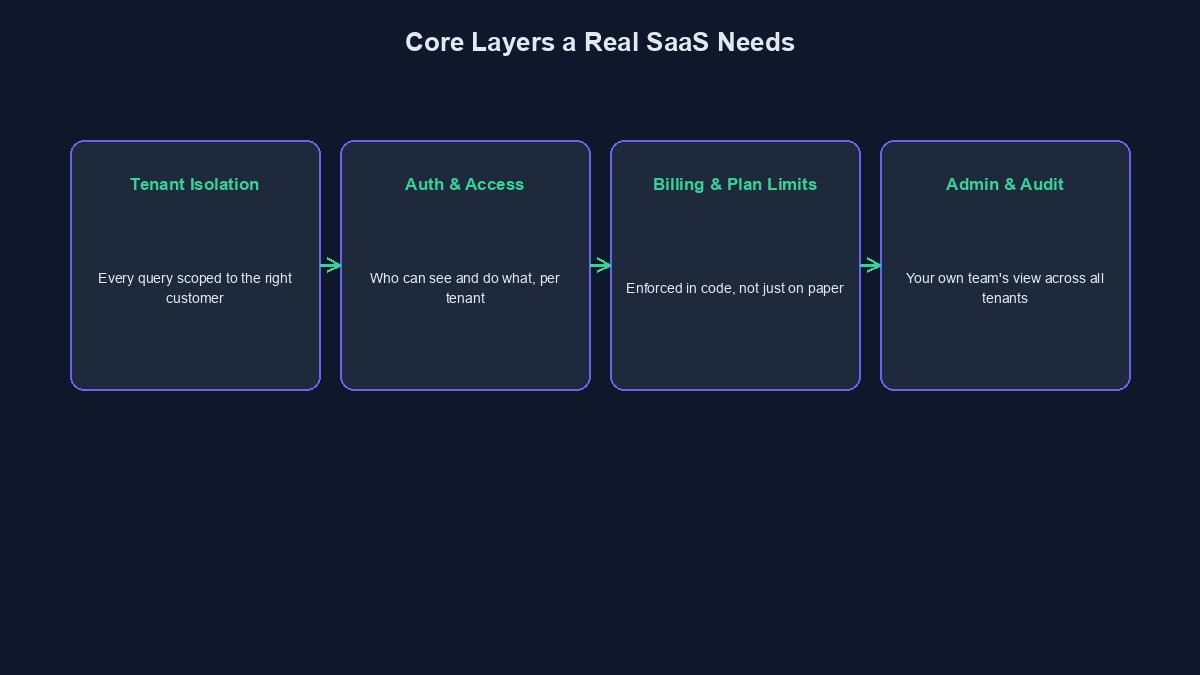
What actually makes something a SaaS, architecturally
The defining technical characteristic is multi-tenancy: many separate customers, each with their own data, their own users, their own billing, all running on the same underlying application and infrastructure, rather than each customer getting their own separate, individually deployed copy. This single decision, how tenants are actually separated at the data layer, shapes nearly everything else about the architecture, and it is worth understanding the real options before writing a line of code.
The three real ways to separate tenant data, and their actual tradeoffs
A separate database per tenant gives the strongest isolation, one customer's data is physically incapable of leaking into another's through an application bug, but it is the most operationally expensive to run and scale, since every new customer means provisioning and maintaining another real database. A shared database with a tenant identifier column on every table is the most common approach for a genuine SaaS at real scale, every query filtered by tenant ID, cheaper to run and easier to scale, but it puts real weight on getting that filtering correct in every single query, since a missed filter is a genuine, serious data leak between customers. A shared database with separate schemas per tenant sits between these two, a reasonable middle ground some platforms use, though it is less commonly the right default choice than the shared-table approach for most new products.
Authentication: harder than it looks the moment tenants enter the picture
A single-tenant application's login system is comparatively simple. The moment you add multiple tenants, real questions appear that a tutorial rarely covers honestly: can the same email exist across two different tenants as genuinely separate accounts, how does a user who belongs to more than one tenant switch between them, and, critically, how do you guarantee, in code, that a logged-in user from tenant A can never see or act on tenant B's data, even if a bug elsewhere in the application tries to let them. This last point deserves to be enforced at the lowest practical layer of your code, not merely assumed because the user interface only shows the right tenant's data, since a UI-only boundary is not a real security boundary.
Billing: the part that is genuinely its own project
Recurring subscription billing, upgrades, downgrades, failed payment retries, proration when a customer changes plans mid-cycle, is deep enough that most real SaaS products building from scratch integrate an existing payment gateway's subscription tooling, our own guide to setting up recurring billing with Paystack and Flutterwave covers the practical mechanics, rather than building billing logic entirely in-house from first principles. Building your own full billing engine is rarely the right use of early effort, since it is a solved problem elsewhere and getting it subtly wrong has real financial consequences.
The features a genuine SaaS needs that a normal web app does not
Usage limits and plan gating, actually enforcing that a free-tier customer cannot exceed the specific limits your pricing promises, in code, not just in your pricing page's copy. An admin view for your own team to see and manage customers across the whole platform, distinct from any individual tenant's own view of their own data. Audit logging, a real record of who did what and when, which becomes genuinely important once you have paying customers whose trust depends partly on your ability to answer "what happened to my data" accurately. And a real onboarding flow, since a SaaS product's first few minutes for a brand new customer are disproportionately important to whether they become a paying one at all.
Security: where a from-scratch SaaS carries more responsibility than a typical website
Beyond the tenant-isolation concern already covered, a SaaS product handling other businesses' real data carries security obligations a simple website does not: proper API authentication for any programmatic access you offer, careful handling of any payment or personal data your tenants' own customers might pass through your system, and a genuine incident response plan, since a data leak between your paying customers' tenants is a business-ending event in a way a typical website's security incident usually is not. Our broader guide to website security fundamentals covers the baseline this builds on top of, not a substitute for the tenant-isolation discipline specific to SaaS.
Choosing a tech stack: a decision worth making deliberately, not by trend
The specific programming language and framework matter far less than most early-stage discussions treat them as mattering, and a real SaaS has been successfully built on nearly every popular, well-supported stack available. What genuinely matters more: choosing tools your own team, or the developer you hire, genuinely knows well, since deep familiarity with an unglamorous, proven stack consistently outperforms a trendier choice nobody on the team has real, deep experience with, and confirming the stack has a genuinely mature ecosystem for the specific hard parts, subscription billing, background job processing, real-time features if your product needs them, rather than requiring you to build foundational infrastructure yourself that a mature framework would have handled already.
A worked example: a realistic early architecture decision
Picture a founder building a genuine SaaS product for small logistics businesses, starting the technical design before writing significant code. Rather than defaulting to a separate database per customer, based on an instinct that it "sounds safer," they choose a shared database with a tenant ID on every table, specifically because their realistic early customer count, dozens rather than thousands, does not yet justify the operational cost of per-tenant databases, and they build a single, shared, well-tested query layer that automatically applies the tenant filter on every database call, rather than trusting every individual feature's code to remember to add it manually. This one architectural decision, made deliberately rather than by default, shapes how confidently they can promise data isolation to their first real paying customers.
Mistakes that show up repeatedly in from-scratch SaaS builds
Building a fully custom billing system before validating anyone will actually pay. This is consistently a misallocation of early effort; a genuinely working, unglamorous integration with an existing payment gateway's subscription tools gets you to real paying customers faster.
Enforcing tenant isolation only in the user interface, not in the actual data-access code. A UI that only shows the right tenant's data is not the same as a system that cannot return the wrong tenant's data if a developer makes a mistake elsewhere later.
Skipping usage limits and plan gating until "later." A pricing page promising tiered limits that the actual product does not enforce is not a technical shortcut, it is a real gap between what you are selling and what you are delivering.
Underestimating how much of "building a SaaS" is actually operational, not code. Customer support, onboarding, handling a tenant's data-deletion request properly, are real, ongoing work that a from-scratch build has to account for from the start, not features to bolt on once the "real" product is done.
A short glossary
Multi-tenancy: one application serving many separate customers, each with isolated data, on shared underlying infrastructure. Tenant: one customer organisation within a multi-tenant system. Plan gating: enforcing, in actual code, the usage limits a pricing tier promises. Proration: adjusting a bill fairly when a customer changes plans partway through a billing cycle.
Where to go from here
If you specifically want to build a SaaS without a from-scratch technical build, our companion guide to building a SaaS without coding covers that different, genuinely faster path honestly, including where it stops being enough. If a real, custom from-scratch build is what your specific product actually needs, our custom software development team builds exactly this kind of multi-tenant architecture professionally, and a direct conversation about your specific requirements is worth more than generic advice at this stage.

Comments
No comments yet. Be the first to share your thoughts.