
How to Create an API for a Website or Mobile App
Most guides about APIs are written for the person consuming someone else's. This one is for the other side, the moment your own website or app has grown to the point where something else, your own mobile app, a partner's system, or a customer's internal tool, needs to talk to it directly. Building an API sounds bigger than it usually is. Here is what actually goes into doing it properly.
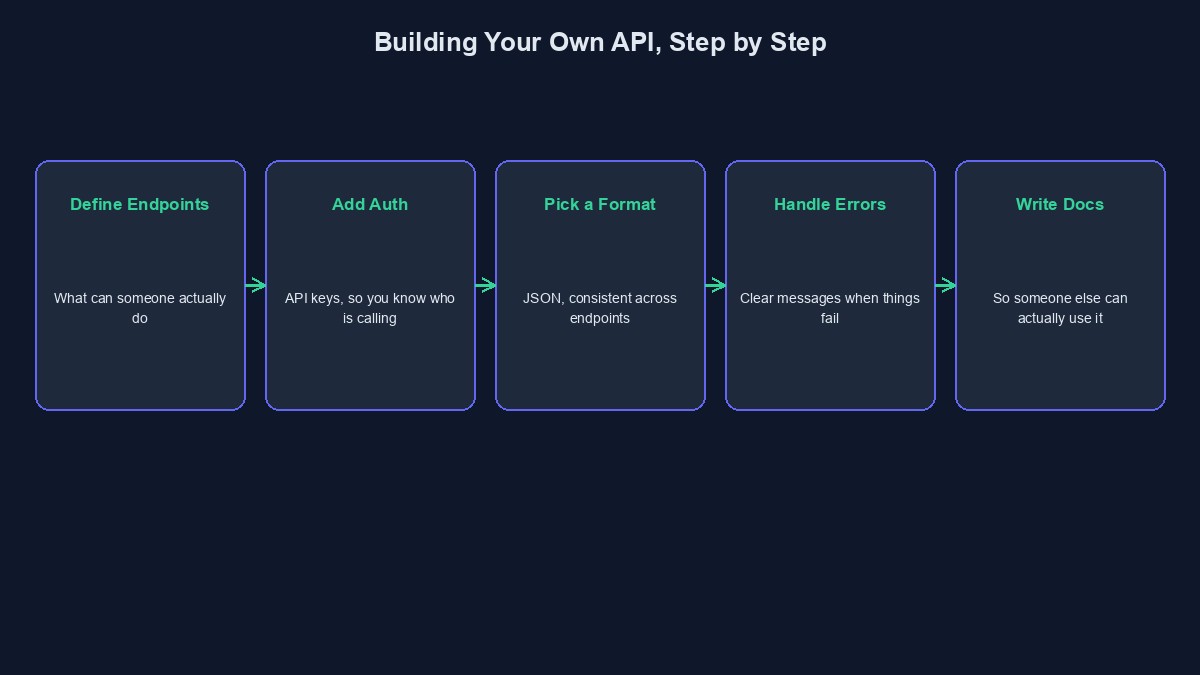
Work out exactly what someone would actually need to do with it
Before writing anything, get specific about who is actually going to call this API and why. "Let other developers integrate with us" is not specific enough to design anything from. "A customer's own app needs to check their wallet balance and trigger a data purchase" is specific enough to actually start. The real, concrete list of actions someone needs to take becomes your list of endpoints, and a shorter, well-thought-out list beats a large, vague one you have not actually validated anyone needs.
Decide what each endpoint actually does, one at a time
Each endpoint should have one clear job. A "check balance" endpoint answers one specific question. A "buy data" endpoint performs one specific action. Resist the urge to build one giant, do-everything endpoint that tries to handle many different requests through a pile of optional parameters, since this becomes genuinely harder to document clearly, harder for someone else to use correctly, and harder for you to change safely later without breaking something unrelated.
Pick how people will prove who they are
An API with no authentication at all is an API anyone can call, including people you never intended to give access to, which is a real security problem the moment your API does anything involving real money or real personal data. The common, practical approach for most businesses is an API key, a unique string you generate for each person or each project, sent in a request header, that you can check on every single request and revoke individually if it is ever misused, without affecting anyone else's access.
Choose a data format and stay consistent about it
JSON is the practical default today, readable by essentially every programming language in common use, and well understood by any developer who might build against your API. Once you choose it, stay consistent, the same field names meaning the same thing across every endpoint, the same date format everywhere, the same way of reporting an error everywhere. Inconsistency between endpoints is one of the most common, avoidable reasons an otherwise well-built API feels frustrating to actually use.
Design your errors as carefully as your successes
A request will fail sometimes, invalid input, insufficient balance, a number that does not exist. What you send back in that moment matters as much as what you send back on success. A clear error response states plainly what went wrong, in terms a developer can act on, "insufficient wallet balance" rather than a generic, unhelpful "something went wrong," alongside the correct status code. A vague error message is one of the fastest ways to turn a developer who is trying to integrate with you into a developer who gives up and complains publicly instead.
Write the documentation while you still remember why you built it this way
Documentation written months later, once you have forgotten the small decisions you made along the way, is consistently worse than documentation written while the work is still fresh. For every endpoint, state plainly what it does, exactly what it expects, exactly what it sends back, on both success and failure, and include one real, working example someone can copy and adjust rather than build from scratch. An API without documentation is not really usable by anyone except you, no matter how well it is built underneath.
Test it the way an actual outside developer would use it
Testing your own API only through your own, already-working app tends to hide real problems, since you unconsciously avoid the mistakes a new developer, unfamiliar with your specific assumptions, would naturally make. Deliberately send it bad or missing data, a badly formatted phone number, a missing required field, and confirm it fails clearly and safely rather than breaking in some confusing, unhandled way. A little deliberate, adversarial testing here catches real problems before an actual outside developer, or your own mobile app months later, finds them for you instead.
Think about limits before you genuinely need them
An API with no limit on how often it can be called is vulnerable to being accidentally hammered by a buggy integration, or deliberately abused by someone testing its limits. Rate limiting, capping how many requests a given key can make in a given window, protects your own system's stability and is far easier to build in from the start than to retrofit once real usage already depends on the API working without it.
Where a template platform changes this calculation entirely
If your actual need is a way for your own app to trigger transactions, check a wallet balance, or vend data and airtime on a VTU, ecommerce, or booking business, building and maintaining all of the above yourself is very often unnecessary work. Our own platform includes project-scoped API keys and a documented developer API as a feature of the paid plan tiers, authentication, consistent JSON responses, clear error handling and real documentation already built and already live in your dashboard, rather than something you design and maintain from nothing. For a business whose real need is "let my own systems talk to my platform programmatically," this is frequently the entire project, already done.
A worked example: a small business exposing one real endpoint
Picture a business running a loyalty programme that wants its own mobile app to check a customer's points balance. Rather than building an entire API platform, they build exactly one endpoint, "check points balance," accepting a customer ID and an API key, returning the current balance and the customer's tier. It is documented in one short page, tested against a handful of real and deliberately broken requests, and given a sensible rate limit. This is a genuinely complete, real API, scoped honestly to the one thing that was actually needed, not an over-built platform nobody asked for.
Mistakes worth avoiding
Building endpoints nobody has actually asked to use yet. Start with the specific, real need in front of you, not every feature you can imagine someone eventually wanting.
Shipping without rate limits. This is cheap to add early and genuinely painful to retrofit once real, dependent traffic already exists.
Treating documentation as optional. An undocumented API quietly becomes an API only you can use, which defeats much of the point of building one at all.
A short glossary
Endpoint: one specific action or piece of data your API exposes to whoever calls it. Rate limiting: capping how many requests a given API key can make in a given window of time. API key: a credential you generate and can individually revoke, proving a specific caller's requests are genuinely theirs. Documentation: a clear, written explanation of what each endpoint does, what it expects, and what it returns.
Where to go from here
Our guide to how APIs actually work covers the request-and-response mechanics this guide assumes. If your actual need is exposing transactions from a VTU, ecommerce, or booking business you are already running, rather than a fully custom build, you can start building free and see a documented developer API directly in your dashboard before writing a single line of your own.



Comments
No comments yet. Be the first to share your thoughts.