How to Get a Web Development Job Without a Computer Science Degree
A lot of people who want to become web developers stop themselves before they even start, because they believe they need a Computer Science degree first. This is one of the most common, and most costly, myths in tech. It is simply not true, and this guide explains exactly why, and what actually matters instead.
What employers actually care about, in plain terms
An employer hiring a web developer wants one thing above everything else: can you actually build what they need. That is it. A Computer Science degree is one way to try to prove that, but it is not the only way, and for many companies, especially smaller ones and startups, it is not even the main way they judge you. What they actually look at is your real work, things you have built that they can see and test for themselves.
Why this myth exists in the first place
Older, larger companies, and some traditional job listings, still list a degree as a requirement, mostly out of habit, copying old job descriptions rather than thinking freshly about what the role actually needs. This makes the myth feel true, since you see it written down. But a huge share of real hiring, especially for web development specifically, happens through a different, less formal path, referrals, portfolios, direct outreach, freelance work turning into a full role, where a degree is never even asked about.
What actually replaces a degree, and works
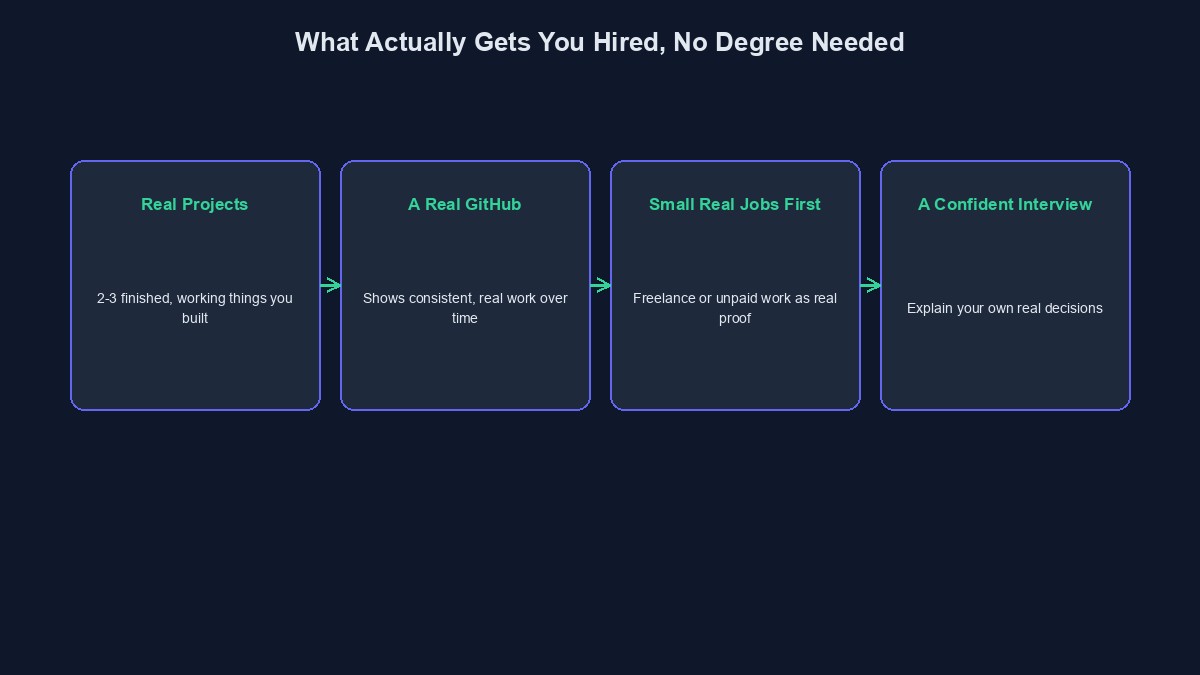
A real, working portfolio is the single strongest replacement. Two or three genuine projects you built yourself, even small ones, prove far more than a certificate ever could, since an employer can actually open them and see real, working code. A GitHub profile showing consistent, real work over time adds real weight too, since it shows you actually build things regularly, not just occasionally. And real experience, even unpaid or very small paid freelance jobs, counts as genuine proof you can work with an actual client's real requirements, not just a tutorial's made-up ones.
The specific skills worth having before you apply anywhere
Solid HTML, CSS and JavaScript, the real foundation everything else sits on. At least one modern framework relevant to the jobs you are applying for, commonly React for front-end roles. Basic understanding of how a backend and a database work together, even if you specialise in front-end, since being able to talk about it intelligently in an interview matters. And genuine comfort using Git, since almost every real job uses it daily, and struggling with it in your first week is a bad first impression that is entirely avoidable by practising beforehand.
How to actually build a portfolio worth showing, without a job yet
Build real, complete projects, not half-finished ones. A single, fully working project that actually does something beats five abandoned ones every time. Solve a real, specific problem rather than copying a generic tutorial exactly, since employers have seen the same three or four tutorial projects hundreds of times and can spot them instantly. And write a short, honest description with each project explaining what it does and what you personally built, since context turns a plain link into something an employer actually understands quickly.
Getting your first opportunity when you have no formal experience yet
Start with small, real freelance jobs, even low-paying or unpaid ones for someone you know, purely to get one genuine, real project you can point to. Apply directly to smaller companies and startups rather than only large corporations, since smaller companies are far more likely to judge you on actual skill rather than a checklist. And be honest and direct about your background in interviews, since many employers respect someone who is self-taught and can clearly demonstrate real skill far more than they respect a formal-sounding but empty answer.
What to actually say when an interviewer asks about your background
Do not apologise for not having a degree, and do not over-explain it either. A short, confident answer works best: say you are self-taught, say how long you have been learning and building, and then move the conversation straight to your actual projects. Let your real work do the talking. Employers who genuinely care only about a degree were unlikely to interview you in the first place, so if you are already in the room, focus your energy on showing what you can actually do.
A worked example: a realistic, honest path
Picture someone who taught themselves web development entirely from free online resources over about eight months, with no degree of any kind in the field. Instead of waiting to feel "ready," they built three real projects, a small business website for a family member's shop, a simple booking tool, and a personal project solving a problem they genuinely had. They put all three on a simple portfolio site, with clear, honest descriptions of what each one does. They applied directly to five small local companies rather than large ones, and one interview specifically asked to see real code, not a certificate. The portfolio, not a degree, is what got them the interview, and their ability to explain their own real decisions in that code is what got them the job.
Mistakes that genuinely slow this process down
Waiting to feel "ready" before building anything real. Nobody feels fully ready. Building real, if imperfect, projects is what actually creates readiness, not the other way around.
Only doing tutorials, never building an original project. Tutorials teach you syntax. Original projects teach you how to actually solve a problem, which is the real skill being hired for.
Applying only to large companies that explicitly list a degree requirement. This is the hardest, slowest door to try first. Smaller companies are usually a faster, fairer way in.
Being vague or apologetic about not having a degree. A confident, direct answer, paired with real work to back it up, lands far better than sounding unsure of your own path.
A short glossary
Portfolio: a small collection of real projects you built, shown to prove your skill to a potential employer. GitHub: a platform developers use to store and show their code, often checked by employers directly. Framework: a set of tools built on top of a programming language that makes building certain kinds of apps faster, React being a common example for web front-ends. Self-taught: someone who learned a skill on their own, outside a formal degree program.
Where to go from here
Our fuller guide to becoming a web developer in Nigeria from zero covers the actual learning path this guide assumes, step by step. And if you want a fast, real way to build genuine portfolio projects, our own platform lets you build working VTU, ecommerce and booking sites quickly, real projects you can actually show. You can start building free to try it.


Comments
No comments yet. Be the first to share your thoughts.