
What to Do If Someone Clones Your Business Website
A Nigerian business owner who has spent months, sometimes years, building genuine trust with customers faces a specific, deflating discovery: someone has copied their website, their product photos, their prices, sometimes their entire visual identity, onto a near-identical site or a look-alike domain, and is using that trust, the trust you built, to take money from people who genuinely believe they are buying from you. This is not a rare, exotic threat. It happens to real Nigerian retailers and service businesses, and yet almost nothing written about it is specific or practical enough to actually act on. This guide is.
How a clone actually gets built, and why it is easier than people assume
Cloning a website has become a genuinely low-effort task for anyone willing to do it. Tools built for entirely legitimate purposes, mirroring your own site for a backup or an offline archive, can be, and regularly are, misused to copy an entire competitor's or target's site wholesale, product photos, descriptions, layout, sometimes even working checkout pages, in minutes rather than days. The cloned version is then either published on a newly registered domain designed to look almost identical to yours, a single added hyphen, a swapped letter, a different but similar-sounding extension, or occasionally on an old, expired domain that once belonged to a genuinely different, unrelated business, repurposed for exactly this.
What a clone is actually built to do
The end goal varies, but two patterns dominate in practice. The more common one is a fake storefront: customers browse what looks exactly like your real catalogue, place a genuine order, pay through a checkout that may or may not even process the payment correctly, and simply never receive anything, while believing throughout that they dealt with your actual business. The second, more targeted pattern mimics your login or checkout page specifically to harvest credentials or card details directly, sent to a link through email, WhatsApp or social media rather than found through search, and built to look identical to your real login for exactly as long as it takes a rushed customer to enter their details.
How you actually find out this is happening
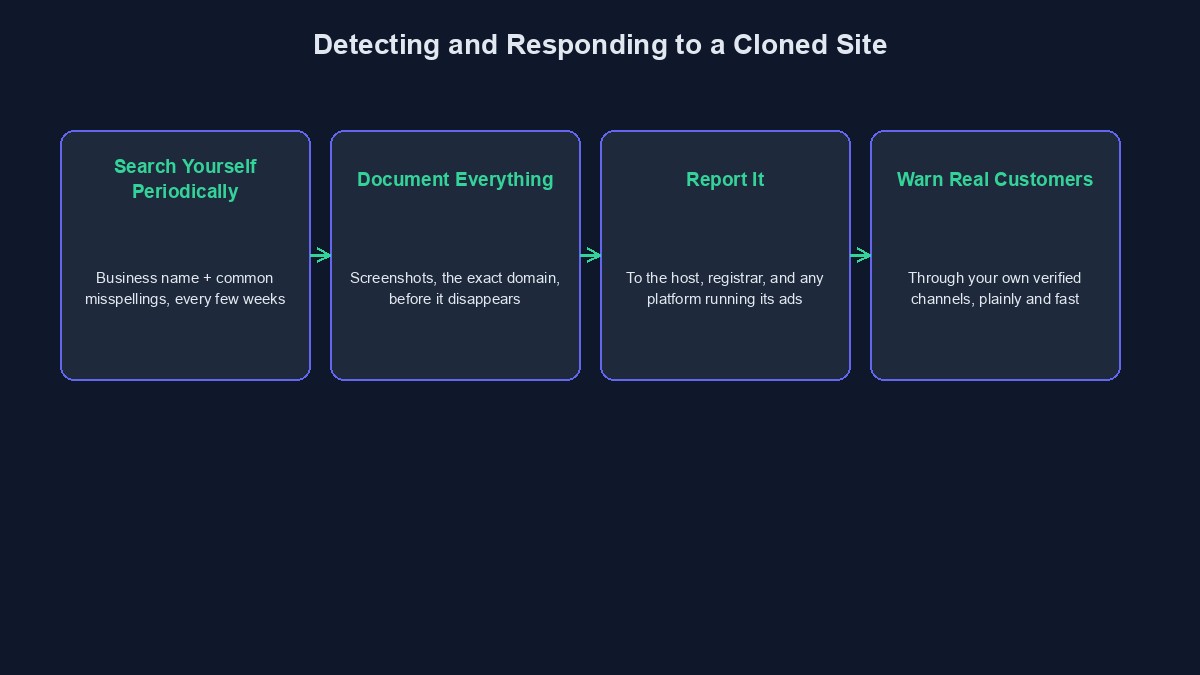
Discovery usually comes from one of a small number of sources, and it is worth actively watching for all of them rather than waiting passively. A confused or angry customer message is the most common first sign, someone asking why their order never arrived, or why a price they saw differs from what you actually charge, often the very first clue that something is wrong. A direct report from another customer who noticed the fake site themselves, sometimes while trying to find you again through a search engine, is the next most common. Periodically searching your own business name, alongside common misspellings and your product category, is a deliberate, proactive step worth doing every so often rather than only reacting once a customer has already been harmed, and it is genuinely the only method on this list that can catch a clone before anyone else does.
What to actually do once you find one
Document everything first, screenshots of the cloned site, its exact domain name, and, where visible, any contact details or payment information it displays, before it potentially disappears or changes, since this evidence is what every subsequent step depends on. Report the specific domain to its hosting provider and domain registrar directly, most have a dedicated abuse-reporting process, and a clear, evidenced report, this site is impersonating a genuine business and defrauding customers, is taken seriously more often than business owners expect, even without a lawyer involved at this stage. If the clone is being actively promoted through social media ads, report it directly to that platform as well, using its own impersonation or fraud reporting flow, which is frequently faster than waiting for the underlying hosting report to be actioned.
Warn your real, existing customers promptly, through your own genuinely verified channels, your real website, your real social media pages, your real WhatsApp broadcast, stating plainly that a fake version exists, describing specifically what to look for, the wrong domain, an unfamiliar payment method, so they can protect themselves and, just as importantly, so they know the fake is not actually your fault or your failure to secure your own business.
Making your real business meaningfully harder to convincingly clone
A custom domain, one you fully control rather than a free or shared subdomain, is genuinely harder for an impersonator to closely mimic, since a look-alike version of your own distinctive domain is more visually obvious to a careful customer than a look-alike of a generic, shared platform address would be. State your real domain clearly and consistently everywhere your business appears, your social media bios, your email signature, your packaging, so that a customer encountering an unfamiliar variation has an actual, easy reference point to check against. Consider registering the most obvious near-miss variations of your own domain yourself, the version with an added hyphen, the most common misspelling, where the cost is genuinely modest, specifically to deny an impersonator the exact addresses most likely to fool a rushed or careless customer.
A note on marketplace listings, since a clone is not always a full website
Not every impersonation attempt is a full, standalone cloned website. A simpler, more common version lists your product photos and descriptions, copied directly, on a genuinely legitimate marketplace platform, under a completely different, unrelated seller account, offering your exact products at an undercut price, collecting payment through the marketplace itself while never delivering anything genuine. This is worth watching for separately, since it requires a different response, most marketplaces have a direct intellectual-property or counterfeit-listing report specifically for this situation, distinct from a domain or hosting abuse report, and it is generally resolved faster because the marketplace itself has a direct, immediate interest in not hosting fraudulent listings on its own platform.
A worked example: catching a clone before real damage was done
Picture a Nigerian fashion retailer who makes a habit of searching their own business name every few weeks, a small, five-minute task fitted into an otherwise ordinary afternoon. One such search turns up a site on an unfamiliar domain, one letter different from their own, displaying their exact product photos and prices. Screenshots are taken immediately, and the domain and hosting provider are reported the same day, with the evidence attached directly to the report. A clear warning post goes out on the retailer's own verified Instagram and WhatsApp broadcast within hours, describing the fake domain specifically. Within a week, the fake site is taken down by its host following the report, and, because the warning went out early, no known customer actually lost money to it, specifically because the retailer found it through active, deliberate searching rather than waiting for a customer complaint to arrive first.
Mistakes that let a clone do real damage before anyone acts
Only ever discovering a clone reactively, through a customer complaint, rather than searching for one periodically. By the time a confused customer reaches out, real financial damage to real people has often already happened; a business that searches for itself occasionally has a genuine chance of finding a clone before that point.
Staying quiet about a discovered clone out of embarrassment, worrying it reflects badly on the business. Customers overwhelmingly understand that being impersonated is not the victim business's fault, and a prompt, clear warning protects far more people than silence ever does.
Not having a distinctive, consistently stated real domain for customers to actually check against. A business whose real address is not clearly, consistently communicated everywhere gives customers no genuine reference point to notice something is wrong.
Assuming a hosting or registrar abuse report will be ignored, and not bothering to file one. A clear, well-evidenced report describing genuine fraud is taken seriously considerably more often than discouraged business owners tend to assume, and costs only a few minutes to file.
A short glossary
Domain clone: a copy of your website's content, design or both, published on a different, often deliberately similar-looking, domain. Look-alike domain: a domain name deliberately designed to resemble a real one closely, through an added character, a swapped letter, or a different extension. Credential harvesting: a fake login or checkout page built specifically to capture whatever a visitor types into it. Abuse report: a formal complaint filed with a hosting provider, registrar or platform, describing a specific policy violation such as impersonation or fraud.
Where a real, controlled domain fits into this
Our guide to adding a custom domain to your site covers the specific setup this guide's prevention advice assumes, a real, distinctive, fully-controlled address rather than a generic shared one. Combined with the broader patterns in our guides to WhatsApp impersonation and how VTU business owners actually get scammed, this covers the main ways a Nigerian online business's own identity gets used against its customers. You can start building free on a platform where a real, custom domain with automatic SSL is part of the setup from the start.
Comments
No comments yet. Be the first to share your thoughts.