Web Developer vs Software Developer: What's the Difference?
People use "web developer" and "software developer" like they mean the same thing, and honestly, most of the time nobody notices or cares. But the two terms do mean something genuinely different, and knowing the difference actually helps, whether you are choosing what to learn, hiring someone, or just trying to describe your own job correctly.
The simple version first
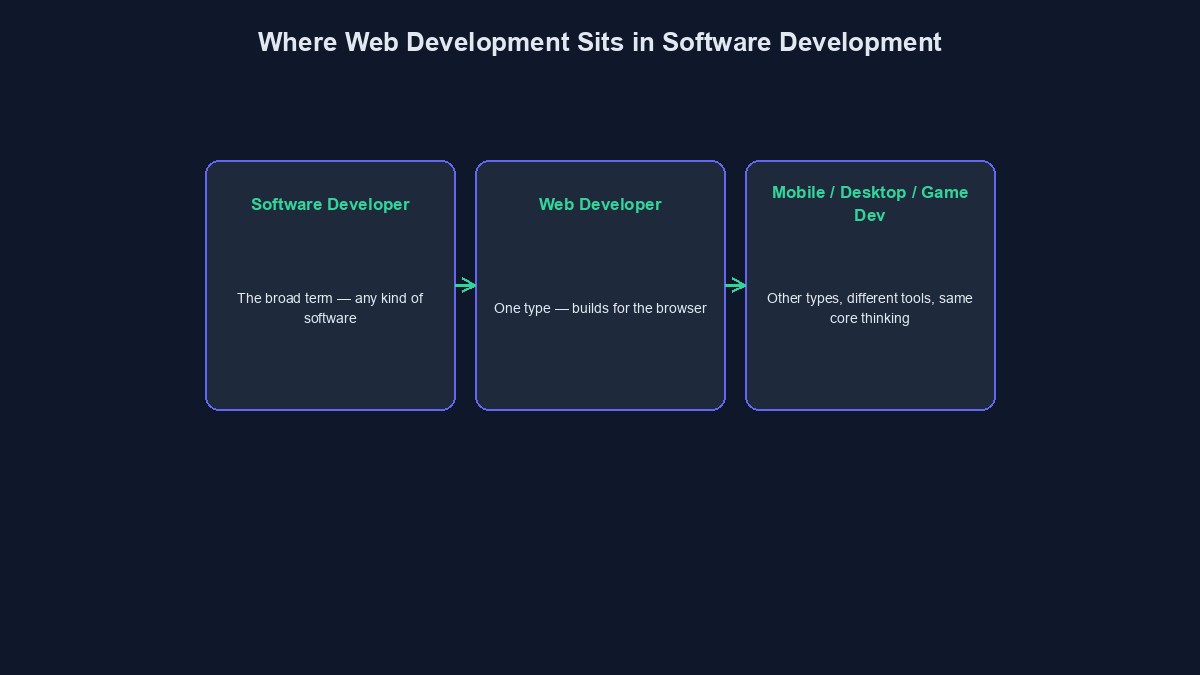
A software developer is the bigger, broader term. It covers anyone who builds software of any kind, websites, mobile apps, desktop programs, games, the software running inside a car, anything. A web developer is one specific type of software developer, someone who specifically builds things that run in a web browser, websites and web apps.
Put simply: every web developer is a software developer. Not every software developer is a web developer.
What a web developer actually spends their day doing
A web developer works with the tools and languages a browser understands, HTML, CSS, JavaScript, and web-specific frameworks built on top of them, React, Vue, and similar. Their work usually splits into two sides. Front-end, everything a user actually sees and clicks on, and back-end, the server, database, and logic running behind the scenes that the user never directly sees. Someone who does both is often called full-stack.
What a software developer might be doing instead
A software developer outside the web world might be building a mobile app using tools specific to Android or iPhone, a desktop program that installs and runs directly on a computer, embedded software running inside a physical device, or a game using an entirely different set of tools than a website would ever need. The core thinking, solving a problem with code, is similar. The actual tools, languages, and daily work can look completely different from what a web developer does.
Why the confusion happens so often
Web development is, by far, the most common entry point into tech for beginners in Nigeria and many other places, since it is genuinely easier to start learning, needs less expensive equipment, and has a huge amount of free learning material available. Because so many people's first, and sometimes only, experience of "coding" is web development, the word "developer" often quietly becomes shorthand for "web developer" in everyday conversation, even though the actual, correct meaning is much wider than that.
Does the skill actually transfer between the two?
Yes, a genuine amount of it does. The core skill of thinking logically, breaking a big problem into smaller steps, and writing clean, working code, carries over regardless of what you are actually building. A web developer who wants to move into, say, mobile app development already understands programming fundamentals, and mainly needs to learn new, specific tools rather than starting completely from zero. This is exactly why many software developers end up comfortable working across more than one of these areas over a real career, rather than staying in only one lane forever.
Which one should you actually learn first, if you are just starting out
For almost everyone starting from zero, web development is the more sensible first step, honestly. It needs less setup, has a shorter path to building something real you can actually show someone, and directly leads to real freelance and job opportunities faster than most other paths. Once you are comfortable there, moving into another area of software development, if you want to, becomes a genuinely easier, faster transition than trying to start there from scratch.
What this means for how you describe your own job
If you build websites and web apps, calling yourself a web developer is accurate and specific, and it actually helps you, since a client or employer looking specifically for that skill will find you faster than if you use the vaguer term "software developer." If your work genuinely spans more than the browser, mobile apps, desktop tools, and web work together, "software developer" fits better, since it honestly covers everything you actually do. Being specific about your own title is not a small detail. It directly affects who finds you and what kind of work they expect from you.
A worked example: two people, two different, equally valid paths
Picture two people who both call themselves "developers." The first builds ecommerce websites and business sites for clients, working daily with HTML, CSS, JavaScript and a payment gateway integration, a classic, genuine web developer. The second builds a mobile app for a logistics company, working daily with tools specific to Android development, handling GPS tracking and background location updates, a genuine software developer, but not a web developer at all, despite both people correctly using the word "developer" to describe themselves. Neither is doing the "real" version of the job and the other a lesser one. They are simply doing two genuinely different, equally real jobs that both fall under the same wider umbrella term.
Mistakes people make around this distinction
Assuming "developer" always means "web developer." It is one common type, not the entire definition, and assuming otherwise causes real confusion in job postings and hiring conversations.
Thinking web development is somehow "lesser" or "not real" software development. It is a genuine, real, in-demand specialisation, not a simplified version of something else.
Applying for a web developer role with only game development or embedded systems experience, assuming the skills fully transfer. Some core thinking transfers, but the actual tools are different enough that this is a real, honest gap worth acknowledging and addressing.
Not being specific enough when describing your own skills to an employer. Saying simply "I am a developer" is vague. Saying "I am a web developer, front-end focused, working mainly in React" tells an employer exactly what to expect from you.
A short glossary
Front-end: the part of a website or app a user actually sees and interacts with directly. Back-end: the server, database and logic running behind the scenes, not directly visible to the user. Full-stack: a developer who works comfortably on both the front-end and the back-end. Embedded software: software written to run inside a specific physical device, rather than on a general computer or in a browser.
Where to go from here
If you are deciding where to start, our guide to becoming a web developer in Nigeria from zero lays out a genuinely realistic starting path. And if you already know some code and want to build something real quickly, our platform lets you build working VTU, ecommerce and booking sites fast, without needing to write every part from scratch. You can start building free to see it directly.


Comments
No comments yet. Be the first to share your thoughts.