AI Code Review for Laravel Projects
Laravel makes a lot of things easy, which is exactly why it also makes a few specific mistakes easy too. Eloquent hides real database queries behind friendly, readable code, and that friendliness is precisely what lets a genuinely expensive query slip through a normal read-through unnoticed. Here is what an AI code reviewer actually catches in a Laravel pull request, and why those specific catches matter more in this framework than in most others.
The N+1 query problem, Laravel's most common silent performance bug
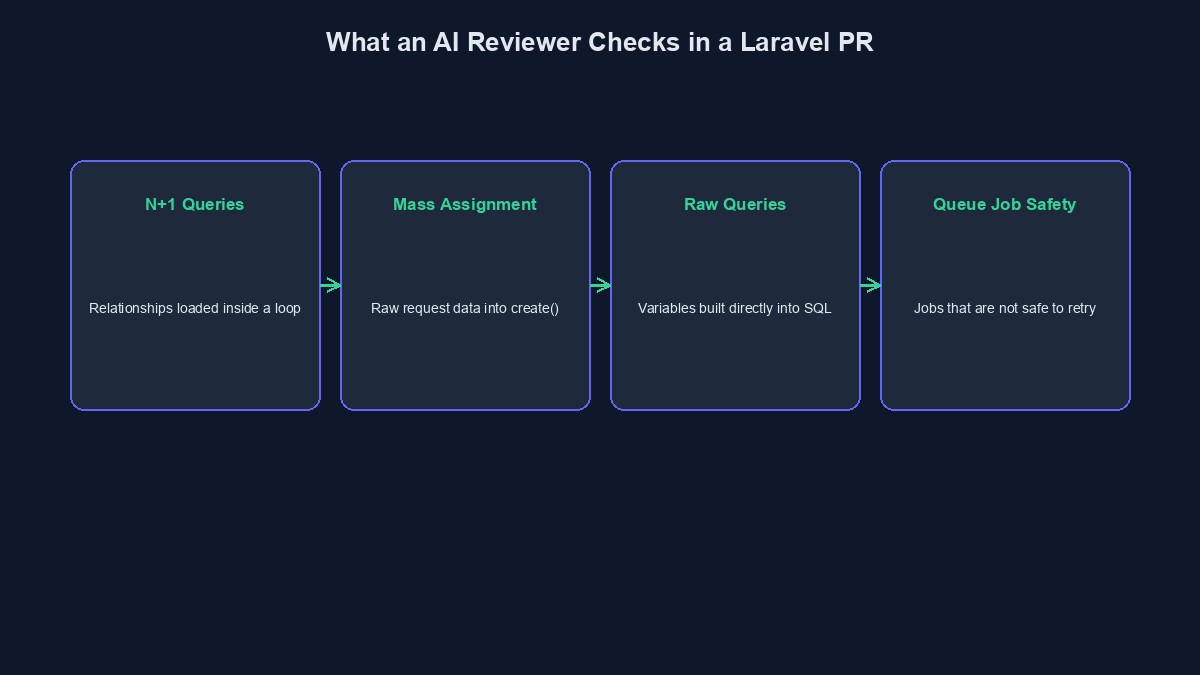
Looping over a collection of models and accessing a relationship inside that loop, `$order->customer->name` inside a loop over orders, looks completely innocent and reads perfectly naturally. Underneath, it can quietly trigger one separate database query per item in the loop, instead of one single, efficient query up front. This works fine, and looks fine, with ten test records, and becomes a genuinely serious performance problem the moment a real customer has a few thousand orders. An AI reviewer trained on Laravel code recognises this specific pattern, a relationship accessed inside a loop without `with()` or `load()` used beforehand, and flags it immediately, well before it reaches a real production dataset large enough to actually feel slow.
Mass assignment, one line away from a real security problem
Laravel's `$request->all()` passed directly into `Model::create()` is convenient, and it is also a real, known way for a user to set fields they were never meant to touch, an `is_admin` flag, a `user_id` that should have come from the authenticated session, not from the request body. Laravel's own `$fillable` or `$guarded` protection helps, but only if it is actually configured correctly and not quietly bypassed somewhere. An AI reviewer flags raw `$request->all()` passed into a mass-assignment call specifically because this exact pattern has caused real, documented security incidents across a huge number of real Laravel applications.
Validation that happens in the wrong place, or not at all
Laravel gives you Form Request classes specifically to keep validation consistent and out of the controller itself, and a genuinely common review catch is a controller method that skips this entirely, trusting request data without validating it first, or validating it inconsistently between similar endpoints. An AI reviewer checks whether a new or changed endpoint that accepts real user input actually validates it somewhere, and flags the ones that quietly do not, before that gap becomes a real bug report from a confused customer.
Raw queries that reopen a door Eloquent normally keeps closed
Eloquent protects you from SQL injection by default, as long as you are actually using it as intended. The moment a developer drops into `DB::raw()` or builds a raw query string with variables concatenated directly in, that protection is gone unless parameter binding is used correctly instead. An AI reviewer specifically flags raw query construction that includes a variable directly in the string, since this is one of the most reliably dangerous, and reliably catchable, patterns in any Laravel codebase.
Queue jobs and their easy-to-miss failure modes
A queued job that is not designed to be safely retried can cause real, visible problems, a payment charged twice because a job partially completed, failed, and then retried from the very beginning instead of picking up where it left off. An AI reviewer checks whether a new queued job handles being run more than once safely, a pattern called idempotency, and flags jobs that clearly are not, particularly around anything touching payments or sending real communication to a customer, where a duplicate action is a genuinely visible, embarrassing mistake, not a quiet, harmless one.
What an AI reviewer will not catch in your Laravel code
It will not know that a specific business rule around how your own discount codes stack together is wrong, since that logic can be entirely valid Laravel code and still produce the wrong real-world answer. It will not catch a bug that only appears with your actual production data's specific, unusual shape. And it will not replace a real human who understands why your application was built the way it was, which is exactly why a flagged pull request still needs a real teammate's judgement before it merges, not just an automated approval.
A worked example: what a real review comment looks like
Picture a pull request adding a new admin report that loops through every active subscription and checks each one's related payment history. An AI reviewer's comment might read: "This loop accesses `$subscription->payments` inside the loop without eager loading, which will run one query per subscription. Consider `Subscription::with('payments')` before the loop." That is a specific, actionable, correct catch, the kind of thing a rushed human reviewer, focused on whether the report's actual numbers are right, might easily read straight past.
Mistakes worth avoiding
Assuming Eloquent protects you everywhere by default. It protects you as long as you use it as intended; raw queries and careless mass assignment both step outside that protection.
Ignoring an N+1 flag because your test data is small. This specific bug is invisible in development and genuinely painful at real scale, which is exactly why it is worth fixing the moment it is flagged, not after a customer complains.
Treating an AI reviewer's approval as a full security check. It catches known, recognisable patterns well; it is not a substitute for a real security review on anything handling payments or personal data.
A short glossary
N+1 query: a performance bug where one query per item in a loop runs instead of one efficient query upfront. Mass assignment: setting several model fields at once from raw request data, risky if not properly restricted. Eager loading: loading a relationship upfront with `with()`, avoiding the N+1 pattern. Idempotency: a job or action that produces the same correct result even if it accidentally runs more than once.
Where to go from here
Our wider guide to what AI code review actually is covers how these tools work in general, and how they actually detect bugs goes deeper into the underlying mechanics. If you are running a Laravel project that has grown past the point a quick read-through can properly cover, our code audit and rescue service is built for exactly that kind of real, thorough, human review.

Comments
No comments yet. Be the first to share your thoughts.