What Is AI Code Review? How It Works for Developers
A few years ago, "code review" meant a colleague reading your pull request, leaving a few comments, and approving it once they were satisfied. In 2026, there is a real chance the first set of comments on your pull request came from software, not a person. AI code review has gone from a curiosity to something a huge share of development teams now use every day, and it is worth understanding honestly, what it actually does, what it is genuinely good at, and where it still needs a human to finish the job.
What AI code review actually is, in plain terms
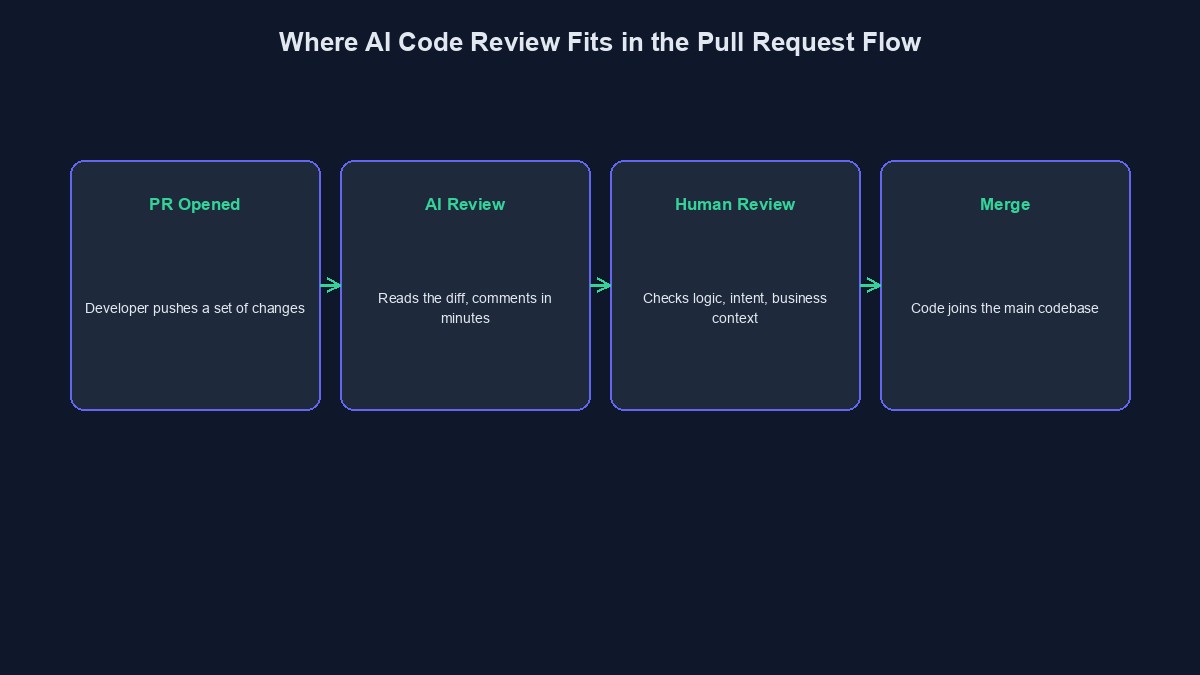
AI code review is software that reads the changes in a pull request, the same way a human reviewer would, and leaves comments, flags, and suggestions automatically, usually within minutes of the pull request being opened. It is not replacing the idea of review, it is adding a fast, tireless first pass before a human ever looks at the code, catching the kind of issues that are genuinely easy for software to spot and genuinely tedious for a person to check line by line every single time.
How it actually works, under the hood
When a pull request opens, or updates, the AI review tool receives the diff, the specific lines that actually changed, not the entire codebase from scratch. It reads those changes with the surrounding context, the rest of the file, related files, sometimes your project's own coding conventions, and compares what it sees against patterns it has learned are common mistakes, security risks, or simply against your team's own established style. It then posts its findings back as comments directly on the pull request, the same place a human reviewer's comments would appear, often within a minute or two of the pull request being opened or updated.
What it is genuinely good at catching
AI code review consistently catches the kind of issues that are boring to check manually but genuinely important: an unused variable left behind, a missing null check before using a value that might not exist, an obvious off-by-one error in a loop, a hardcoded value that should probably be a setting, a security pattern that looks like it could allow an injection attack. It is also genuinely useful for summarising a pull request itself, giving a reviewer a plain-English overview of what changed and why, before they read a single line of the actual diff, which measurably speeds up how quickly a human reviewer gets oriented.
Where it genuinely falls short, honestly
An AI reviewer does not know your business the way a human teammate does. It cannot tell you that a particular discount calculation is wrong because it contradicts a decision your team made in a meeting three weeks ago, since that context was never in the code or the pull request description. It can also be confidently wrong, flagging something as a problem when it is not, or missing a genuinely serious issue that requires understanding intent, not just pattern matching against code. The honest, current reality, reported directly by teams using these tools at scale, is that acceptance rates on AI-suggested changes often sit around one in five, meaning most suggestions still get reviewed, adjusted, or dismissed by a human before anything is actually accepted, not blindly merged as-is.
Why teams are adopting it anyway, despite the imperfections
Even an imperfect first pass that catches the boring, easy-to-miss issues frees a human reviewer to spend their actual attention on the things that matter more, whether the logic is genuinely correct, whether the approach fits the wider system, whether the change is actually a good idea at all. The value is not that AI review replaces careful human judgement, it is that it removes a real share of the tedious, repetitive checking that used to eat into a human reviewer's limited attention and time, especially now that AI-assisted coding tools have measurably increased how many pull requests a typical team opens in the first place.
The tools actually doing this today
GitHub's own Copilot code review is built directly into the platform most teams already use, with a free tier covering ten reviews a month and a paid tier removing that limit. CodeRabbit is a popular third-party option, working across GitHub, GitLab, Bitbucket and Azure DevOps, built specifically around reviewing only the changed lines for speed and fewer false positives. Other tools like Qodo, Greptile and Sourcery exist in the same space, each with a slightly different balance of depth, speed and how they are priced. None of these require you to change how your team already works, they plug into the pull request workflow you already have.
A sensible way to actually use it
Treat an AI reviewer's comments the way you would treat a junior teammate's first pass, genuinely useful, worth reading properly, but not something you accept without your own judgement applied. Use it to catch the small, easy things fast, and to get a quick summary of a large pull request before diving in, but keep a real human as the one who decides whether a pull request is actually ready to merge. The teams getting the most value from this are not the ones who removed human review entirely, they are the ones who used AI review to make their human review faster and more focused.
Mistakes worth avoiding
Auto-merging based purely on an AI reviewer's approval. These tools are a first pass, not a final decision-maker, and treating them as one removes the actual safety net code review exists to provide.
Ignoring its comments entirely because a few were wrong. One bad suggestion does not mean the tool has no value; dismissing it outright throws away the genuinely useful catches along with the occasional miss.
Assuming it understands your business logic. It reads code patterns, not your product decisions, and treating its silence on something as confirmation it is correct is a real, avoidable mistake.
A short glossary
Pull request (PR): a proposed set of code changes submitted for review before being merged into the main codebase. Diff: the specific lines that changed between the old and new version of a file. False positive: a flagged issue that, on closer human inspection, is not actually a real problem. Linter: a tool that checks code against a fixed set of style and quality rules, often used alongside AI review, not instead of it.
Where to go from here
Our guide to how AI code review actually detects bugs goes deeper into the specific mechanics behind the comments these tools leave. If you are working in a specific stack, our guides to AI code review for Laravel, React and Python and Django projects cover what actually matters for each one specifically. And if you have inherited a codebase that needs a genuine, thorough human look, not just an automated first pass, our code audit and rescue service is built for exactly that.

Comments
No comments yet. Be the first to share your thoughts.