How AI Code Review Detects Bugs in Pull Requests
"The AI caught a bug in my pull request" sounds almost magical the first time it happens to you, and then you start wondering how, exactly, a tool that has never run your code actually found a problem in it. The honest answer is less magical than it sounds, and understanding it actually makes these tools more useful, because you learn what to trust them for and what to still check yourself.
It is reading patterns, not running your program
An AI code reviewer almost never actually executes your code the way a test suite does. It reads the code itself, the actual text of your changes, and compares what it sees against an enormous amount of real code it has effectively learned from, including common bugs and how they typically look in the source before anyone catches them. This is a genuinely different approach from running your program and checking the output, and it is exactly why an AI reviewer can catch things a test never would, and also exactly why it can miss things a test would catch immediately.
Layer one: obvious logic mistakes
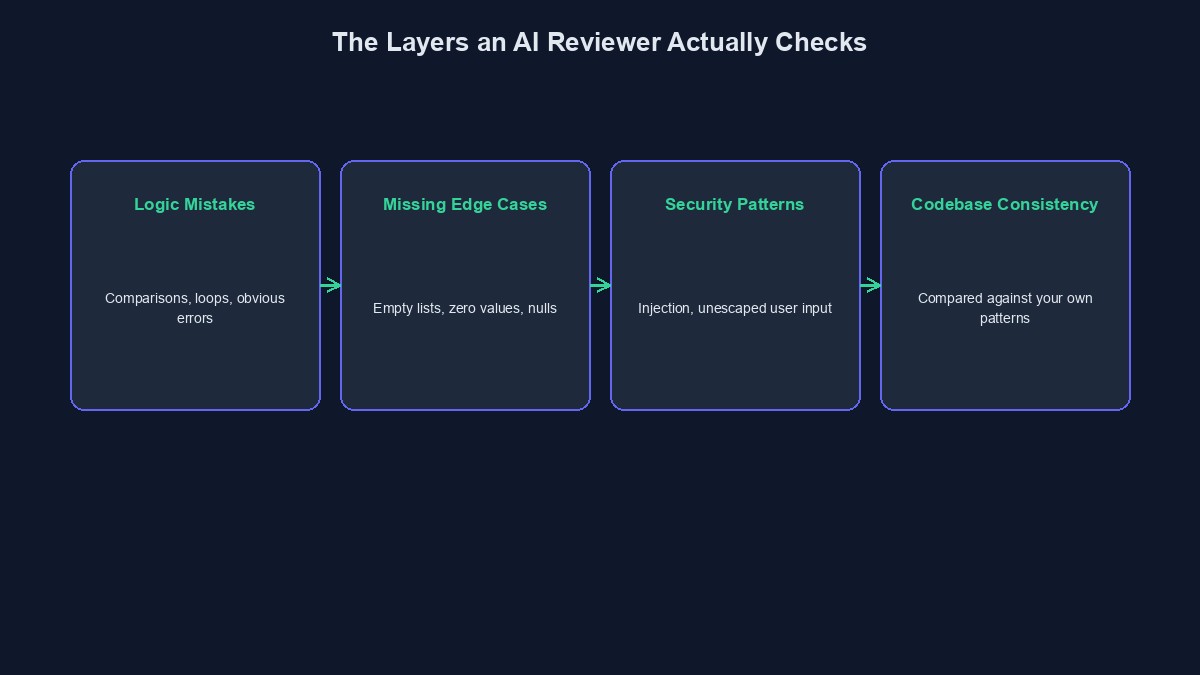
The simplest, most reliable catches are logic patterns that are almost always wrong regardless of what the code is actually trying to do. Comparing a value to itself instead of another variable. A loop condition that will clearly never end, or will end one step too early. Using the assignment operator where a comparison was obviously intended. These are the bugs an AI reviewer is most consistently reliable at catching, because the pattern is wrong on its face, independent of your specific business logic.
Layer two: missing the case that has not happened yet
A genuinely valuable category of catch is the missing edge case, code that works correctly for the situation you were actively testing while writing it, but breaks the moment something slightly different happens. A function that assumes a list always has at least one item in it. A calculation that works until a value happens to be exactly zero. An AI reviewer, having seen this exact shape of bug many times across a huge amount of other code, can flag "this will break if the list is empty" even though your own test data never actually included an empty list.
Layer three: security patterns that look dangerous on their face
Certain patterns are risky regardless of the specific business context, building a database query by directly joining in text from user input instead of using a parameterised query, which opens the door to SQL injection, or rendering raw, unescaped user input directly into a page, which opens the door to a cross-site scripting attack. These patterns are recognisable on sight to a tool trained on a huge amount of real code and real vulnerabilities, and catching them before they reach production is one of the genuinely highest-value things AI review consistently does well.
Layer four: comparing the change against the rest of your own codebase
More advanced tools do not just look at the specific lines that changed in isolation, they pull in real context, the rest of the file, related files, sometimes your project's established conventions, and check whether the new code is actually consistent with how the rest of your project already does things. This is how a tool can flag "every other function in this file validates this field first, this new one does not," a genuinely useful catch that depends entirely on seeing beyond just the isolated diff.
Where this approach genuinely cannot help you
An AI reviewer reading patterns in text cannot tell you your discount logic charges the wrong amount for a specific, real promotional rule your business uses, because nothing in the code itself reveals that the number is wrong, only that it is present and used consistently. It cannot catch a bug that only appears when your actual production database has a specific unusual shape of data your test environment never had. And it cannot replace an actual test suite that runs your code and checks real behaviour, since pattern recognition and genuine execution are fundamentally different ways of finding out whether something works.
Why it still finds real bugs your tests miss, and vice versa
Your test suite is only as good as the cases someone thought to write, and a huge share of real bugs are exactly the case nobody thought to test for. An AI reviewer, having effectively seen an enormous number of other projects' bugs, often flags exactly that kind of untested case before it ever reaches a real test. At the same time, your test suite genuinely executes your actual logic against real data, something no amount of pattern reading can substitute for. The two approaches catch meaningfully different things, which is exactly why using both together consistently outperforms relying on either alone.
A worked example: the bug that looked fine at a glance
Picture a function that calculates a delivery fee based on distance, written and tested against a handful of normal, realistic distances, and working correctly for every one of them. An AI reviewer flags a specific line: the function divides by the number of stops on a route, without first checking whether that number could ever be zero. Nobody tested a zero-stop route, because it seemed like it would never realistically happen, and the human reviewer, reading the logic quickly, did not think to check either. The AI reviewer, having seen this exact "division by a count that is not actually guaranteed to be non-zero" pattern many times before in unrelated code, flagged it anyway, and a real, if rare, production crash was caught before it ever shipped.
Mistakes worth avoiding
Treating a clean AI review as proof the code actually works correctly. It means no obvious pattern-level issues were spotted, not that your business logic is genuinely correct.
Dismissing a flagged edge case as "that will never happen." This is precisely the reasoning that leads to the production bugs an AI reviewer is specifically good at catching in the first place.
Skipping your actual test suite because the AI reviewer looked thorough. Pattern reading and real execution catch different things, and neither one is a substitute for the other.
A short glossary
Edge case: an unusual or extreme input a piece of code needs to handle correctly but that is easy to forget while writing the normal, expected path. SQL injection: a security flaw where untrusted input is used to build a database query directly, letting an attacker manipulate the query itself. Parameterised query: a safer way of building a database query that keeps user input clearly separate from the query's own structure. Static analysis: examining code without actually running it, the general technique both linters and AI code review are built on.
Where to go from here
Our guide to what AI code review actually is covers the wider picture this guide builds on. If you work in a specific stack, our guides to AI code review for Laravel, React and Python and Django projects cover the specific bug patterns that show up most in each one. And if a real, human-led audit of an existing codebase is what you actually need, our code audit and rescue service goes well beyond what any automated first pass can offer.
Comments
No comments yet. Be the first to share your thoughts.