How to Evaluate a Developer If You Don't Know How to Code
When you cannot read code, hiring a developer feels like hiring a mechanic when you know nothing about engines. Everyone sounds confident. The portfolio looks nice. And you will only find out whether the work is really good months later, when something breaks. The good news is that you can check a surprising amount without understanding any code. You just need to test the right things.
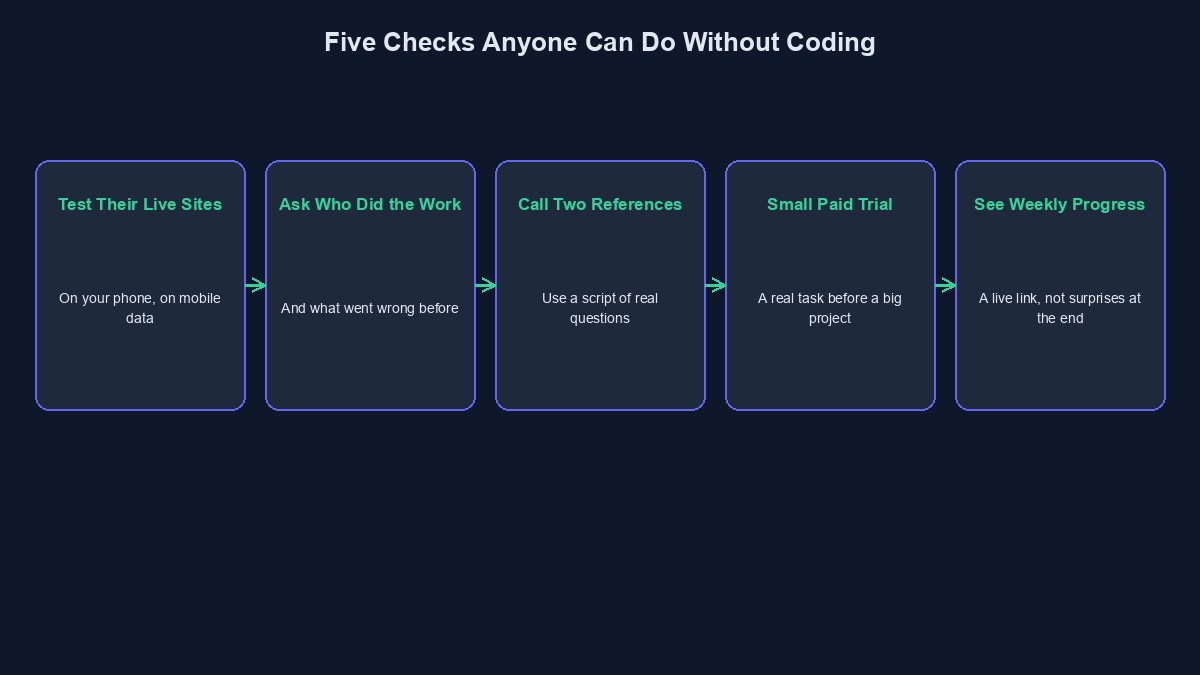
Check 1: Test their past work like a customer would
Do not just look at screenshots. Open two or three of their live projects on your own phone, using mobile data, not office wifi. Does it load in a few seconds? Do the buttons work? Try the contact form. Try it with the wrong information. Try it on a slow connection. You can also paste a site's address into a free tool like Google's PageSpeed Insights, which gives a simple score for speed on mobile. You do not have to understand every line of the report. If most of their sites are slow and broken, that is your answer.
Check 2: Ask who actually did the work
Some portfolios are made of projects the person only touched a little. Ask: "What did you personally build on this one?" and "What was the hardest part?" Someone who really did the work can explain it in plain language, with details. Someone who did not will stay vague.
Check 3: Ask what went wrong
This is a powerful question. "Tell me about a project that went badly and what you learned." Every experienced developer has one. A good answer is honest, specific and shows what they changed afterwards. Someone who says "none of my projects ever had problems" is either new or not telling the truth.
Check 4: Call two references, and use a script
Do not accept a list of names and leave it there. Call at least two past clients. Ask: Did the project finish on time and within the price agreed? How did they handle changes? Did they reply when you messaged? Did anything break after launch, and how fast was it fixed? Would you hire them again? And one more: "Do you own your domain, hosting and code today?" Their answer tells you a great deal about how the developer treats clients.
Check 5: Give a small paid trial first
This is the best test there is. Before committing to a big project, pay for a small piece of real work: one page, one feature, or a short planning document. It might cost a small amount, but you will see how they communicate, whether they deliver when they say, and what the work is actually like. It is much cheaper than finding out on the big project.
Watch how they behave before you pay
The sales stage is a preview of the project. Do they ask good questions about your business, or just send a price? Do they reply within a reasonable time? Do they explain things clearly, without making you feel small? Do they say no to anything, or agree to everything? A developer who says yes to every wish and every deadline is not being kind. They are not being honest.
Ask for a plan, not just a price
Ask how they would approach your project, in plain steps: what happens first, what you will see and when, and what could go wrong. A thoughtful developer will mention risks without being asked, like content arriving late or a payment gateway taking time to verify. If the plan is "I will start and update you," you do not have a plan.
Ask to see work in progress, not only at the end
Agree that you will see a working version, on a live link, every week or two. You do not have to judge the code. You only have to judge whether the thing you see matches what was agreed. A project that is hidden until the end is a project where problems also stay hidden until the end.
Get a second opinion if the job is big
If you are about to spend a lot, ask a technical friend to listen in on one call, or pay an independent person for an hour to review the proposal. A short review is much cheaper than a rebuilt project. We offer a code audit and rescue service that does exactly this kind of independent check, and it is useful for both new proposals and work already in progress.
A simple scorecard
After meeting each candidate, give a score from one to five on these: understood my business, communicated clearly, showed real and working past projects, honest about risks, fair about ownership and payments. Write the scores down. When you feel pulled toward the friendliest person or the lowest price, the numbers help you stay fair.
Common mistakes
Choosing only on price. A very cheap quote can become the most expensive one if the work has to be redone.
Trusting confidence. Confident talk is easy. Working, fast, well-behaved live sites are harder to fake.
Skipping the contract because "we are friends." Friendly projects are the ones most likely to end in confusion. Put the basics on paper.
Short glossary
Reference: a past client who can tell you what it was like to work with the developer. Staging link: a private web address where you can see work in progress before it goes live. Trial task: a small paid piece of work used to test a developer before a big commitment.
Where to go from here
For the basics of finding and paying a developer in Nigeria, see how to hire a web developer in Nigeria without getting burned. Once you have chosen someone, protect yourself with how to protect your website when hiring a developer, and make sure you know what you should own when the work is done.


Comments
No comments yet. Be the first to share your thoughts.