
Link Building for SaaS Companies
SaaS link building is different from link building for a blog or a shop, because a software product has a lot to offer that normal businesses do not: integrations, templates, benchmarks drawn from real usage, and customers who are themselves businesses with websites. It also has a harder problem. The pages that earn links, such as research and guides, are often not the pages that bring in paying customers. The goal is to connect the two. Here is how SaaS companies can build links that help the product, not just the blog.
Link to the pages that make money first
Many SaaS teams earn links to a popular blog post and then wonder why signups do not move. Before you start, decide which pages you most want to rank: your product page, your main feature pages, your pricing page, and the comparison and use-case pages that bring in buyers. Then use your link-building work to strengthen those pages directly, or to pass value to them through internal links from the pages that earn the links.
Integrations and marketplaces
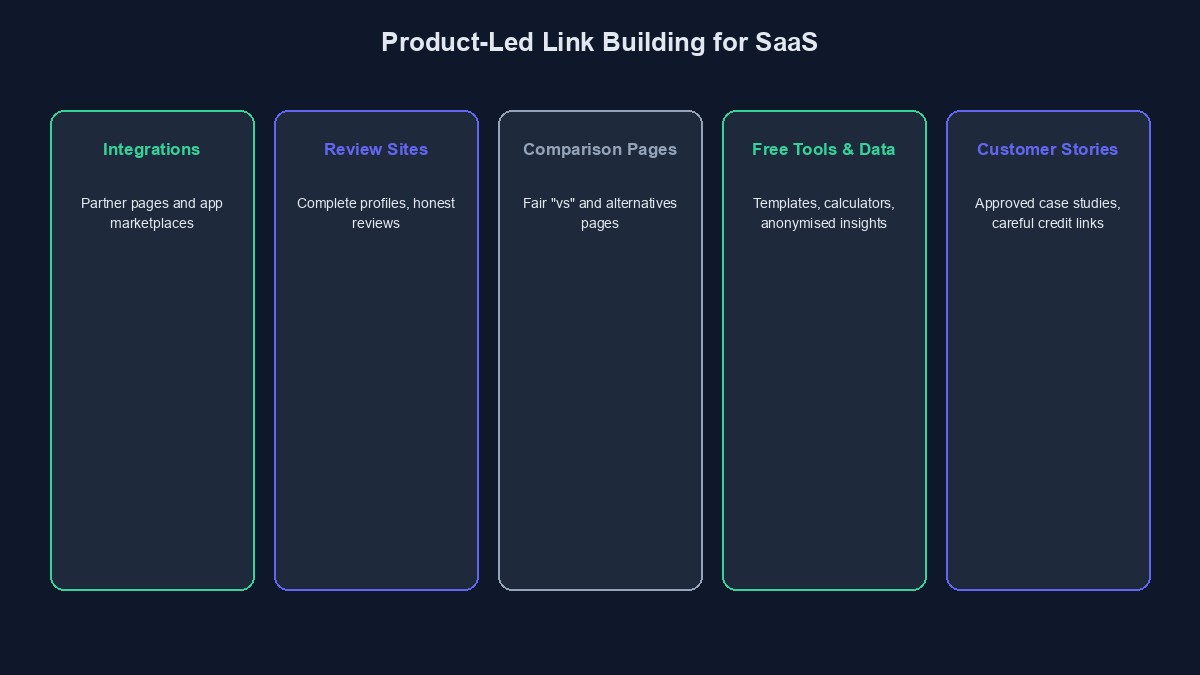
This is one of the most underused tactics in SaaS. When your product connects to another, both companies often publish an integration page, a listing in an app directory or a co-written post, and these usually link to each other. Build real integrations with tools your customers already use, such as payment providers, messaging platforms, accounting tools and automation platforms. Then write a clear page for each one on your site, submit it to the partner's marketplace or directory, and ask for a mention in their newsletter or blog. These links come with relevant traffic, since people looking at an integration directory are already searching for solutions.
Review sites and software directories
Listings on well-known software review and comparison sites, such as G2, Capterra and TrustRadius, give you profile links and, more importantly, a place where buyers form opinions. Complete your profile, ask real customers to leave honest reviews, and keep your information current. Many of these links carry limited ranking value, but the reputation and referral traffic are worth the effort. Never pay for or fake reviews.
Comparison and alternative pages
People search for "X vs Y" and "alternatives to X" when they are close to a decision. Create fair, accurate comparison pages that list real differences, including where a competitor is better. Pages like these attract links from reviewers, bloggers and communities who need something to point to, and they bring buyers. Be honest: wrong or exaggerated claims can get you complaints and lose trust.
Free tools, templates and calculators
A free resource connected to your product's purpose is a strong link magnet. A project management tool might publish a project plan template. An invoicing product might offer an invoice generator. A WhatsApp or chatbot product might offer a message-template library. Each should solve a real problem on its own, with a gentle path to the product. Expect it to take a few months before links appear, and promote it in communities and newsletters where your customers read.
Data from your own product
If your platform holds data on how businesses behave, you may be able to publish anonymised, aggregated insights, such as how quickly businesses reply to messages or what typical purchase patterns look like. Be careful with privacy: never publish anything that can identify a customer, check what your terms and local data-protection rules allow, and get proper advice if you are unsure. When done well, this kind of research becomes the source other writers cite. Our guide on creating original research that gets backlinks shows how.
Customer stories and customer links
Your customers are businesses with websites, and a story about how they use your product often earns a link from them. Write case studies with real numbers that the customer has approved. Some SaaS products also add a small "Powered by" credit on customer-facing pages. Google's guidance says plain, boilerplate platform credits are not a worry, while credit links you control are best marked nofollow, and a link should never be forced through a contract without letting the other party choose how to qualify it. Our own platform shows a brand-name credit on customer sites, and businesses on the Enterprise plan can replace it with their own brand. We explain more in how to get backlinks from customers.
Partner and affiliate programmes, with care
Partner pages that list agencies or consultants who work with your product can produce links in both directions. Affiliate programmes are different: affiliate links are commercial, so they should be marked with the sponsored or nofollow attribute, and you should not rely on them for ranking power. Treat them as a sales channel and not as a link-building tactic.
Launches, funding and expert comments
News about a launch, a milestone or a partnership can earn links from technology publications, but only if there is something real to report. Smaller wins come from expert quotes: journalists writing about your industry often want a founder's view. Be ready with a short, useful comment and a clear bio. Services that connect experts and journalists have changed in recent years, so check what is currently available and affordable before you sign up.
A simple way to prioritise
Rank each idea by how relevant the linking site is to your buyers, how much work it needs, and how directly it helps a page that earns revenue. Integrations, review profiles and comparison pages tend to score well early on. Free tools and original research take longer but can pay off for years. Pick two or three, do them properly, and track what happens in Search Console and in your signups.
What to avoid
Buying links or using link networks. Google treats these as spam and the risk is high for a company whose revenue depends on organic traffic.
Mass-producing thin pages. Hundreds of near-identical "template" pages can look manipulative and rarely earn links.
Chasing links to pages nobody buys from. Count signups and demos, not just link numbers.
A short example
Illustrative example: the people, businesses and numbers in this section are made up to show how this works. They are not real clients or real results.
A small SaaS tool for salon bookings builds an integration with a popular payment provider and a messaging platform. It publishes a clear page for each, lists itself in both partners' directories and writes a short tutorial that the partners share. It also adds fair comparison pages and fills out its profile on two software review sites. Within a few months, it has links from the partner pages, a few reviewers and a handful of salon blogs, and the pages that earned them link naturally to the product page.
Short glossary
Integration: a connection between two software products. Marketplace: a directory of apps or add-ons for a platform. Linkable asset: something useful that others link to. Nofollow / sponsored: link tags used for ads, paid and some other links, which Google treats as hints.
Where to go from here
For the general version of this topic, see link building for software companies. If you are starting from zero, read how to get your first 10 backlinks. And since marketing is now part of what our team offers, you can talk to us about SEO and outreach on the contact page.

Comments
No comments yet. Be the first to share your thoughts.