Link Building for Web Development Companies
A web development company has an awkward problem when it comes to link building. You build websites for other people, so you may have dozens of finished projects, and yet your own site has almost no links. The usual reason is that agencies are busy serving clients and treat their own marketing as a spare-time job. The good news is that agencies have natural sources of links that most businesses do not, and a clear plan can earn a healthy number within a few months. Here is how.
Your clients are your biggest link source
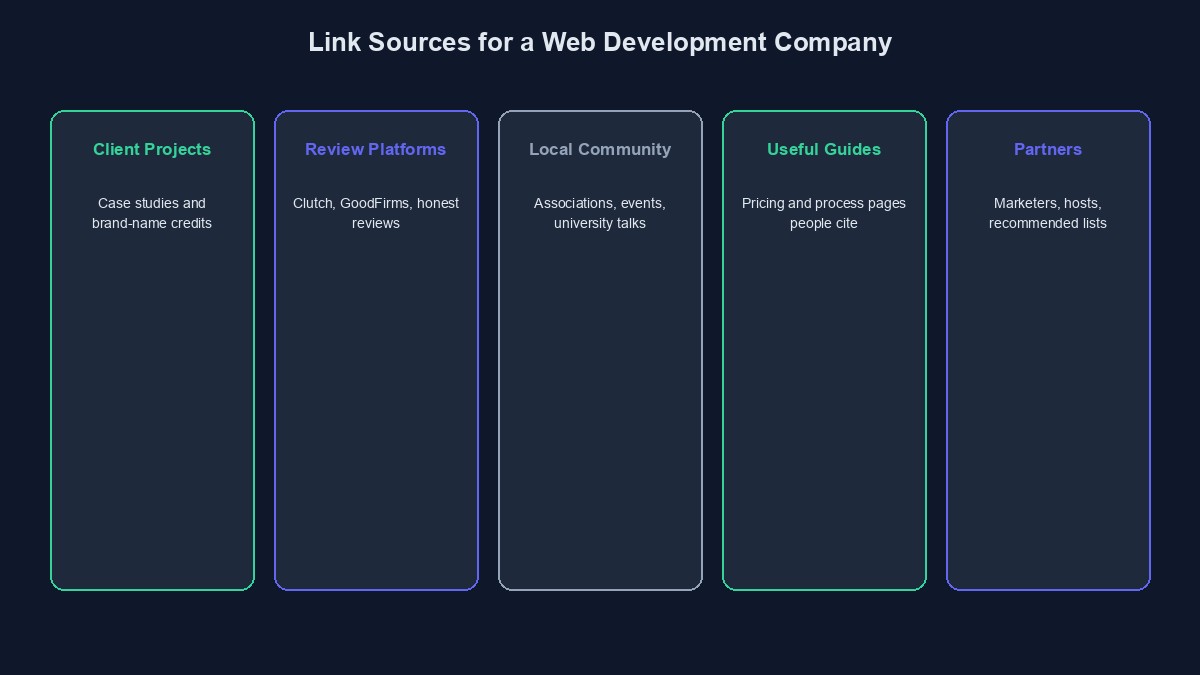
Every client site you build is a potential link. The classic version is the small "Website by" credit in the footer. Used carefully, it works, but Google has guidance on it. Credit links that you control are best marked nofollow, and boilerplate credits that are built into a platform are not a concern. Do not make the credit a hidden condition of your contract. Google's spam policy specifically warns against requiring a link in a contract without letting the other party choose how to qualify it. Use your agency name as the link text, not "cheap web design Lagos," and always ask the client's permission. Even if footer links pass little ranking value, they bring visitors, and they let prospects see your work. More valuable are links from a client's "news" page, a blog post about the new site or a case study they share. Our guide on getting backlinks from customers covers this in detail.
Case studies that clients are proud to share
Write short, honest stories about projects: the problem, what you built, and the result in numbers the client has approved. Send the client the draft, let them correct it, and give them the link. Clients often share it on their site or social pages, and the study becomes a page that prospects, journalists and other agencies can link to. Use real names and real results. Fake or inflated case studies are easy to spot and damaging.
Review platforms for agencies
Platforms such as Clutch and GoodFirms are where many buyers research agencies, and they offer public profiles that link to your site. Complete your profile fully, list your services accurately, and ask past clients to leave honest reviews, ideally verified by the platform. Some require a fee for premium placement. If you pay for any placement, remember that paid listings may carry sponsored or nofollow links, and treat the value mainly as visibility and trust. Do not buy reviews.
Be useful in your local community
Local business associations, chambers of commerce, co-working spaces, startup hubs and alumni groups often have member directories or news pages. Join the ones your clients belong to and ask to be listed. Sponsor or speak at a local event, and the organiser's website will usually list and link to you. Offer a free talk on "how to get your business online" at a university, a bootcamp or a business association. These links are relevant, and the people reading them are buyers.
Publish guides that clients and other agencies cite
Practical, honest content earns links. Clear pricing guides are especially linkable, because people want real numbers. For example, our articles on how much a website costs in Nigeria and on getting an accurate software quote are examples of the kind of practical, number-led page that people tend to cite. Other ideas: a checklist for preparing a website brief, a guide to what a client should own after a project, or a plain-language explanation of hosting and domains. See also what you should own after paying a developer.
Give away something useful
A free theme, plugin, starter template, design kit or small tool can earn links from developers and designers, especially if it solves a common problem. Keep it well maintained and give it a clear landing page on your site with documentation. Even a modest free resource builds your reputation among other developers, who often recommend agencies to their own clients.
Partner with businesses that serve the same customers
Marketers, photographers, copywriters, hosting providers, payment companies and accountants all serve businesses that need websites. Refer work to each other, and ask to be listed on their "recommended partners" pages. Partnerships like these tend to produce relevant links, and referrals, over time.
Pitch your expertise to publications
Local business media, technology news sites and industry blogs often need expert comments on topics like online shopping, website security and digital skills. Offer a short, specific comment or a practical article. You are more likely to be linked if you give them something clear and original, such as a few real numbers from your projects, rather than general advice. Keep client details private unless you have permission.
Do not forget your own website
Your site is your best portfolio. It should load fast, look good on a phone, and make it easy to see your work, your process and your contact details. If your own site is slow or confusing, people will not link to you, however good your outreach is. Do the basics first, and consider using our guide on building a website that generates leads from Google as a checklist.
What to avoid
Do not buy links, join link-exchange schemes, or put hidden links on client sites. Do not stuff keywords into footer credits. Do not publish dozens of low-quality guest posts. Google's guidance treats these as spam, and an agency whose own site gets penalised has a hard time selling its services.
A short example
Illustrative example: the people, businesses and numbers in this section are made up to show how this works. They are not real clients or real results.
A small web studio in Kano adds a polite, brand-name credit to client sites with permission, writes three short case studies with client approval, completes its Clutch profile and asks two clients for reviews, joins the local chamber of commerce and gives a talk at a nearby university. It also publishes a plain-language price guide. Over four months, it earns around fifteen relevant links, and the enquiries that follow mention the price guide and the case studies.
Short glossary
Credit link: a small link such as "Website by" in a client's footer. Case study: a short, approved story of a client project. Citation: a mention of your business name, address and phone number elsewhere online. Nofollow: a link tag that tells search engines not to pass ranking credit, which Google treats as a hint.
Where to go from here
If you are building from nothing, start with how to get your first 10 backlinks. For the product-company version of this topic, see link building for software companies. And since marketing is now part of what our team offers, you can contact us about SEO and outreach through the contact page.
Comments
No comments yet. Be the first to share your thoughts.