How to Explain Your App Idea to a Developer
Most people who have an app idea can talk about it for an hour. The trouble starts when a developer asks, "So what exactly should it do?" and the hour of passion turns into a few vague sentences. That gap, between how clear the idea feels in your head and how clear it sounds to someone else, is where a lot of projects quietly go wrong. The good news is that you do not need technical words to close it. You need a few plain answers, in the right order.
Start with the person, not the app
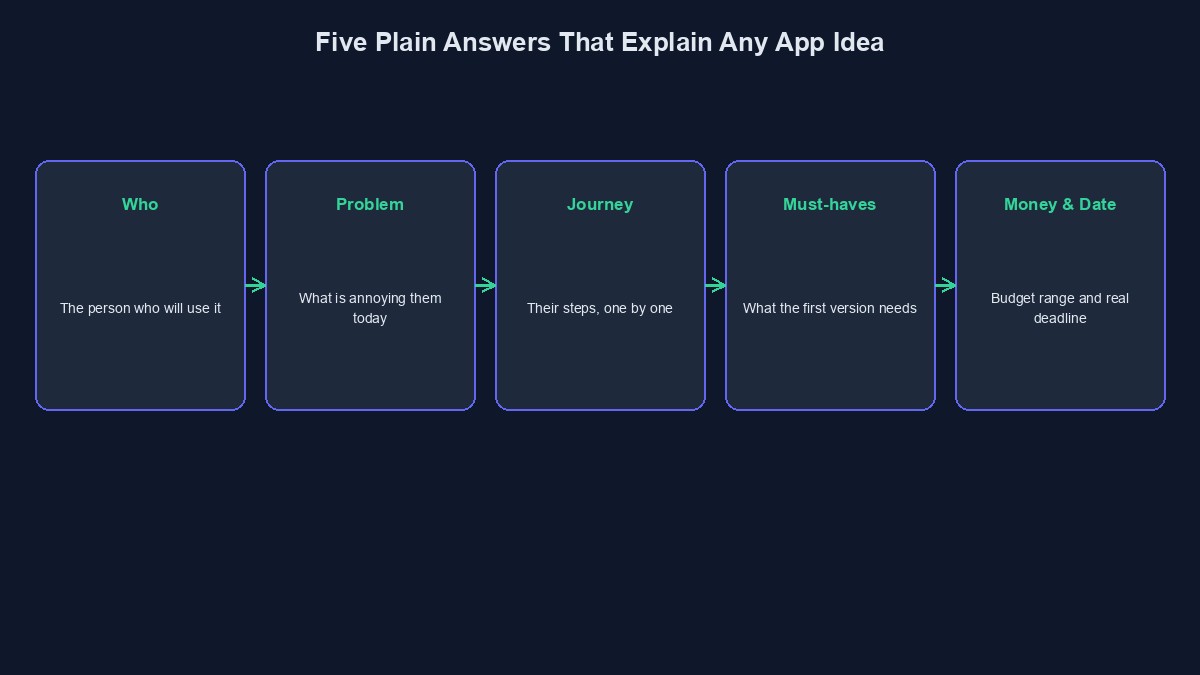
Before you describe a single screen, say who will use this and what is annoying them today. "Small laundry shops in Lagos lose customers because nobody remembers who dropped what" tells a developer far more than "I want a laundry app." The first sentence has a real person and a real problem in it. The second is just a label. A developer can build from the first one, because they can start asking useful questions about it.
Walk through one real journey, step by step
Pick one person and follow them from start to finish. A customer opens the app. What do they see? They choose a pickup time. What happens next? The shop gets a message. Then what? Write it as a simple list, one line per step, the way you would explain it to a friend sitting next to you. Developers call this a user flow, but you do not need the name. You just need the steps. If you can walk one journey clearly, the developer already understands the heart of your idea.
Say what must be there, and what can wait
Almost every first idea is too big. Be honest about which parts the first version cannot live without, and which parts you would like later. For the laundry example, "customer books a pickup and the shop sees it" is a must. "Loyalty points" and "live rider tracking" can wait. This one list saves more money than any other thing you can bring to a developer, because it stops the first version from quietly growing into a project three times the size.
Show examples instead of describing them
"Something like Bolt but for laundry" helps. A screenshot of an app you like, with a note saying what you like about it, helps even more. Bring two or three examples. Say what you like in each one, and also what you do not like. Pictures and examples carry a lot of detail that is hard to put into words, and they stop the developer from imagining something very different from what you see in your head.
Draw it on paper
Nobody expects a designer's drawing. Boxes on a sheet of paper, one box per screen, with arrows between them, is enough. Take a photo and send it. Even a rough sketch shows the order of things and what is on each screen, and it often exposes a gap you had not noticed, like "wait, how does the shop mark an order as ready?"
Be open about money and deadline early
Some people hide their budget, thinking it will make the quote lower. It usually does the opposite. A developer who knows your range can suggest what fits inside it, and can tell you honestly if the idea does not. A real deadline helps too, for example a launch event or a season when your customers are busy. If you do not know the budget yet, say that, and ask what a small first version would cost.
Ask them to say it back to you
When you finish explaining, ask the developer to repeat the idea in their own words. This takes two minutes and catches a surprising number of misunderstandings. If their version is different from yours, you have found the problem on day one instead of month two. It also shows you how well they listen, which matters a lot over a long project.
You do not have to know the technology
A common fear is "I will sound silly because I do not know the technical terms." Good developers do not need you to. Your job is to explain the problem, the people and the steps. Their job is to suggest how to build it. If a developer makes you feel stupid for not knowing a term, that tells you something about how the rest of the project will feel.
A simple example
Illustrative example: the people, businesses and numbers in this section are made up to show how this works. They are not real clients or real results.
Imagine Ada, who runs a small food-delivery business in Port Harcourt. She tells her developer: "My customers are office workers who order lunch by WhatsApp, and I lose orders because I miss messages. I want them to pick a meal on a page, pay, and have me see the order in one list. First version only for the three offices near me. Later I may add delivery tracking. I like how the Chowdeck order page looks, and I do not like how many steps it takes to pay. I can spend around this much and I want to start taking orders in six weeks." That is under a minute long, and a developer can work with every line of it.
Mistakes that cost people money
Describing the app by its features only. A list of features without the reason behind them leaves the developer guessing what matters most.
Changing the idea every week. Small tweaks are normal. A new direction every week is not, and it is the quickest way to double a bill.
Keeping the "secret sauce" so secret that nothing is explained. If you are worried about your idea being copied, sign a simple confidentiality agreement and then explain properly. A developer cannot build what you refuse to describe.
A few words you may hear
User flow: the steps one person takes to get something done in your app. MVP: the smallest first version that is useful enough to test with real people. Wireframe: a rough sketch of a screen, without colours or design. Scope: the list of what is included in the project.
Where to go from here
Once you can explain the idea, the next step is putting it on paper properly. Our guide on preparing your website requirements shows how, and what to give a developer before they start covers everything else they will ask for. If you would like to talk it through with a real team, you can send us a custom project request and we will tell you honestly what a first version would involve.



Comments
No comments yet. Be the first to share your thoughts.